Helping design and engineering professionals discover, evaluate and specify technologies and processes that shorten the design cycle and enable success.


Alert!
Digital Engineering ceased publication on July 1, 2026. This website remains available as an archive of engineering content.
For inquiries or information, please email [email protected].
Sponsored

Digital Engineering April 2026
In the latest issue of Digital Engineering, we take a look at the latest innovations in design for additive manufacturing, including the use of natural language inputs, social media cosplayers, and AI integration. The issue also includes a feature…

January Special Focus Issue: Design for Additive
In this Special Focus Issue of Digital Engineering, learn about the latest advancements in design for additive manufacturing, including new software tools, additive in automotive, custom medical devices, and more.

 Dear DE Reader:
Knowing how to drive a car does not qualify you to fly a passenger jet, although both have accelerators, steering, brakes and windshield wipers. So, if you have some or lots of 3D thermoplastic AM (additive manufacturing) printing experience, what makes you think that metal AM is the same process? “Making the Case for Building an AM Team,” written by DE in partnership with SLM Solutions, delves into what you should know and do to implement then exploit metal AM technology in your workflows successfully.
This paper begins with a broadside aimed at those with limited 3D thermoplastic printing experience: Metal-based AM requires expert, trained professionals just like manufacturing processes such as casting, forming, injection-molding and machining do. The danger of having some knowledge lies in the fact that so much of the metal AM process seems the same.
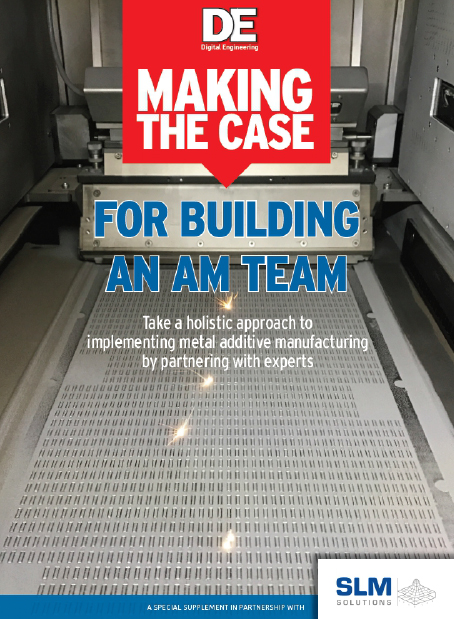 “Making the Case for Building an AM Team” argues that a multidisciplinary team of experts made up of engineers partnered with the right vendor is key to maximizing the potential and benefits of metal additive manufacturing technology.
This miscalculation has become widespread with the rise of low-cost, so-called “push button/get print” 3D printers. Those of you with deep experience making functional parts and complex prototypes know that designing for and operating a 3D system requires skill. Lots of it. Metal AM fabrication requires the greatest skill set of all.
Fabricating optimal metal parts means professional-level understanding of the nuances of a given metal AM system's operations, design potential, material characteristics and post-processing methodologies. These, among other attributes, are completely different from other AM technologies.
The paper argues that a multidisciplinary team approach is an absolute necessity for metal AM fabrication. Members of that team are the applications, systems and service engineers as well as metallurgists. Each plays a key role.
Take the applications engineer. This person must know how to design a component that fully exploits the capabilities of metal AM printing from concept through final inspection — including machine configuration. The service engineer is the go-to person, your trusted partner from your AM system developer. Their role starts with installation and training then continues on up through on-site system maintenance and repair.
“Making the Case for Building an AM Team” offers a cogent argument. If you operate metal AM machinery already, this paper can help you do it better. Keen readers considering metal AM for their enterprise can repurpose this paper to create a checklist to ensure that they both introduce metal AM technology properly and maximally benefit from its unique capabilities over the long term. Hit today's Check it Out link for your complimentary copy.
Thanks, Pal. – Lockwood
Anthony J. Lockwood
Editor at Large, DE

Serving as the North American subsidiary of SLM Solutions Group AG SLM Solutions NA, Inc. is a leading provider of 3D additive technology and machinery for metal part prototypes and manufacturing production.These powerful and innovative…
Making the Case for Building an AM Team
There's no question that metal AM technology has arrived at the point where it's a viable production alternative for companies of all sizes, across many industries. Manufacturers just need to do the proper due diligence to ensure they choose the right metal AM technology for their application. At the same time, they also need to align with a trusted and expert partner that can help navigate the inevitable twists and turns in what’s likely to be a rewarding and transformative journey.

Anthony J. Lockwood is Digital Engineering's founding editor. He is now retired. Contact him via [email protected].
Follow DE






About Us · Contact Us · Editorial Team · Advertising · Privacy Policy · Subscriber Services · © 2026 Digital Engineering 24/7 · Peerless Media