Helping design and engineering professionals discover, evaluate and specify technologies and processes that shorten the design cycle and enable success.



May 2026 Special Focus: Artificial Intelligence in Design and Simulation
In this Special Focus Issue, learn about the latest developments in the integration of artificial intelligence into engineering workflows.

April 2026 Special Focus Issue: Generative Design
In this Special Focus Issue, Digital Engineering takes a look at how generative design solutions can be used across different types of design problems and with a variety of manufacturing approaches to accelerate design space exploration, and…
Siemens announces that Mazda Motor Corporation has adopted the Capital electrical design software suite from Mentor, a Siemens business, to help maximize innovation in the design of next-generation automotive electrical systems. Recognized worldwide for its launch of innovative technologies, Mazda uses Capital for model-based generative design for the electrical and electronic systems of the entire vehicle platform. The Capital automated generative design flow helps Mazda automotive design teams manage design complexity and changes across the entire vehicle platform, minimizing errors and reducing costs.
Capital tools deliver real time feedback against target metrics such as cost, weight, and network bandwidth consumption. This allows engineers to explore alternative design approaches. Capital software also provides Mazda with extensive simulation and verification functionalities.
At Mazda, from system design, harness design and verification down to manufacturing and service documentation, outputs of each process have been generated in its natural language, requiring designers to translate between processes and fill in the missing pieces using their talents and skills.
“In order to remove ambiguity while maintaining the diversity of expressions that are characteristics of these natural languages, we applied formal methods to eliminate the loss in information transfer and set a goal to build a development environment that is consistent and connected all the way through the manufacturing phase,” says Kazuichi Fujisaka, technical leader, Mazda Motor Corporation. “Furthermore, we also aim to shift to a development methodology that allows us to optimize the vehicle as a whole, with all possible variations being considered in the early development stage.
"To make this happen, we needed a development environment to visualize the entire vehicle circuitry and standardize our language, tools, and processes without compromise, creating standard models across the company," Fujisaka adds. "Mentor’s Capital technologies provide this environment and make Mazda’s electric development much more efficient.”
“One who keeps challenging what seems impossible leads innovation – a fact Mazda clearly understands, as evidenced by its long history of innovation,” says Martin O’Brien, senior vice president, Integrated Electrical Systems, Siemens Digital Industries Software. “As a long-standing Capital customer, Mazda has proven to be a fast adopter of new capabilities, such as platform-level architecture optimization spanning the electrical, electronic, networking, and embedded software disciplines. As a growing number of Japanese automotive OEMs adopt Capital, Mazda has established its reputation as a forward-thinking early adopter, with a long track record of leveraging our sophisticated technologies from their ‘customer first’ point of view.”
In addition to the Capital Electrical Design Software suite, Mazda also uses Siemens’ NX software and Teamcenter portfolio for enterprise collaboration. To learn more about the Capital solution, visit: https://www.mentor.com/products/electrical-design-software/.
Sources: Press materials received from the company and additional information gleaned from the company’s website.


Simcenter™ software, from Siemens Digital Industries Software, uniquely combines system simulation, 3D CAE and test to help you predict performance across all critical attributes earlier and throughout the entire product lifecycle. By combining…
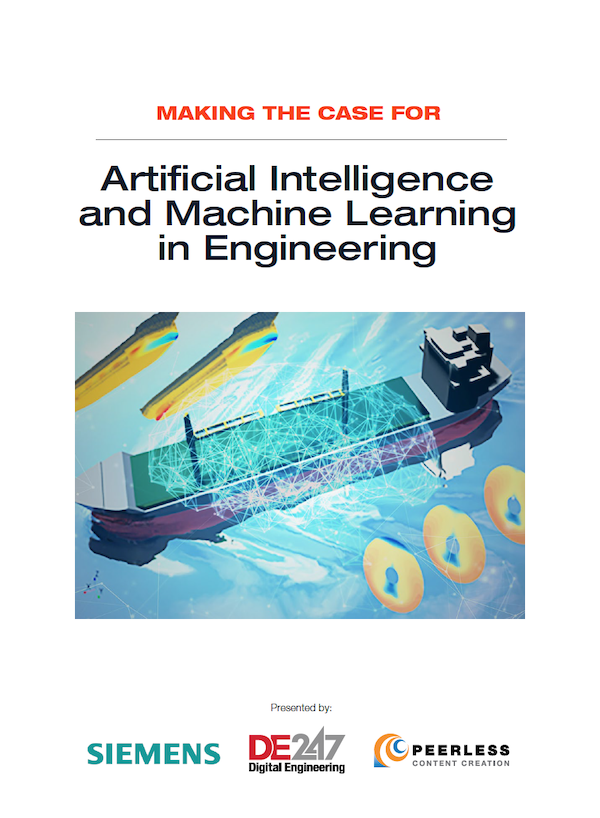
Making the Case for Artificial Intelligence and Machine Learning in Engineering
In this paper, Siemens Digital Industries Software and Digital Engineering will provide an overview of how AI/ML-enabled software can improve design workflows, while also addressing common questions and concerns around implementing this technology in an engineering organization.

DE's editors contribute news and new product announcements to Digital Engineering. Press releases may be sent to them via [email protected].
Follow DE
Join over 90,000 engineering professionals who get fresh engineering news as soon as it is published.






About Us · Contact Us · Editorial Team · Advertising · Privacy Policy · Subscriber Services · © 2026 Digital Engineering 24/7 · Peerless Media