Helping design and engineering professionals discover, evaluate and specify technologies and processes that shorten the design cycle and enable success.


Alert!
Digital Engineering ceased publication on July 1, 2026. This website remains available as an archive of engineering content.
For inquiries or information, please email [email protected].

Digital Engineering April 2026
In the latest issue of Digital Engineering, we take a look at the latest innovations in design for additive manufacturing, including the use of natural language inputs, social media cosplayers, and AI integration. The issue also includes a feature…

January Special Focus Issue: Design for Additive
In this Special Focus Issue of Digital Engineering, learn about the latest advancements in design for additive manufacturing, including new software tools, additive in automotive, custom medical devices, and more.
Thanks to the chip shortage and on-going geopolitical and macroeconomic hurdles, the automotive sector is facing a series of production challenges, leaving OEMs and suppliers scrambling to turn out vehicles at a pace synced to consumer demand.
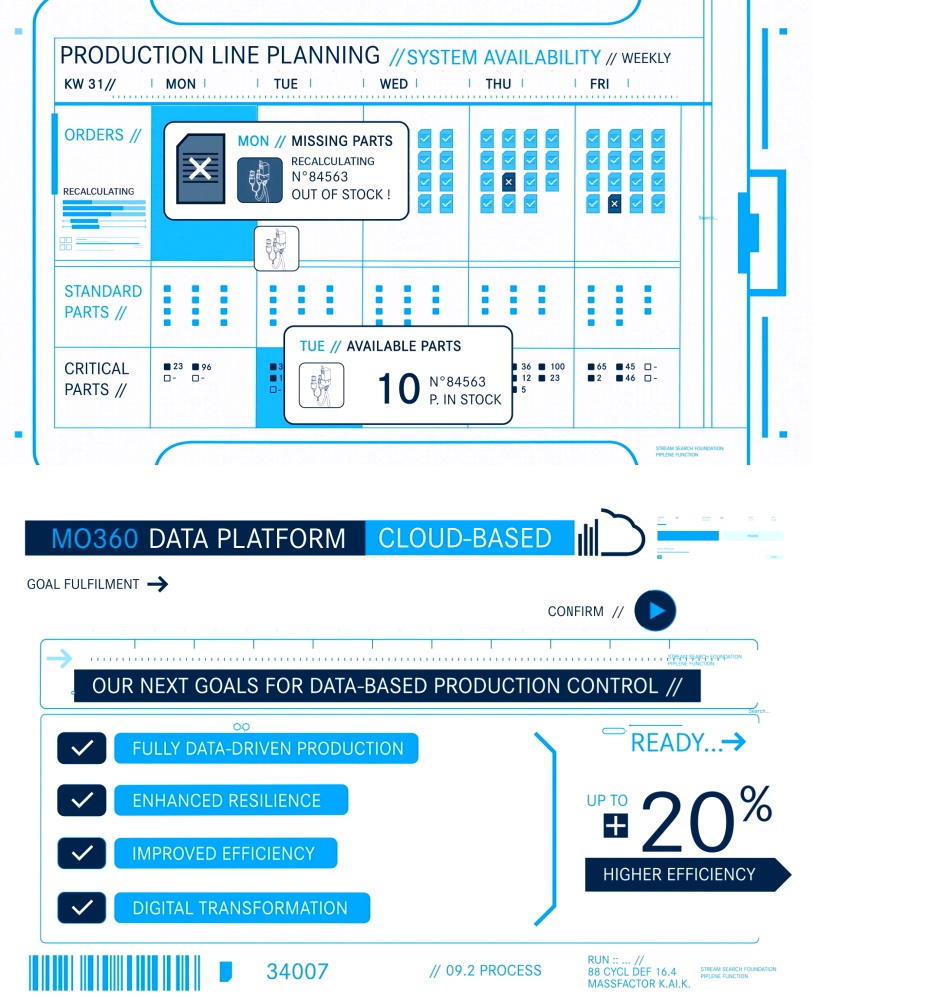
Touting a partnership with Microsoft, Mercedes-Benz is steering towards a different future, one built around data analytics, the cloud, and a merging of the digital and physical worlds. The pair have designed the new MO360 Data Platform, an extension of the car giant’s MO360 digital production ecosystem, which will connect 30 passenger car plants around the globe to Microsoft Cloud, leveraging the cloud paradigm to enhance transparency and predictability across its production facilities and extended supply chain. Using the platform, Mercedes-Benz will be able to identify supply chain bottlenecks faster and dynamically prioritize production resources, specifically for its electric and top-end vehicle lines.
“The new partnership between Microsoft and Mercedes-Benz will make our global production network more intelligent, sustainable, and resilient in an era of increased geopolitical and macroeconomic challenges,” said Joerg Burzer, member of the board of management at Mercedes-Benz Group AG, production & supply chain management. “The ability to predict and prevent problems in production and logistics will become a key competitive advantage as we go all electric.”
The unified data platform is standardized on Microsoft Azure and democratizes access through a self-service portal accessible on any Mercedes-Benz company device, including tablets, smart phones, and laptops. Everyone, including management, process engineers, and plant floor workers, have the ability to model and correlate data, using Microsoft Power BI to create dashboards and what-you-see-is-what-you-get visualizations. For example, shop floor workers have access to real-time production and management-related data to feed drill-down dashboards and initiate data-based decisions. Management can leverage the tools to optimize operational patterns to reduce CO2 emissions in production.
The partners are also designing the MO360 Data Platform to support closed data loops. In one example, executives described the need to apply certain torque strength to screw connections for both safety and regulatory reasons. With the new platform, the torque is sent through the WiFi network to the tool and is then backwards documented to ensure it’s on record.
The MO360 Data Platform will be leveraged in myriad ways and drive multiple benefits. Among them:
Driving production excellence. Plants can create a virtual replica of the vehicle manufacturing process, empowering Mercedes-Benz workers with insights from assembly, production planning, shop floor logistics, supply chain, and quality management. Virtually simulating and optimizing processes before unleashing them on the plant floor also helps accelerate operational efficiency and unlock energy savings. Use of AI helps identify bottlenecks in logistics, helping plants flag problems and make adjustments before they even occur.
Increasing supply chain resilience and efficiency. The centralized data platform lets teams instantly analyze and visualize data to optimize production and supply chain processes. With data in hand, production teams can dynamically allocate operational resources within and across plants for more efficient operations. Logistics teams can easily address supply chain problems by comparing the availability of components against production orders and then position the data against production parameters like operational running plants. In this way, Mercedes-Benz can keep production running and prioritize relevant vehicles even with supply chain glitches on the horizon.
Promote sustainability. The MO360 Data Platform incorporates an analytics tool used to monitor and reduce the company’s ecological footprint during vehicle production. Teams can tap the tool to track and forecast carbon emissions, energy and water usage, and waste management.
To learn more about how the Mercedes-Benz MO360 Data Platform is changing car production, check out this video.


Beth Stackpole is a contributing editor to Digital Engineering. Send e-mail about this article to [email protected].
Follow DE
Join over 90,000 engineering professionals who get fresh engineering news as soon as it is published.






About Us · Contact Us · Editorial Team · Advertising · Privacy Policy · Subscriber Services · © 2026 Digital Engineering 24/7 · Peerless Media