Helping design and engineering professionals discover, evaluate and specify technologies and processes that shorten the design cycle and enable success.



Digital Engineering April 2026
In the latest issue of Digital Engineering, we take a look at the latest innovations in design for additive manufacturing, including the use of natural language inputs, social media cosplayers, and AI integration. The issue also includes a feature…

January Special Focus Issue: Design for Additive
In this Special Focus Issue of Digital Engineering, learn about the latest advancements in design for additive manufacturing, including new software tools, additive in automotive, custom medical devices, and more.
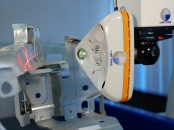 |
Metris has released the multi-laser XC65D scanner that captures 3D details of features, edges, pockets, ribs, and freeform surfaces in a single scan. The cross scanner’s digital operation boosts scanning frequency and drives intelligent laser intensity adaptation to scan any surface without user interaction, according to the company.
Incorporating three lasers in a cross pattern, the XC65D obtains a full 3D view that captures the bore of a hole or the flanges of a notch. In this way, geometric features can be extracted from the acquired point cloud. The XC65D avoids taking multiple scans of the same feature using different scanner paths and orientations, eliminating time-consuming probe head indexing and reducing overall inspection time. With laser stripes being projected from three sides, the XC65D also provides maximum coverage of complex surfaces with many ribs and pockets.
To effectively scan surfaces with varying color or high reflectivity, Metris introduces third-generation enhanced sensor performance (ESP3). Dynamic point-per-point adaption of laser source intensity enables the XC65D to deal with nearly all sample materials and surface finishes without operator interaction, according to Metris.
The XC65D Cross Scanner introduces wider laser stripes and high-speed CMOS camera technology, which triples scanning frequency compared to its predecessor. This allows the velocity of the XC65D scanner to be increased drastically, boosting the number of features that can be scanned in the same time frame. Temperature stability is built in through intelligent airflow management and software compensation measures.
In addition to the regular XC65D scanner, Metris also offers the XC65D-LS variant with a higher standoff distance. This scanner variant gains better access to cavity surfaces of body-in-white structures, and scans over fixture clamps without scanner path modification.
For more information, visit Metris.
Sources: Press materials received from the company and additional information gleaned from the company’s website.


DE's editors contribute news and new product announcements to Digital Engineering. Press releases may be sent to them via [email protected].
Follow DE
Join over 90,000 engineering professionals who get fresh engineering news as soon as it is published.






About Us · Contact Us · Editorial Team · Advertising · Privacy Policy · Subscriber Services · © 2026 Digital Engineering 24/7 · Peerless Media