Helping design and engineering professionals discover, evaluate and specify technologies and processes that shorten the design cycle and enable success.


Alert!
Digital Engineering ceased publication on July 1, 2026. This website remains available as an archive of engineering content.
For inquiries or information, please email [email protected].

May 2026 Special Focus: Artificial Intelligence in Design and Simulation
In this Special Focus Issue, learn about the latest developments in the integration of artificial intelligence into engineering workflows.

Design & Simulation Software Guide 2025
In this Special Issue, Digital Engineering presents its second annual guide to design and simulation software vendors.
That's the situation Carnegie Wave Energy faced during the design of CETO 5, technology that generates power from ocean swells using submerged buoys. CETO 5 is a cornerstone of the Perth Wave Energy Project (PWEP), which is the world's only currently operating grid-connected wave energy array. CETO 5 is a multidisciplinary system, converting hydrodynamic forces from the ocean to mechanical energy by the motion of the buoy, then to hydraulic energy through use of a pump, and finally to electrical energy using hydroelectric conversion devices.
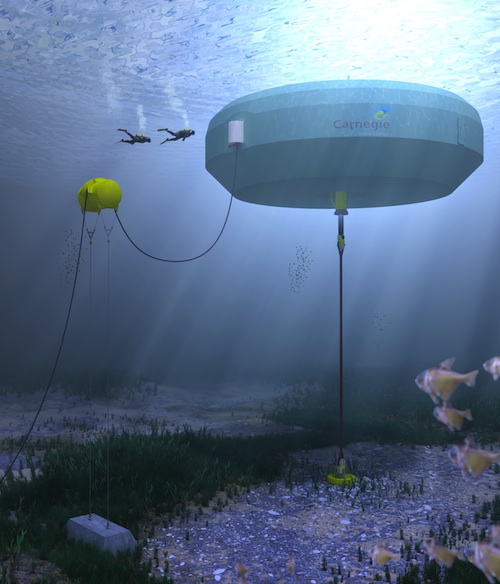 Carnegie Wave Energy's CETO 5 unit is the foundation for the grid connected Perth Wave Energy Project. Image Courtesy of Carnegie Wave Energy
Before physically building the CETO 5 system, Carnegie Wave Energy engineers needed insight into multiple variables, including how much load could be placed on the system's mechanical components so they could be sized properly. A design that incorporated components that were too strong or heavy would result in additional costs, while specing the system with less-than-robust components would put it at risk for failure in stormy seas. Building out a scale model of the entire system was not feasible so the team opted for a model-based design approach that would support a multidomain system along with simulations to explore a range of configurations, sea conditions, and faults.
Harnessing MathWork's MATLAB and Simulink Model-Based Design tools, Carnegie Wave Energy was able to iterate and test virtual prototypes of the CETO 5 design as opposed to building physical prototypes. The approach allowed the team to demonstrate the ability of a small CETO 5 array to produce and sell power reliably while also verifying the accuracy of the computational CETO system model against the measured project performance, according to Mathieu Cocho, analysis engineer at Carnegie Wave Energy.
"We are the first wave energy company to ever commission an array of wave energy convertor," he explains. "We had to answer questions such as array layout, taking into consideration hydrodynamic interaction between units and array stroking pattern — nothing was written in the books and we have now capitalized a lot valuable know how. Also, having three [buoys] in the water can also multiply commissioning and maintenance work if you don’t plan ahead and make the right calls."
Taking a model-based approach also enabled the team's cross-disciplinary approach to design — a critical tactic for a project of this complexity. "We can implement original solutions into our model and understand their implications on all other areas of the system, allowing us to efficiently benchmark design options and make the right engineering decisions," Cocho says.
Simulink was used to simulate a 2D virtual prototype of the CETO 5 technology, including the buoy, pump, and tether connecting them. SimHydraulics was tapped to model the system's hydraulic circuit, including hydraulic cylinders and cylinder cushions, check valves, accumulators, pipelines and hydroelectric conversion devices. MATLAB was used to analyze the test data to validate the models, and initial tests indicate a strong correlation between the modeled and measured results.
Watch this video to see an animation of how the Perth Wave Energy Project works.


Beth Stackpole is a contributing editor to Digital Engineering. Send e-mail about this article to [email protected].
Follow DE
Join over 90,000 engineering professionals who get fresh engineering news as soon as it is published.






About Us · Contact Us · Editorial Team · Advertising · Privacy Policy · Subscriber Services · © 2026 Digital Engineering 24/7 · Peerless Media