Helping design and engineering professionals discover, evaluate and specify technologies and processes that shorten the design cycle and enable success.


Alert!
Digital Engineering ceased publication on July 1, 2026. This website remains available as an archive of engineering content.
For inquiries or information, please email [email protected].

Digital Engineering April 2026
In the latest issue of Digital Engineering, we take a look at the latest innovations in design for additive manufacturing, including the use of natural language inputs, social media cosplayers, and AI integration. The issue also includes a feature…

January Special Focus Issue: Design for Additive
In this Special Focus Issue of Digital Engineering, learn about the latest advancements in design for additive manufacturing, including new software tools, additive in automotive, custom medical devices, and more.
In the end, it’s consumers who will decide the issue, and some of them recently backed another home 3D printer, The Micro, on Kickstarter. The product of startup M3D, the Micro is being touted as the first AM system designed with home consumers in mind. Kickstarter backers can get one for a mere $299 (if they hurry), and early backers got an even better deal at $199.
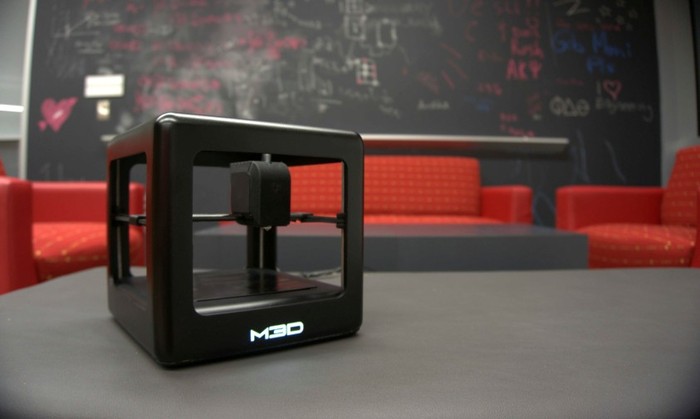
So what are people getting for their pledges? You heard the phrase you get what you pay for, and in the case of The Micro this is exactly the case. The new 3D printer is a material extrusion model (like a MakerBot), with a build envelope of 109 x 113 x 116mm (4.29 x 4.45 x 4.57 in.). That is a seriously small build area, even for a home AM system. Most people’s hands wouldn’t even fit inside.
It has a resolution that measures between 50-350 microns. On the one hand, 50 microns is pretty good for a home 3D printer, but on the other you have to consider just how long it will take to print out even a small object at that resolution. If I’m to assume the average resolution is somewhere close to 200 microns, you’ll probably want to stock up on acetone to smooth out the strata layers.
The Micro’s Kickstarter page goes on about how easy it is to use, including a USB port, Wi-Fi, plug-and-play support, custom software, etc., but I don’t see a lot of cautionary advice about exactly how finicky material extrusion printers can be, nor much about the need to calibrate the system.
Below you’ll find The Micro’s Kickstarter video.
Source: Kickstarter


John Newman is a Digital Engineering contributor who focuses on 3D printing. Contact him via [email protected] and read his posts on Rapid Ready Technology.
Follow DE






About Us · Contact Us · Editorial Team · Advertising · Privacy Policy · Subscriber Services · © 2026 Digital Engineering 24/7 · Peerless Media