Helping design and engineering professionals discover, evaluate and specify technologies and processes that shorten the design cycle and enable success.



Cut Retrieval-Augmented Generation (RAG) Hallucinations by 50%
Most teams hit the same wall with enterprise AI: LLMs that hallucinate, pipelines that don’t scale, and infrastructure that’s harder to design than the models themselves.

What Is Intelligent BOM Management? A Guide to Smarter Product Development
Learn how intelligent Bill of Materials (BOM) management helps teams collaborate, reduce errors, and bring innovative products to market faster with cloud-based PLM tools.
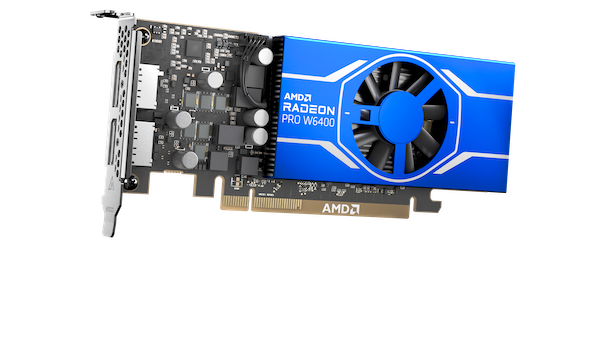
AMD announced new additions to the AMD Radeon PRO W6000 Series desktop and mobile workstation GPU family.
The new AMD Radeon PRO W6400 graphics card is built on the AMD RDNA 2 graphics architecture and 6nm manufacturing process technology, with 16MB of high-bandwidth, low-latency AMD Infinity Cache memory technology acting as a bandwidth amplifier. According to the company, the GPU is optimized for the requirements of popular CAD and office productivity applications.
Compared to the previous generation, the AMD Radeon PRO W6400 graphics card delivers up to three times higher performance in Autodesk AutoCAD 2022 during 3D orbit rotational tests in shaded modes, the company says. It also offers up to 87 percent higher performance in McNeel Rhino using the Holomark 2 benchmark with mesh, object and model data stress tests. The company says the card also offers performance gains in typical office applications and workloads, such as videoconferencing, email and web browsing.
According to a briefing with AMD PRO Graphics Marketing Lead Jamie Gwilliam, the New W6400 fills a gap in the Radeon PRO line, providing an option for users with a slightly lighter graphics workload. The new GPU complements the existing W6600 and W6800 cards. "But you are not sacrificing any speed or bandwidth," Gwilliam said.
The company also announced the AMD Radeon PRO W6500M and AMD Radeon PRO W6300M GPUs for mobile workstations. The new GPUs are also built on AMD RDNA 2 graphics architecture with 6nm process technology and harness up to 8MB of AMD Infinity Cache memory technology.
“Work patterns have changed dramatically over the last year, requiring professional users to work more efficiently and complete projects faster than ever,” said Scott Herkelman, senior vice president and general manager, Graphics Business Unit at AMD. “The Radeon PRO W6400 is a powerful graphics card that harnesses the award-winning AMD RDNA 2 architecture feature set, enabling not only mainstream CAD professionals to produce incredible and complex designs, but also meeting the demands of today’s office workers who need to edit images, create presentations, collaborate and multitask more than ever. In addition, the new AMD Radeon PRO W6000 Series mobile graphics provide the ideal combination of performance and mobility to drive a range of workloads for professionals on the go.”
Additional features include:
A list of certified applications can be found here.


AMD, or Advanced Micro Devices, has driven innovation in high-performance computing, graphics and visualization technologies. They develop high-performance computing and visualization products to solve some of the world’s toughest and most…

Accelerating Electric Vehicle Development with Multidisciplinary Simulation and High-Performance Computing
In this new Making the Case guide, learn how a unified approach to design and multidisciplinary simulation from Dassault Systèmes, combined with high-performance computing powered by AMD EPYC™ processors, can accelerate EV design.

Brian Albright is the editorial director of Digital Engineering.
Contact him at [email protected].

Join over 90,000 engineering professionals who get fresh engineering news as soon as it is published.






About Us · Contact Us · Editorial Team · Advertising · Privacy Policy · Subscriber Services · © 2026 Digital Engineering 24/7 · Peerless Media