Helping design and engineering professionals discover, evaluate and specify technologies and processes that shorten the design cycle and enable success.


Alert!
Digital Engineering ceased publication on July 1, 2026. This website remains available as an archive of engineering content.
For inquiries or information, please email [email protected].
Sponsored
 Dear DE Reader:
Workstation graphics capabilities are expanding faster than my gut, and engineering applications are rapidly taking advantage of this newfound agility. AMD's brand-new Radeon Pro WX Series of professional graphics cards seem designed to keep you both abreast and ahead of changing technology. You'll soon be seeing them in workstations, and you can upgrade right now for far less than you imagine. So, what's in it for you? Today's Check it Out link takes you to the full details, but here's a quick look.
Three cards make up the Radeon Pro WX Series: WX 4100, WX 5100 and WX 7100. They're engineered to handle the latest technologies like VR (virtual reality), low-overhead APIs (application programming interfaces) like DirectX 12 and Vulkan, open-source tools and applications as well as real-time game engines in professional settings. Suggested pricing ranges from $399 to $799.Radeon Pro WX Series cards leverage AMD's Polaris architecture-based GPUs (graphics processing units). They run a 5K HDR (high dynamic range) display and support HEVC (high efficiency video coding) encoding/decoding as well as TrueAudio Next for VR. They're quiet, cool, energy efficient and all undergo application certification testing.
For small form-factor workstations, the low-profile Radeon Pro WX 4100 is CAD professional ready. AMD says it's the first in its class to break the 2 TFLOPS single-precision compute performance barrier. It has 4GB of GDDR5 memory and 16 compute units (1024 stream processors). It'll drive four 4K monitors or one 5K monitor at 60Hz.
The Radeon Pro WX 5100 handles jobs like real-time content engines as well as immersive design and manufacturing for CAD or CAM. This TDP (thermal design power) GPU delivers up to 3.9 TFLOPS of single-precision compute performance using just 75 watts of power. Its 8GB GDDR5 memory and 28 compute units (1792 stream processors) deliver 41% faster performance running Siemens’ NX than other card in its class, according to AMD.
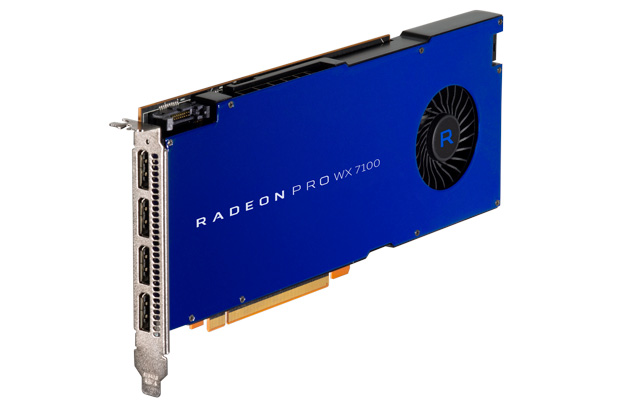 At the top of AMD's new Radeon Pro WX line of professional graphics cards, the 8GB Radeon Pro WX 7100 delivers 5.7 TFLOPS of single-precision floating-point performance and 36 compute units (2304 stream processors) for high-quality visualization workloads. Image courtesy of AMD Inc.
For high-quality rendering, visualization and VR workloads, the single-slot Radeon Pro WX 7100 delivers 5.7 TFLOPS of single-precision floating-point performance. It has 8GB GDDR5 memory and 36 compute units (2304 stream processors). AMD reports that it provides up to 45% more performance than other cards in its cohort running SOLIDWORKS 2015.
Hit today's Check it Out link to learn more about the Radeon Pro WX Series family. Make sure to scroll down, watch the video and hit the “learn more” button to drill into the details.
Thanks, Pal. – Lockwood
Anthony J. Lockwood
Editor at Large, DE


Anthony J. Lockwood is Digital Engineering's founding editor. He is now retired. Contact him via [email protected].
Follow DE






About Us · Contact Us · Editorial Team · Advertising · Privacy Policy · Subscriber Services · © 2026 Digital Engineering 24/7 · Peerless Media