Helping design and engineering professionals discover, evaluate and specify technologies and processes that shorten the design cycle and enable success.



May 2026 Special Focus: Artificial Intelligence in Design and Simulation
In this Special Focus Issue, learn about the latest developments in the integration of artificial intelligence into engineering workflows.

Design & Simulation Software Guide 2025
In this Special Issue, Digital Engineering presents its second annual guide to design and simulation software vendors.
How can you tell if a tech firm is influential enough to affect global politics? When you see its CEO sitting alongside the UK Prime Minister.
This week, NVIDIA CEO Jensen Huang is in Europe for NVIDIA GTC Paris. One of his public appearances is with the U.K. Prime Minister Sir Keir Starmer, as part of the opening act of London Tech Week.
Huang said, "NVIDIA will continue to invest in the U.K. We’re going to start our AI lab here… we’re going to partner with the UK to upskill the ecosystem of developers into the world of AI." Matching him, the Prime Minister also promised to invest around £1 billion ($1.35 billion) in AI research compute by 2030.
From a GPU startup, NVIDIA has grown into a $3.46 trillion AI powerhouse, with a product line that spans across microchips, supercomputers, interconnects, and GPU-accelerated software suites.
"Because of the scale and the speed by which we can now simulate almost everything, we can turn everything into a digital twin," Huang said in his keynote at GTC Paris. "We can design, optimize, and operate things completely digitally before we put them in the physical world. Everything physical will be built digitally. Everything operated at a gigantic scale, will be built digitally first."
NVIDIA's Huang is fueling AI enthusiasm not just in the UK but across Europe. The company revealed it is building AI technology centers in Germany, Sweden, Italy, Spain, the U.K. and Finland.
“France is committed to investing in AI to strengthen our economy, benefit our citizens and uphold our values,” said Emmanuel Macron, president of the French Republic. “By working closely with our nation’s leading technology innovators and NVIDIA, we are equipping researchers, entrepreneurs and public institutions with the tools they need to explore new ideas, tackle complex challenges and help shape the future of AI for France.”
Adolfo Urso, Minister of Enterprise and Made in Italy, said, “The collaboration with top-tier partners such as NVIDIA and Domyn confirms the government’s commitment in supporting high-level alliances to foster innovation and the competitiveness of the national production system.”
As a graphics hardware developer, NVIDIA was well-positioned to capture what Huang saw as the first wave of AI: computer vision. Currently it continues to dominate the hardware space with AI-targeted products to power generative AI. But NVIDIA is now looking across the horizon, at the next phase. "In the physical implementation of agentic AI, the generative capability is generating motion, instead of images, videos, and texts ... The ability to embody AI in a physical form, is basically robotics," he said in his keynote at GTC Paris.
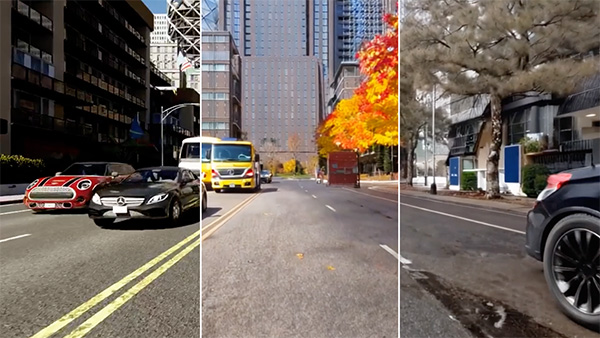
At GTC Paris (June 10–12, 2025), NVIDIA announced it's rolling out a full stack of AI and AV (Autonomous Vehicle) software. Its Drive AV software is set to debut in the Mercedes-Benz CLA Sedan. The stack includes active safety, parking, and automated driving features. The company also announced that in the next few months, its partner Volvo would be launching the new S90 Sedan, built on dual-AGX Horn computers running NVIDIA's safety-certified Drive OS and trained on NVIDIA DGX.
NVIDIA is also releasing three new NVIDIA Cosmos models pre-trained on AV data. Cosmos models are NVIDIA's neural networks that simulate real-world environments, useful for AV and robotic training. The models released include NVIDIA Cosmos Predict-2, "with improved future world state prediction capabilities for high-quality synthetic data generation," according to NVIDIA. The company also released Cosmos Transfer as an NVIDIA NIM microservice, to augment existing datasets and generate photorealistic videos based on structured input or ground-truth simulations from the NVIDIA Omniverse platform.
In January, NVIDIA launched the DRIVE AI Systems Inspection Lab, which earned the accreditation from ANSI National Accreditation Board. This week, the company announced four new automakers joining the lab: Bosch, Easyrain, Nuro, and Wayve.
In the same week, at the Computer Vision and Pattern Recognition (CVPR) conference in Nashville, Tennessee, an ocean away from Paris, NVIDIA's research won the End-to-End Driving challenge for the second consecutive year.
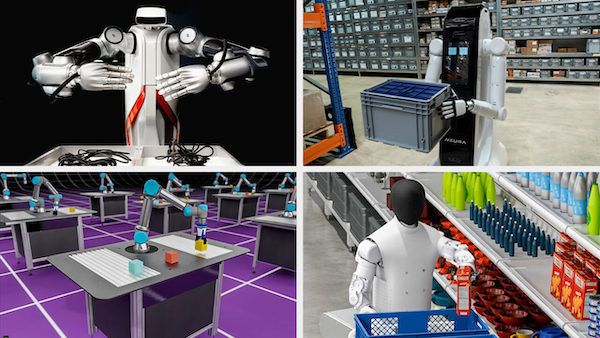
At GTC Paris, NVIDIA highlighted the works of Agile Robots, Extend Robotics, Humanoid, idealworks, Neura Robotics, SICK, Universal Robots, Vorwerk, and Wandelbots as examples of AI-powered robotics made possible by its technologies. The company is also releasing NVIDIA Isaac GR00T N1.5, an update to its open foundation model for humanoid robots, through Hugging Face.
"These robots are born in simulation in Isaac Sim, and their AI models are trained in AI Factories. This simulation-first approach to robot development is accelerating their time to market significantly. Soon, they will make Europe one of the largest makers and users of autonomous robots," said Rev Lebaredian, NVIDIA's VP of Omniverse and Simulation.
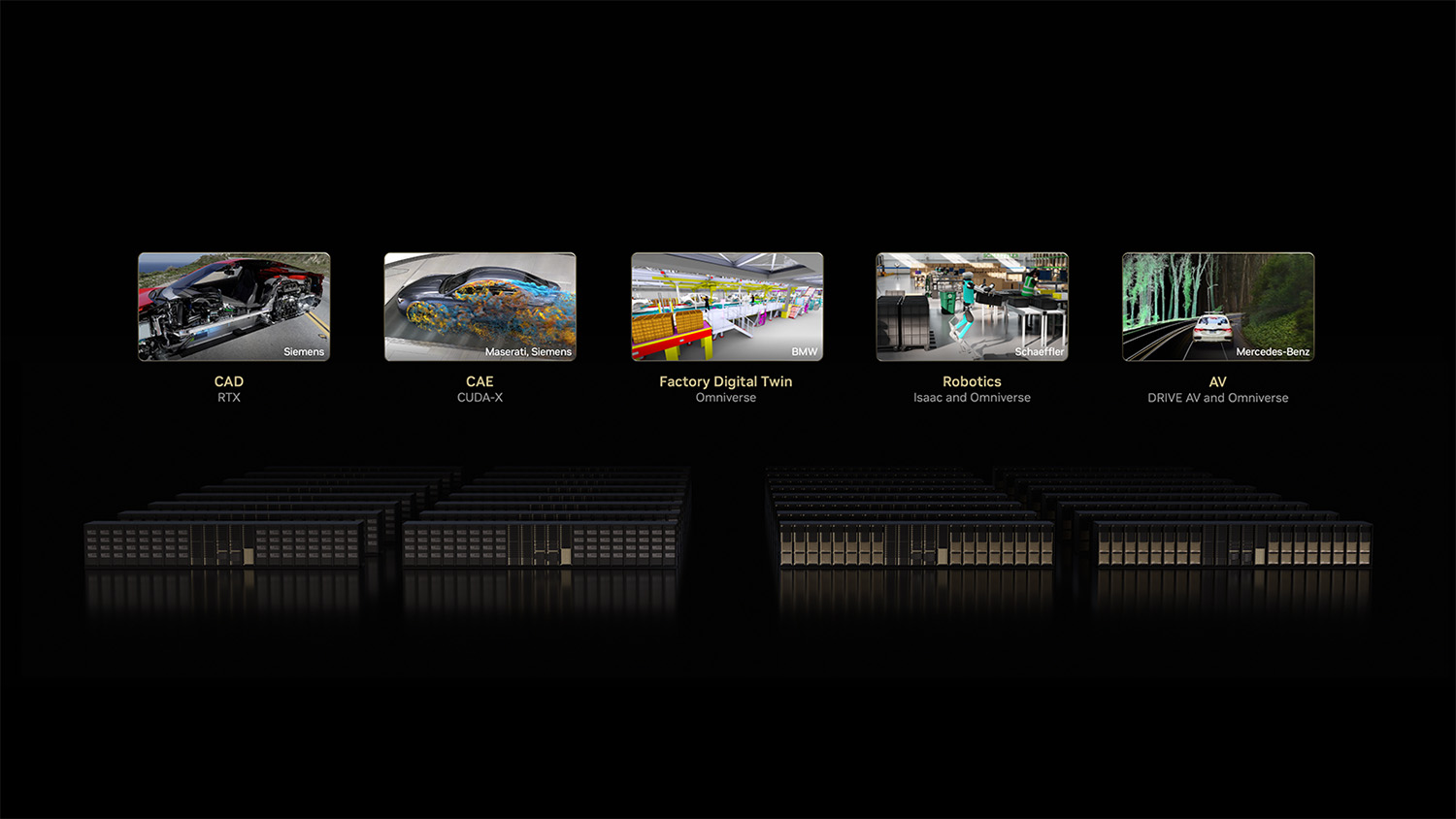
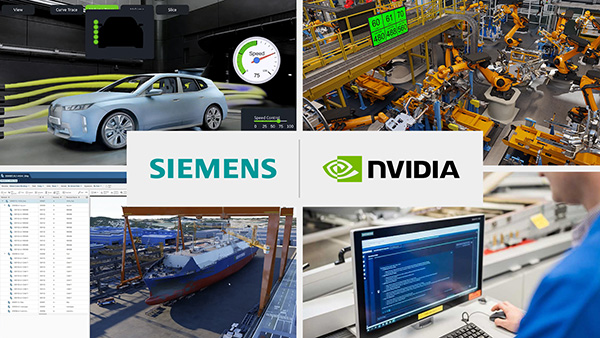
Siemens was one of the early adopters of NVIDIA Omniverse, an immersive 3D simulation environment with built-in physics. In 2022, Siemens struck a partnership with NVIDIA to integrate Omnivere-powered visualization features and digital twin functions into its Siemens Xcelerator portfolio. In the pre-show press briefing, Lebaredian said Siemens would be integrating NVIDIA CUDA X, RTX, and Omniverse libraries into its Teamcenter and Simcenter products.
“AI is fundamentally transforming manufacturing and infrastructure. Over the last three years, we’ve worked closely to merge AI models and high-performance computing, with industrial data and domain know-how,” said Roland Busch, president and CEO of Siemens AG. “Together, Siemens and NVIDIA are now empowering companies across every industry to unlock the scaled impact of AI in the physical world.”
Lebaredian said, "We're building NVIDIA Metropolis-based industrial copilots that will act as digital assistants to shop floor workers. We're integrating Omniverse libraries into each of their [Siemens'] CAD and CAE applications to deliver comprehensive digital twins for every use case."
NVIDIA wrote in its announcement, "Advanced AI agents will work seamlessly across the Siemens Industrial Copilot portfolio, executing entire AI-powered processes without human intervention. Siemens’ Industrial Copilot for Operations brings generative AI to shopfloor operators and will be optimized to run on premises with NVIDIA RTX PRO 6000 Blackwell Server Edition GPUs. The Operations Copilot leverages NVIDIA NeMo microservices and the NVIDIA AI Blueprint for video search and summarization to deliver real-time, AI-powered assistance for shopfloor operations, saving 30% of reactive maintenance time."


Since its founding in 1993, NVIDIA (NASDAQ: NVDA) has been a pioneer in accelerated computing. The company’s invention of the GPU in 1999 sparked the growth of the PC gaming market, redefined computer graphics, ignited the era of modern AI and…

Cut Retrieval-Augmented Generation (RAG) Hallucinations by 50%
Most teams hit the same wall with enterprise AI: LLMs that hallucinate, pipelines that don’t scale, and infrastructure that’s harder to design than the models themselves.

Kenneth Wong is Digital Engineering's resident blogger and senior editor. Email him at [email protected] or share your thoughts or suggestions at digitaleng.news/facebook.
Follow DE
Join over 90,000 engineering professionals who get fresh engineering news as soon as it is published.






About Us · Contact Us · Editorial Team · Advertising · Privacy Policy · Subscriber Services · © 2026 Digital Engineering 24/7 · Peerless Media