Helping design and engineering professionals discover, evaluate and specify technologies and processes that shorten the design cycle and enable success.


Alert!
Digital Engineering ceased publication on July 1, 2026. This website remains available as an archive of engineering content.
For inquiries or information, please email [email protected].


Sponsored
Artificial Intelligence for Design and Engineering Workflows
In this white paper, learn how artificial intelligence and machine learning can improve design and simulation.
Technology Focus: Designing for Optimization & Simulation
Simulation is pervasive, with people from different departments and backgrounds discovering new ways to put it to use, in all of its varied forms.
Earlier this month at SIGGRAPH 2025 (Vancouver, BC, Canada), Jensen Huang, founder and CEO of NVIDIA, delivered a special video message. He said, “We’re living through extraordinary times. AI is reshaping every industry. AI is essential infrastructure, like electricity or the internet. This revolution is powered by the GPU, the heart of a new type of computing, one that can solve problems normal computers can’t, and it started with graphics.”
In the age of raytracing, pixels were calculated; in the age of AI, pixels are inferred, speeding up what could be visualized in real time. Huang pointed out, “Today, fifteen out of sixteen pixels are inferred. RTX [NVIDIA’s GPU architecture with built-in AI, released in 2018] is transforming gaming.” This has huge implications for not only movies and video games but also simulation.
For example, with Omniverse, NVIDIA’s interactive simulation environment, engineers can conduct robotic training in virtual manufacturing plants. “Robots don’t learn from codes; they learn from experience,” said Huang.
Huang’s message was followed by a presentation by NVIDIA Research, featuring Aaron Lefohn, VP of Research, Real Time Graphics Lab; Sanja Fidler, VP of Research, Special Intelligence Lab; and Ming-Yu Liu, VP of Research, Deep Imagination Research Lab, all from NVIDIA.
“AI is advancing our simulation capabilities, and our simulation capabilities are advancing AI systems,” said Fidler. “There’s an authentic and powerful coupling between the two fields, and it’s a combination that few have.”
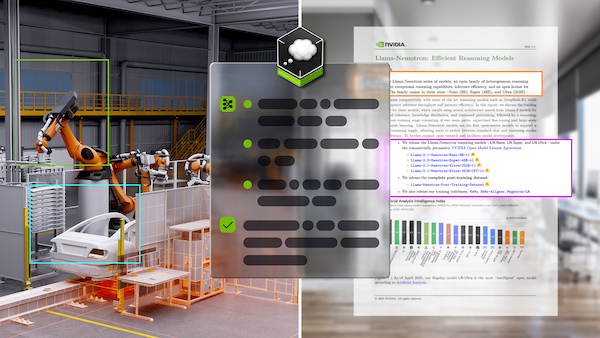
NVIDIA envisions physical AI to become part of smart cities and factories. Customers such as Accenture, Avathon, Belden, DeepHow, Milestone Systems, and Telit Cinterion are testing NVIDIA’s physical AI-based perception and reasoning, the company revealed. (You can learn more in this blog.)
Intelligent infrastructures rely on video sensors and AI functions to detect and react to anomalies. According to NVIDIA, “Using the NVIDIA Metropolis platform – which simplifies the development, deployment and scaling of video analytics AI agents and services from the edge to the cloud – developers can build visual perception into their facilities faster to enhance productivity and improve safety across environments.”
Reflecting Huang’s outlook, NVIDIA’s initiatives in the field of robotics are also picking up momentum. During SIGGRAPH, the company released new NVIDIA Omniverse libraries and NVIDIA Cosmos world foundation models, aimed at accelerating simulation-based robotic training.
“Computer graphics and AI are converging to fundamentally transform robotics,” said Rev Lebaredian, VP of Omniverse and Simulation, NVIDIA. “By combining AI reasoning with scalable, physically accurate simulation, we’re enabling developers to build tomorrow’s robots and autonomous vehicles that will transform trillions of dollars in industries.”
The new releases include:
new Omniverse SDKs, which offer data interoperability between MuJoCo (MJCF) and Omniverse’s USD format;
new Omniverse NuRec libraries and AI models, which add Omniverse RTX ray-traced 3D Gaussian splatting, a rendering technique that lets you use sensor data to reconstruct real-world environments; and
NVIDIA Isaac Sim 5.0 and NVIDIA Isaac Lab 2.2 open-source robot simulation and learning frameworks.
NVIDIA revealed that Boston Dynamics, Figure AI, Hexagon, RAI Institute, Lightwheel, and Skild AI are adopting Omniverse libraries, Isaac Sim and Isaac Lab, to speed up their AI-powered robotics development. In addition, Amazon Devices & Services is using them to power a new manufacturing solution.
At the conference, NVIDIA released the NVIDIA RTX PRO 6000 Blackwell Server Edition GPU for data centers. The product is expected to become part of NVIDIA hardware partners’ offerings, such as the Dell PowerEdge R7725 servers. Dell describes the line as “a high-performance, universal 2U rack-mounted data center platform engineered for demanding enterprise AI, industrial AI and advanced visual computing workloads.”
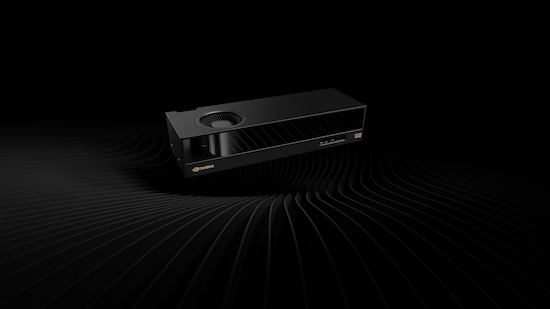
The new Blackwell servers are part of Dell’s AI Data Platform. According to Dell’s announcement, “Through deeper collaboration with NVIDIA and a new partnership with Elastic, we are delivering a tightly integrated AI stack that streamlines the ability to build, deploy and scale enterprise AI—whether for media and entertainment or any other industry.”
The real-time search engine Elastic is described as “a fast, scalable vector database for structured, unstructured and vector data-powering hybrid search, real-time analytics, and exceptional relevance through one flexible API.”
NVIDIA also revealed it’s adding two new GPUs to its desktop workstation lineup: the RTX PRO 4000 SFF (small form factor) and RTX PRO 2000. With lower power in half the size of a traditional GPU, they are packaged with fourth-generation RT cores and fifth-generation Tensor cores.
In the announcement, NVIDIA noted, “Compared to the previous-generation architecture, the RTX PRO 4000 SFF features up to 2.5x higher AI performance, 1.7x higher ray-tracing performance and 1.5x more bandwidth, creating more efficiency with the same 70-watt max power consumption.”
Early adopters of these GPUs include Thornton Tomasetti, a global engineering and design consulting firm. Rob Otani, CTO of Thornton Tomasetti, said, “We benchmarked the RTX PRO 2000 Blackwell on CORE.Matrix--our in-house, GPU-based Finite Element Analysis solver--running almost 3x faster than with the RTX 2000 Ada and 27x faster than with a standard CPU. This enabled us to accelerate our structural analysis workflows for more iterative, design-integrated engineering.”
You can learn more about the new NVIDIA GPUs and Dell hardware, and how they can help optimize SOLIDWORKS workflows, in these webinars from Goengineer and Trimech.
You can learn more about Dell’s activities at SIGGRAPH here.


DE's editors contribute news and new product announcements to Digital Engineering. Press releases may be sent to them via [email protected].
Follow DE
Join over 90,000 engineering professionals who get fresh engineering news as soon as it is published.






About Us · Contact Us · Editorial Team · Advertising · Privacy Policy · Subscriber Services · © 2026 Digital Engineering 24/7 · Peerless Media