Helping design and engineering professionals discover, evaluate and specify technologies and processes that shorten the design cycle and enable success.



May 2026 Special Focus: Artificial Intelligence in Design and Simulation
In this Special Focus Issue, learn about the latest developments in the integration of artificial intelligence into engineering workflows.

April 2026 Special Focus Issue: Generative Design
In this Special Focus Issue, Digital Engineering takes a look at how generative design solutions can be used across different types of design problems and with a variety of manufacturing approaches to accelerate design space exploration, and…
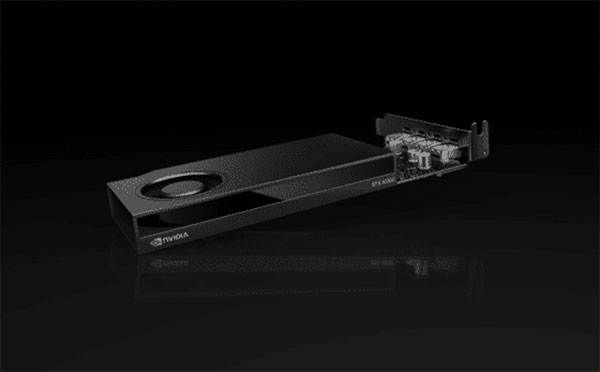
NVIDIA is expanding its RTX professional graphics offerings with two new NVIDIA Ampere architecture-based GPUs for desktops: the NVIDIA RTX A400 and NVIDIA RTX A1000. They expand access to artificial intelligence (AI) and ray-tracing technology.
The RTX A400 GPU introduces accelerated ray tracing and AI to the RTX 400 series GPUs. With 24 Tensor Cores for AI processing, it enables professionals to run AI applications, such as intelligent chatbots and copilots, directly on their desktops.
The GPU delivers real-time ray tracing so creators can build physically accurate 3D renders that push the boundaries of creativity and realism. The A400 also includes four display outputs, a first for its series. The NVIDIA RTX A1000 GPU brings Tensor Cores and RT Cores to the RTX 1000 series GPUs.
With 72 Tensor Cores, the A1000 delivers faster generative AI processing for tools like Stable Diffusion. In addition, its 18 RT Cores speed graphics and rendering tasks, accelerating professional workflows such as 2D and 3D computer-aided design (CAD), product and architectural design, and 4K video editing.
The A1000 also excels in video processing, handling up to 38% more encode streams and offering faster decode performance over the previous generation. With a single-slot design and consuming just 50W, the A400 and A1000 GPUs bring features to compact, energy-efficient workstations.
Engineers can transition ideas from 3D CAD concepts into tangible designs. Teams working in smart spaces can use the GPUs for real-time data processing, AI-enhanced security and digital signage management in space-constrained settings.
The NVIDIA RTX A400 and A1000 GPUs are equipped with features designed to supercharge everyday workflows, including:
Sources: Press materials received from the company and additional information gleaned from the company’s website.


Since its founding in 1993, NVIDIA (NASDAQ: NVDA) has been a pioneer in accelerated computing. The company’s invention of the GPU in 1999 sparked the growth of the PC gaming market, redefined computer graphics, ignited the era of modern AI and…

Cut Retrieval-Augmented Generation (RAG) Hallucinations by 50%
Most teams hit the same wall with enterprise AI: LLMs that hallucinate, pipelines that don’t scale, and infrastructure that’s harder to design than the models themselves.

DE's editors contribute news and new product announcements to Digital Engineering. Press releases may be sent to them via [email protected].
Follow DE
Join over 90,000 engineering professionals who get fresh engineering news as soon as it is published.






About Us · Contact Us · Editorial Team · Advertising · Privacy Policy · Subscriber Services · © 2026 Digital Engineering 24/7 · Peerless Media