Helping design and engineering professionals discover, evaluate and specify technologies and processes that shorten the design cycle and enable success.



Digital Engineering April 2026
In the latest issue of Digital Engineering, we take a look at the latest innovations in design for additive manufacturing, including the use of natural language inputs, social media cosplayers, and AI integration. The issue also includes a feature…

January Special Focus Issue: Design for Additive
In this Special Focus Issue of Digital Engineering, learn about the latest advancements in design for additive manufacturing, including new software tools, additive in automotive, custom medical devices, and more.
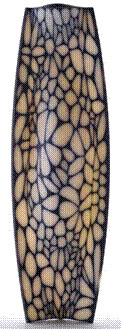 Four abstract artworks that were printed using Objet technology have been acquired for the collection of The Museum of Modern Art (MoMA) in New York City, according to Objet Geometries Ltd. (Rehovot, Israel).
Originally selected for a special MoMA exhibition entitled “Design and the Elastic Mind,” and created by leading artist Neri Oxman, the pieces were printed on Objet’s Connex500, which allows the printing of several materials with several mechanical and physical properties simultaneously.
Oxman, who is currently a Presidential Fellow at the Massachusetts Institute of Technology (MIT) pursuing a Ph.D. in design and computation, based at the MIT Media Laboratory, said she needed this capacity to develop the pieces, which were mathematically designed to showcase multiple structural and environmental qualities such as stiffness, transparency, and temperature control. She credits the Connex500 with allowing her to realize her vision.
The exhibition, which took place between February 24 and May 22, 2008, featured the works, entitled Catesian Wax, Monocoque, Raycounting, and Subterrain. These works are prototypes for “structural skin,” said Oxman, a construction technique that supports structural load using external skin instead of a traditional internal framework covered with non-load bearing casing. The pieces are designed to show the result of queries about the intrinsic qualities of natural structures and inspire future directions for applied research, Oxman said. They were created using algorithms and other computational tools.
Oxman is currently working on a larger-scale piece using the Objet Connex500, which involves printing between eight and 21 different materials with various physical properties that fit together in the form of a chair. The new work will appear in the Museo de Bellas Artes in Seville, Spain, in October 2008.
For more information, visit Objet Geometries, Ltd.
For earlier DE coverage on Neri Oxman’s work, see “Raycounting’ Uses Light to Generate 3D Form.”
Sources: Press materials received from the company and additional information gleaned from the company’s website.


DE's editors contribute news and new product announcements to Digital Engineering. Press releases may be sent to them via [email protected].
Follow DE
Join over 90,000 engineering professionals who get fresh engineering news as soon as it is published.






About Us · Contact Us · Editorial Team · Advertising · Privacy Policy · Subscriber Services · © 2026 Digital Engineering 24/7 · Peerless Media