Helping design and engineering professionals discover, evaluate and specify technologies and processes that shorten the design cycle and enable success.


Alert!
Digital Engineering ceased publication on July 1, 2026. This website remains available as an archive of engineering content.
For inquiries or information, please email [email protected].
Sponsored

May 2026 Special Focus: Artificial Intelligence in Design and Simulation
In this Special Focus Issue, learn about the latest developments in the integration of artificial intelligence into engineering workflows.

Design & Simulation Software Guide 2025
In this Special Issue, Digital Engineering presents its second annual guide to design and simulation software vendors.
In most cases, Computational Fluid Dynamics (CFD) simulation can be achieved using the industry-proven body-fitted Finite Volume (FV) method. After more than 20 years of research, particle-based methods, and especially Smoothed Particle Hydrodynamics (SPH), have reached industrial maturity. Today, SPH can complement established CFD solutions where FV shows its limitations, either in its capability to simulate correctly the fluid flows, or in terms of lengthy computation time.
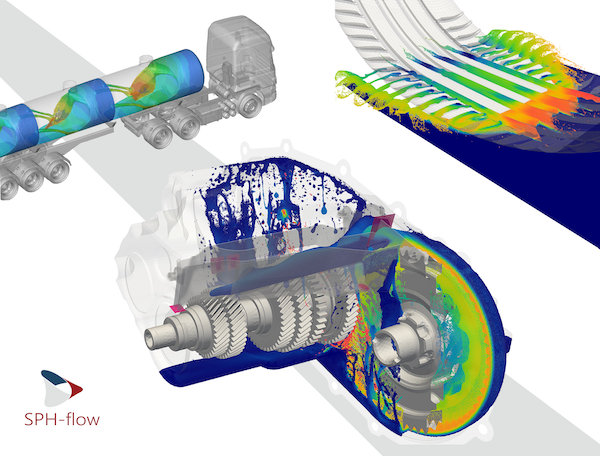
Thanks to Nextflow Software and other actors, the SPH method has been moving from academic labs to industrial engineering offices. SPH is being significantly adopted by automotive manufacturers and tier-1 providers for key applications like powertrain and transmission system lubrication and cooling (including e-motors), or vehicle river crossing (a.k.a. fording or wading) studies. Still, many other industries are adopting SPH for other applications in aerospace, marine & offshore, environment & energy, industrial process/machinery and manufacturing, etc.
The main characteristics of the SPH method are:
• SPH solves the Navier-Stokes equations (like FV) but represents fluid flows with moving particles. It is especially well adapted for simulations involving complex solid interfaces (body motion, deformation, contact...) and fluid interfaces (multiphase, atomization, coalescence...). Traditional FV methods are often limited by their mesh-based nature and cannot simulate effectively such interfaces.
• SPH does not rely on manual meshing and allows engineers to launch fluid flow simulations few minutes after getting their CAD files ready. Traditional mesh-based FV methods require tedious and user-dependent manual meshing operations, taking hours or even days of highly skilled engineers.
Nextflow Software’s SPH-flow solver offers compressible and incompressible formulations to accurately target all fluid flows:
• SPH-flow incompressible formulation is best-suited for highly fragmented flows, where the fluid is atomized into droplets or jets, and for long-duration flows.
• SPH-flow compressible formulation is best-suited for fluid flows involving complex physics and brief dynamics, such as shocks and impacts. This formulation is especially recommended when local pressure field and free-surface accuracy matter.
SPH-flow can be 5 to 100 times faster than FV solvers on specific applications that best fit with the SPH method, meaning that 1 week of computation may now shrink to few hours, with often better simulation results compared to FV on such applications. These capabilities open up for new uses of fast 3D CFD in the design-simulate-update loop, either as standalone simulation tool or embedded in design tools (whether 3D or not).



Nextflow Software is an Independent Software Vendor (ISV) startup headquartered in Nantes, France. Nextflow develops and sells advanced Computer-Aided Engineering (CAE) software in the field of Computational Fluid Dynamics (CFD).

Join over 90,000 engineering professionals who get fresh engineering news as soon as it is published.






About Us · Contact Us · Editorial Team · Advertising · Privacy Policy · Subscriber Services · © 2026 Digital Engineering 24/7 · Peerless Media