Helping design and engineering professionals discover, evaluate and specify technologies and processes that shorten the design cycle and enable success.


Alert!
Digital Engineering ceased publication on July 1, 2026. This website remains available as an archive of engineering content.
For inquiries or information, please email [email protected].

Design & Simulation Software Guide 2025
In this Special Issue, Digital Engineering presents its second annual guide to design and simulation software vendors.

Design & Simulation Software Guide
In this Special Issue, Digital Engineering presents its inaugural guide to design and simulation software vendors, including listings for CAD, CAM, simulation, generative design, PLM, rendering and visualization, design for additive manufacturing,…
 Bruce Jenkins, president of Ora Research.
Editor’s note: This article has been reprinted from Ora Research, with permission.
By Bruce Jenkins
Ford Motor Company adopted ESTECO’s SOMO as a tool to enable what it terms an enterprise multidisciplinary design optimization (EMDO) system, announced Dr. Yan Fu, technical leader of business strategy and engineering optimization at Ford. SOMO is an enterprise collaboration and distributed execution framework developed by ESTECO and customized to meet Ford’s engineering processes and IT requirements.
Ford’s move affirms two key points we have long observed:
Notable is that Ford elected to obtain this strategic capability not from an enterprise PLM provider nor from a mainstream CAE vendor, but instead from a developer with long, deep specialization in PIDO—process integration and design optimization.
A flagship account for Siemens PLM’s Teamcenter Simulation Process Management, Ford’s embrace of SOMO highlights what the automaker evidently saw as capability gaps in mainstream SPDM (simulation process and data management). Most centrally, it raises the question of whether today’s SPDM is seen to be more FEA-centric and validation-oriented than best supports the multidisciplinary, multi-domain optimization processes for which Ford looked to ESTECO (similar to how traditional PDM was too CAD-centric to be of much help managing simulation data and processes).
While in many respects Teamcenter Simulation Process Management is the most capable SPDM product on the market today, and Siemens PLM’s broad range of simulation offeringsincludes some important optimization capabilities, the company does not own PIDO technology, relying instead on partners specialized in this domain, ESTECO among them. We recently speculated whether this could be the year that Siemens makes an acquisition here, as did Dassault Systèmes in buying Engineous Software in 2008, and CD-adapco in acquiring Red Cedar Technology in 2013.
Now, in light of Ford’s endorsement, we expect more than one of the PLM and CAE vendors currently partnered with ESTECO will contemplate a bid for the company. What might entice ESTECO to entertain any such interest of course remains to be seen.
“Our longstanding technical partnership with ESTECO has enabled us to find a made-to-measure, highly flexible solution that integrates with our IT systems and meets our internal IT policies," said Dr. Fu, explaining Ford's rationale for its decision. "For more than a decade, modeFRONTIER desktop platform has been successfully used as a process integration, design optimization and decision support tool inside the organization. This close technical partnership has brought to life a common vision to expand from the desktop paradigm to a web-enabled solution—SOMO—capable of satisfying all design needs of a global enterprise like Ford.”
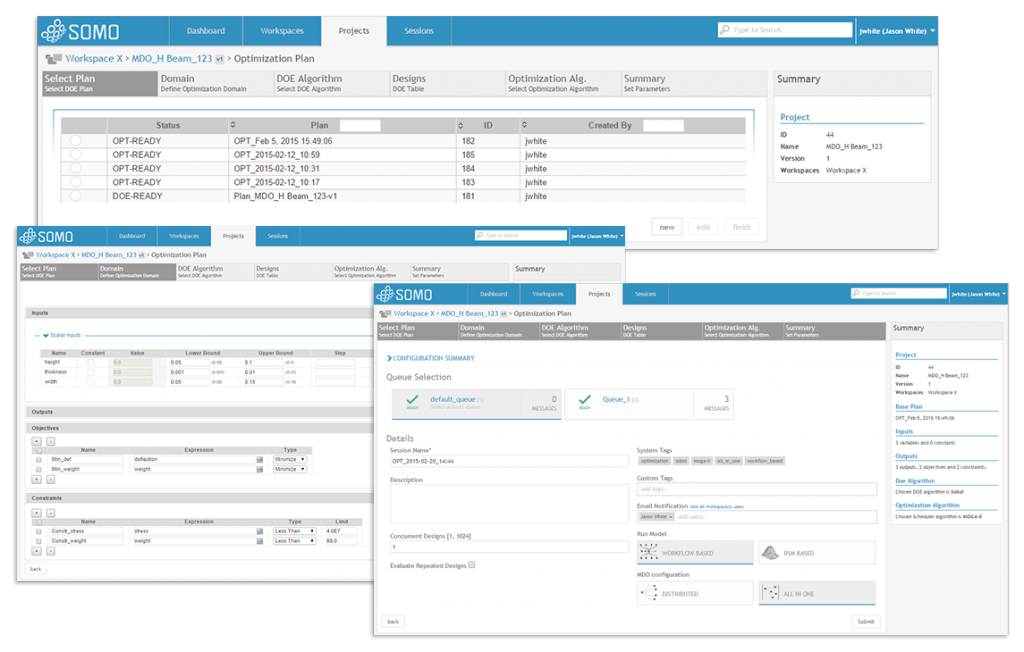 Image courtesy of ESTECO.
ESTECO describes its objectives with SOMO, saying the technology “has brought MDO to the next level by streamlining the information flow and facilitating the distributed execution of complex engineering design projects. While networking multiple departments and geographically distributed organizations, ESTECO enterprise technology helps companies achieve an institutionalized and transparent management of the engineering MDO design process, with engineers truly enabled to focus on their work without depending on the schedules of other department experts. Collecting domain-specific models, integrating them into a large-scale optimization workflow, preserving and versioning all the data in a central archive as well as sharing results with managers and decision makers—all of these activities can now be efficiently carried out within a single, secure enterprise environment.”
Additional perspective from Desktop Engineering: Ford Kicks Enterprise MDO Strategy Up a Notch with ESTECO SOMO






About Us · Contact Us · Editorial Team · Advertising · Privacy Policy · Subscriber Services · © 2026 Digital Engineering 24/7 · Peerless Media