Helping design and engineering professionals discover, evaluate and specify technologies and processes that shorten the design cycle and enable success.


Alert!
Digital Engineering ceased publication on July 1, 2026. This website remains available as an archive of engineering content.
For inquiries or information, please email [email protected].

Digital Engineering April 2026
In the latest issue of Digital Engineering, we take a look at the latest innovations in design for additive manufacturing, including the use of natural language inputs, social media cosplayers, and AI integration. The issue also includes a feature…

January Special Focus Issue: Design for Additive
In this Special Focus Issue of Digital Engineering, learn about the latest advancements in design for additive manufacturing, including new software tools, additive in automotive, custom medical devices, and more.
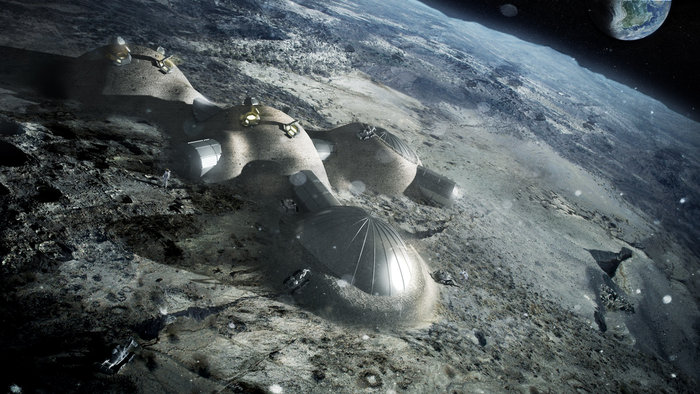
One potential method of using AM is in the construction of a moon base. Rapid Ready last covered ESA ideas for a 3D printed moon base in February of last year, and planning has continued since that time. The general plan for a permanent lunar facility now has a landing site and first-step operations plan set in ink.
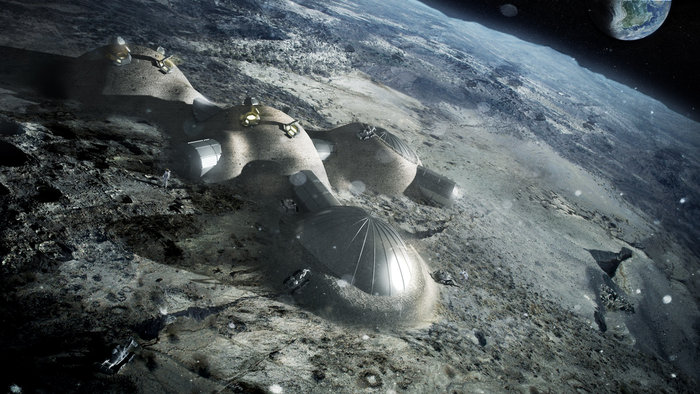 Concept rendering of how a completed moon base might look, based on ESA'[s current plans. Courtesy of ESA.
Taking all of that into account, the ESA has selected Shackleton Crater as a potential landing and building site for the moon base. Not only would the constant light be useful for providing power, but the temperature would also remain fairly constant. That would be good for theoretical humans inhabiting the base, and it would help in the base’s construction.
Currently, the plan would be to send in a moon lander, complete with two 3D printing robots. Part of the lander would include an inflatable dome, which would act as support for a 3D printed structure. The bots would shovel up lunar rock for use as a material, and mix it with binding agent to build honey-comb pattern structure around the inflatable dome. The end result would provide shelter from the potential ravages of space, and use the lander as an air lock.
“The process is based on applying liquids but, of course, unprotected liquids boil away in vacuum,” said Giovanni Cesaretti of Italian research firm Alta. “So we inserted the 3D printer nozzle beneath the regolith layer. We found small 2 mm-scale droplets stay trapped by capillary forces in the soil, meaning the printing process can indeed work in vacuum.”
Rapid Ready will be keeping an eye on future developments of the ESA’s moon base, but until more information becomes available, below you’ll find a video about the project.
Source: ESA


John Newman is a Digital Engineering contributor who focuses on 3D printing. Contact him via [email protected] and read his posts on Rapid Ready Technology.
Follow DE






About Us · Contact Us · Editorial Team · Advertising · Privacy Policy · Subscriber Services · © 2026 Digital Engineering 24/7 · Peerless Media