Helping design and engineering professionals discover, evaluate and specify technologies and processes that shorten the design cycle and enable success.




Design & Simulation Software Guide 2025
In this Special Issue, Digital Engineering presents its second annual guide to design and simulation software vendors.

Design & Simulation Software Guide
In this Special Issue, Digital Engineering presents its inaugural guide to design and simulation software vendors, including listings for CAD, CAM, simulation, generative design, PLM, rendering and visualization, design for additive manufacturing,…
Product lifecycle management (PLM) tools are evolving to help manhttps://www.centricsoftware.comufacturers better manage new competitive challenges, digital transformation, compliance and more. Increasingly, these tools leverage automation as well as artificial intelligence (AI) capabilities to help streamline design, test, launch and service activities, and accelerate innovation.
Projections show that the PLM market is expected to be worth $47.7 billion by 2033, with a compound annual growth rate of 5.89%, driven in part by these new innovations, as well as product complexity, circular product design, and the expansion of digital thread technology, according to IMARC Group.
According to a recent PLM report from Forrester, manufacturers looking for PLM solutions should focus on vendors that offer:
Granular collaboration that moves away from exchanging files toward “sharing discrete design elements and using selective control and edit authorizations.” Branching and merging capabilities can more effectively support product line engineering and propagating innovations to different designs.
Embedded AI and generative AI (genAI) for automating routine or error-prone tasks. According to Forrester, “AI can also help designers comprehensively evaluate all the feasible design options available and avoid the late-stage redesigns that frustrate new product introductions in regulated markets.”
Bidirectional interoperability with design tools. This ensures the PLM solution can synchronize changes across disciplines and across the value chain.
Almost all of the major PLM vendors have announced AI functionality over the past year or so. Data governance, according to CIMdata, will be a critical task for companies trying to use these tools.
In a recent webinar, Peter Bilello, president and CEO of CIMdata, discussed the AI-PLM dynamic, and also emphasized the data issue. “If the data you apply AI on top of is bad, the insights will be bad,” he said. “There will also be ethical and moral considerations around that data.”
According to Bilello, AI will augment human behavior and insight rather than replacing it. “Most companies don’t have data governance and a level of control needed to make sure AI will work on valid information at all times,” he said.
As these tools evolve, companies will need to evaluate how they can go beyond just automating tasks with AI to disrupting business models. “If you are just automating, this won’t be transformative,” he said.
A recent Aras survey found that companies using PLM solutions have more operational resilience, faster AI adoption and improved compliance efficiency. For companies with PLM implementations, the adoption of AI in product development is 28% higher among PLM users. They are also 24% more likely to see the significance of the digital thread to their business.
The survey also found that 80% of companies are already integrating AI into their product development processes.
Asked about challenges around AI, security and intellectual property concerns top the list at 69%, whereas 65% of manufacturers say they lack the skills to fully leverage AI, and 64% report that they struggle with siloed data, according to the Aras survey.
Cloud-based PLM vendor Duro recently re-architected its Duro Design platform from the ground up as an AI-native tool.
A year ago, the company recognized a window of opportunity where Duro was still nimble enough to do a major refactoring of the product using AI to accelerate the process. “We wanted to not just meet the demands of the market, but to exceed them,” Michael Corr, CEO and co-founder of Duro, says.
According to Corr, AI is a good fit for PLM workflows because it can analyze data from different sources without having to normalize the data in a single database, as is the case with traditional PLM platforms. “It’s a perfect fit for PLM, and it has lowered the technical barrier to connect bespoke data,” Corr says.
“PLM’s sole purpose is to capture changes and track them,” Corr adds. “All that information is captured in PLM and that is prime content for an AI model to train on. It can learn what changes tend to be rejected or approved, and what changes resulted in failures in the factory. It can build models on those patterns, so any subsequent submitted changes can be analyzed or pre-processed.”
Users can leverage natural language search to find parts and assemblies within the platform, and there is also an AI copilot that can help build out business logic in the customer’s Duro account. “Historically you needed to do some complex interfacing to configure changes or write custom code,” Corr says. “Now with a natural language prompt, you can tell it to add validations or specify that all mechanical parts have to be steel or aluminum. You can build out business logic that follows a company’s rules or workflows, and configure the platform for them. Any user can engage with Duro and configure it to add business logic.”
Centric PLM 8.0 from Centric Software (which is targeted at consumer goods manufacturers) has also been reconfigured with a focus on AI built into the PLM workflow to help speed time to market through trend and internal product data analysis.
Jotne Connect has also launched a new AI business unit that the company says will drive next-generation innovation in model-based systems engineering (MBSE), PLM and digital twin solutions. AI will enable automated classification, search and reuse of engineering assets; intuitive querying and analysis; predictive maintenance; dynamic linking of design, requirements and analysis data; and AI-powered validation and verification processes.
Another AI PLM startup, Japan-based Things, Inc. recently received an investment from Mitsubishi Electric. Things Inc.’s PRISM PLM product uses generative AI to improve structure and usage of data in manufacturing, according to the company.
Established PLM leaders are also incorporating AI, among other features, including more cloud and software-as-a-service (SaaS) offerings.
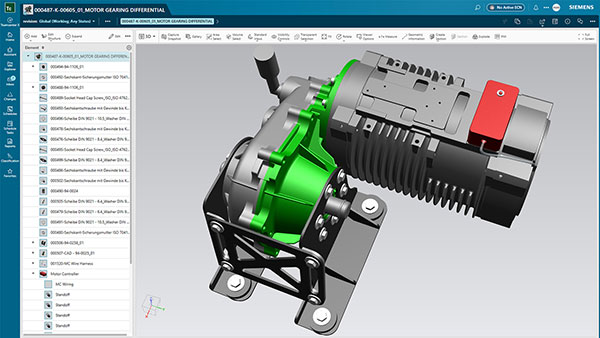
Siemens Digital Industries Software, for example, offers Teamcenter AI Chat to query product information within Teamcenter using natural language prompts. The company also offers Azure AI Vision-based visual search so that users can upload an image and use it to find matching NX models or parts. There is also an AI-driven classification capability.
Siemens has also expanded the capabilities of its cloud-based Teamcenter X offering, with tiered packages for users with different needs.
Aras Innovator also offers capabilities, including AI-Assisted Search, which allows users to search across structured and unstructured data managed by Aras Innovator SaaS. The AI-Powered Intelligent Assistant lets PLM users interact with Aras documentation and knowledge base data using natural language.
Aras also announced its InnovatorEdge low-code application programming interface this year, which simplifies integration of the Innovator platform with other enterprise software and workflows.
PTC released a SaaS version of its popular Windchill PLM platform several years ago, and that cloud-based product (now called Windchill+ PLM) has been embraced by customers like Schaeffler and the U.S. Navy.
In March 2025, PTC previewed its new Windchill AI PLM assistant at Hannover Messe. The Windchill AI preview includes the Document Vault AI agent, which enables an engineer to extract relevant product-related information from documents stored in Windchill.
PTC has also augmented its Arena PLM product with new features. The Arena Supply Chain Intelligence (SCI) offering is a solution that checks for emerging risks from evolving supply chain conditions and leverages AI-driven component monitoring and risk mitigation insight in product development workflows. If supply chain risks are identified, the system can recommend alternative components or suppliers.
PTC has also developed close integrations between its cloud-native OnShape CAD product and Arena.
Earlier this year, Dassault Systèmes introduced 3D UNIV+RSES, an AI-based architecture that the company says will help customers “work with 3D design, virtual twins and PLM data in a new space of representation, a digital environment to train new categories of experience as a service (XaaS)—namely: generative experiences (GenXp), virtual companions, as well as intelligent virtual twin experience as a service (VTaaS).” The company has also been incorporating AI capabilities across its 3DEXPERIENCE suite.

CIMdata Consulting provides a comprehensive set of unbiased and independent strategic management consulting services. CIMdata offers guidance and support to industrial organizations and PLM solution providers. We maintain a strategic…

Brian Albright is the editorial director of Digital Engineering.
Contact him at [email protected].

Join over 90,000 engineering professionals who get fresh engineering news as soon as it is published.






About Us · Contact Us · Editorial Team · Advertising · Privacy Policy · Subscriber Services · © 2026 Digital Engineering 24/7 · Peerless Media