Helping design and engineering professionals discover, evaluate and specify technologies and processes that shorten the design cycle and enable success.




May 2026 Special Focus: Artificial Intelligence in Design and Simulation
In this Special Focus Issue, learn about the latest developments in the integration of artificial intelligence into engineering workflows.

Design & Simulation Software Guide 2025
In this Special Issue, Digital Engineering presents its second annual guide to design and simulation software vendors.
 Tucker Inovation's
The general rule of thumb is, if you want to produce a strong, durable part with simple, straightforward geometry, you rely on traditional machining, known as subtractive manufacturing; on the other hand, if you want to produce a complex, organic shape and don't need the strength of metal, you rely on 3D printing, also called additive manufacturing. This is the dilemma for those who want to produce a complex metal part.
But Tommy Tucker, CEO of Tucker Innovations, wants to offer a way to get both, though what he calls "subtractive 3D printing." The method originated as a research project at Georgia Tech, according to Tucker.
Describing his company's SculptPrint software, Tucker writes: "The underlying technology uses a fundamentally different geometry representation from traditional CAD/CAM systems and leverages a suite of different GPU parallel processing algorithms to accomplish its workflow. SculptPrint technology is referred to as 'Subtractive 3D Printing' to distinguish it from traditional NC CAM."
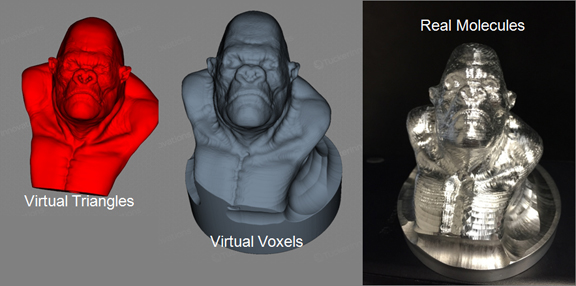
"We use voxels to represent geometry, which is higher in resolution," explained Tucker. "The method leverages the GPU heavily. If we run the same algorithm on the CPU, it wouldn't be fast enough."
Whereas "pixels" represent visual information as 2D squares on displays, "voxels" represent data as cubes in 3D space. Therefore, voxel-driven visualization tends to be much more computation intensive. The advantage of this approach, Tucker explained, is the ability to swiftly analyze collision and clearance in tool path calculations in machining operations.
Simple parts that can be produced with three-axis machining don't benefit from SculpPrint's technology; however, complex parts that usually require five-axis machining see dramatic speed increases, Tucker revealed.
According to Tucker, his company has received support and funding from the U.S. Navy to manufacture ship propellers, which demands both metal's durability and additive manufacturing's geometric complexity. SculptPrint is still in development, therefore not widely available as a commercial package.
Tucker is set to speak at the upcoming NVIDIA GPU Technology Conference (GTC 2016). His talk is titled "S6146 - SculptPrint: Subtractive 3D Printing through GPUs.


Kenneth Wong is Digital Engineering's resident blogger and senior editor. Email him at [email protected] or share your thoughts or suggestions at digitaleng.news/facebook.
Follow DE
Join over 90,000 engineering professionals who get fresh engineering news as soon as it is published.






About Us · Contact Us · Editorial Team · Advertising · Privacy Policy · Subscriber Services · © 2026 Digital Engineering 24/7 · Peerless Media