Helping design and engineering professionals discover, evaluate and specify technologies and processes that shorten the design cycle and enable success.



May 2026 Special Focus: Artificial Intelligence in Design and Simulation
In this Special Focus Issue, learn about the latest developments in the integration of artificial intelligence into engineering workflows.

Design & Simulation Software Guide 2025
In this Special Issue, Digital Engineering presents its second annual guide to design and simulation software vendors.
The dreaded word in the world of electric vehicle (EV) batteries is thermal runaway. EV FireSafe, a private firm devoted to EV battery fires and emergency response, explains, “All EV traction battery fires start with thermal runaway … thermal runaway occurs when a battery cell short circuits and starts to heat up uncontrollably.”
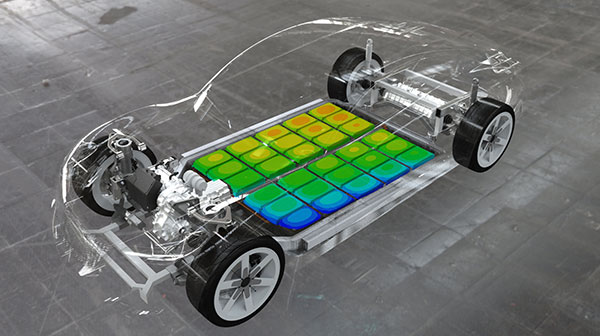
In modern EVs, battery modules are not a single unit but a pack with a series of smaller battery cells, usually numbering in the thousands. Thermal runaway presents a serious threat to the safety of the car since the thermochemical reaction from a single cell could spread to the entire pack, triggering a fire or catastrophic explosion. In this article, we look at the simulation tools available to study and analyze this phenomenon.
Battery packs need to meet certain abuse tests by regulations. The United Nations’ Global Technical Regulation 20 on Electric Vehicle Safety (UN GTR No. 20) spells out the requirements for EVs to provide an advance warning 5 minutes before a hazardous situation like thermal runaway occurs inside the passenger compartment. In North America, UL 2580, developed by the Underwriters Laboratories, spells out the Standard for Batteries for Use in Electric Vehicles. The American National Standards Institute (ANSI) states, “This standard evaluates the electric energy storage assembly and modules based upon the manufacturer’s specified charge and discharge parameters at specified temperatures.”
“The battery cell involves electrical, chemical and mechanical components, so it requires multidomain analysis,” explains Danielle Chu, Product Management & Marketing, MathWorks. “But MathWorks’ solution is different from typical 3D simulation software. Instead of using finite element analysis (FEA), MathWorks’ Simscape Battery uses ordinary differential equations (ODE).” Bypassing the 3D mesh models allows simulations to run much faster, Chu points out.
“Engineers need to make sure that, when one cell suffers from thermal runaway, the heat won’t propagate to the rest of the cells inside the battery pack,” explains Chu. “With Simscape Battery, you can inject faults inside a cell, then analyze how the heat propagates throughout the pack. This allows you to select the minimal conductivity needed in your insulation materials to meet the requirements.”
Simscape Battery provides design tools and parameterized models for developing battery systems. It enables you to tune battery cell behavior to match measured data, run virtual tests of battery pack architectures, design battery management systems and evaluate battery system behavior across normal and fault conditions.
At the cell level, it’s important for the engineers to characterize the individual cells faithfully. That means the model parameters reflect the actual battery’s behavior under various operating conditions. “The cell characterization is the foundation. Engineers need to optimize the model parameters such that the model predicted voltage matches well with experimentally measured voltage,” says Chu. “But the optimization process can often take days. With MathWorks’ Model-Based Calibration Toolbox, engineers can reduce the workflow to just a few minutes. Our algorithm can handle a lot more parameter tables.”
If overheating is a risk with EV battery packs, then designing a cooling system is a critical part of the strategy.
With modern battery packs, “you’re dealing with a lot of physics,” says Royston Jones, chief technology officer of Product Design and senior vice president of Automotive, Altair. “You’ve got thermal, electrical and chemical behaviors in the cells themselves, and in the busbars [conductive strips for distributing power throughout the pack], you’ve got CFD [computational fluid dynamics] analysis for the cooling system. And all these physics have to be coupled together. It’s a complex system. Our goal has always been to design a tool that captures all these physics.”
Altair offers OptiStruct, the company’s flagship product, as a battery pack analysis solution. The latest version of OptiStruct is GPU-accelerated, which speeds up CFD analysis in particular. “About five or six years ago, because of customer demand, we started adding all these physics into OptiStruct: thermoelectrical analysis to model the busbars; and CFD to model the cooling system. They were all internally developed,” says Jones.
Modeling the battery pack in 3D with all its fine details and the coupled physics provides accurate simulation results, but it will take time. Modeling the system with a lower level of resolution or simplifying the physics speeds up the process, but is less accurate. But as a design tool, Jones is in favor of speed. One strategy, Jones suggests, is to model the problematic area in fine detail, but the rest in lower fidelity. “Ultimately, our customers are not designing the cells themselves; they’re designing the assembly around the cells,” he notes.
Batteries are usually supplied by battery manufacturers to the EV makers. And battery makers are usually secretive about the IP content of their products, which makes simulation more difficult than necessary, Jones points out.
“To conduct a full attribute sweep, we would need the cell’s thermal and chemical characteristics, and also the material properties. If we want to study something like battery swelling or thermal runaway, these are essential,” says Jones.
Ansys offers Ansys Fluent, its primary CFD software, as an option for those designing the cooling system.
“Lithium-ion battery cells have a very narrow range of temperature for optimum operation, so they cannot get too hot or too cold,” says Xiao Hu, senior principal engineer, Ansys. “The engineers’ goal is to design a cooling system that can maintain that optimal range. They use our software to design and verify their systems.”
The battery management system (BMS) plays a critical role in monitoring the battery pack’s behavior and mitigating the effects of thermal runaway. “In the early design stage, engineers usually look at the effectiveness of the cooling system by itself,” Hu says. “They just want to know if the cooling system works as intended under normal drive cycles. Typically it’s a standalone CFD analysis. But in later stages, when they look at the entire powertrain with the BMS, they would do simulation with both hardware and software in the loop.”
Hu also brought up thermal runaway, a common concern in EV battery design. “You want to make sure there is enough time for the passengers to escape the car in case of thermal runaway,” he says. “So engineers use our software to simulate a thermal runaway to predict how long the passengers have.” Thermal runaway simulations, like many other battery simulations, require test data as inputs. “The accelerating rate calorimetry (ARC) data is such,” Hu explains. “Ansys Fluent uses such data in its the traditional 1-equ and 4-equ models for battery thermal runaway simulations.”
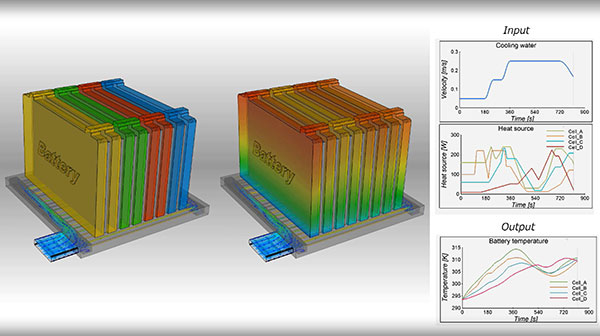
As cell manufacturers develop new cells to satisfy the demand of EVs, more advanced simulation technology will have to be implemented in simulation software. “An N-equ thermal runaway model, developed by Tsinghua University, has been implemented inside Ansys Fluent to address the limitations seen by the 1-equ or 4-equ models when applied to high density NMC cells,” Hu says. These models together allow the OEMs and tier 1 suppliers to optimize the cooling system design to mitigate the risk of thermal runaway.
Victor Oancea, SIMULIA R&D Technology senior director, Dassault Systèmes, points out that developing virtual twins of battery cells and battery packs is becoming a standard practice among carmakers. The twin allows engineers to simulate different physics on the pack.
“For optimal battery pack performance, the range of temperatures of all battery cells for the normal battery pack’s operation should be maintained in narrow ranges,” says Oancea. “Usually, if you deviate more than a few degrees Celsius, you’re going to degrade the battery’s performance. So, having a virtual twin for the cell’s heat rate production in charge/discharge scenarios, at various C-rates, for various ambient conditions and various conditions of cell confinement in a battery pack, is important. That’s how you design a pack where each individual cell is kept within its narrow range of temperatures. That’s important in determining the longevity and durability of the cells.”
A key consideration in counteracting thermal runaways is to devise containment strategies to prevent the damaged cell’s impact from spreading, Oancea notes. “In itself, one cell burning is not catastrophic, but if there’s thermal propagation within the battery pack, the gas generated from one cell sends hot particles (ejecta) to nearby or far away cells, then it can become catastrophic as multiple cells can start burning simultaneously,” he says. Therefore, designing a system that leaves room for the built-up gases to escape is also part of the mitigation strategies.
In the past, the carmakers’ competitive advantage was the internal combustion engine design. For modern EV makers, the battery pack design is a closely guarded secret for the same reason.
“We have good relationships with several major OEMs, but even so, we have yet to see a detailed model of a full battery pack because of IP considerations despite strict NDAs we have in place,” Oancea says. “What we can get from our customers is a representative model—not the actual model, but something that represents the pack realistically. We then devise modeling methods from these representative models and we interact with the OEMs via these models. It’s a two-step process.
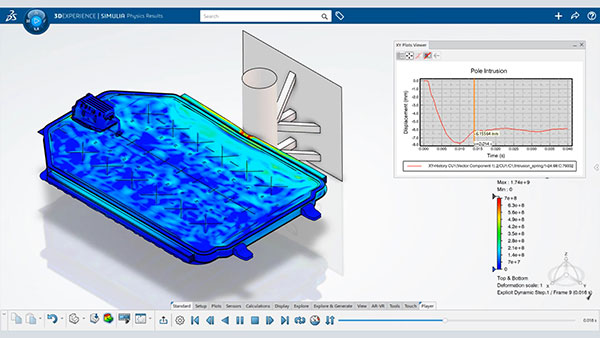
“Engineers talk about cells breathing—meaning the swelling and upswelling that occur when the batteries are charging and discharging. There could be mechanical damage after a number of these cycles in addition to many other degradation mechanisms of an electrochemical nature,” notes Oancea. “So, battery pack simulation is not just thermal, electrical and chemical, but also mechanical, along with fluid flow physics for thermal management. [It’s] a very complex multiphysics/multiscale virtual twin.”
All the efforts that used to be devoted to refining and perfecting the combustion engine are now shifting toward battery design, Oancea observes. Therefore, EV makers’ reliance on simulation software is expected to increase.


Altair transforms design and decision making by applying simulation, machine learning, and optimization throughout product lifecycles. Altair offers software in five categories related to Computer Aided Engineering (CAE) and High Performance…
Accelerating and Advancing CAE
GPUs are changing the nature of engineering simulation, according to a new ebook from Jon Peddie Research (JPR). It explains how GPU acceleration is improving CAE workflows.

Kenneth Wong is Digital Engineering's resident blogger and senior editor. Email him at [email protected] or share your thoughts or suggestions at digitaleng.news/facebook.
Follow DE
Join over 90,000 engineering professionals who get fresh engineering news as soon as it is published.






About Us · Contact Us · Editorial Team · Advertising · Privacy Policy · Subscriber Services · © 2026 Digital Engineering 24/7 · Peerless Media