Helping design and engineering professionals discover, evaluate and specify technologies and processes that shorten the design cycle and enable success.


Alert!
Digital Engineering ceased publication on July 1, 2026. This website remains available as an archive of engineering content.
For inquiries or information, please email [email protected].

Digital Engineering April 2026
In the latest issue of Digital Engineering, we take a look at the latest innovations in design for additive manufacturing, including the use of natural language inputs, social media cosplayers, and AI integration. The issue also includes a feature…

January Special Focus Issue: Design for Additive
In this Special Focus Issue of Digital Engineering, learn about the latest advancements in design for additive manufacturing, including new software tools, additive in automotive, custom medical devices, and more.
A group of students at the University of Toronto have advanced the technology of skin replacement surgery with the PrintAlive Bioprinter. The device was named the Canadian winner of the 2014 James Dyson Award, which qualifies the research team for a shot at the grand prize total of $60,000 in funding.
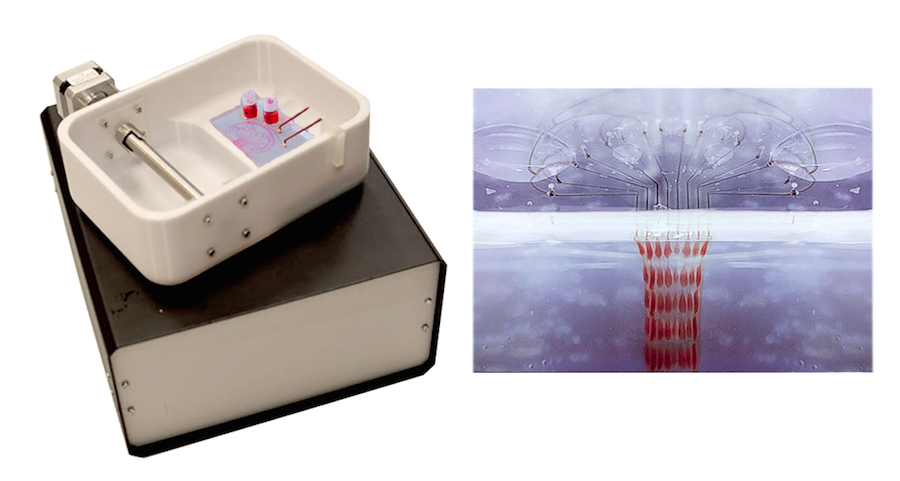 About the size of a toaster, the PrintAlive Bioprinter is capable of manufacturing new skin for burn victims. Courtesy of MaRS Innovation.
Repairing damaged areas of skin suffered by burn victims often requires removing skin from a healthy section of the body and grafting it onto the injury. This process is often quite painful for patients, and further increases risk of infection. The PrintAlive Bioprinter could eliminate the skin graft step by printing new skin directly onto the damaged area using the patient’s own cells to reduce the chances of rejection.
“Ninety percent of burns occur in low and middle income countries, with greater mortality and morbidity due to poorly-equipped health care systems and inadequate access to burn care facilities,” said Dr. Marc Jeschke, head of Sunnybrook Hospital’s Ross Tilley Burn Centre. “Regenerating skin using a patient’s own stem cells can significantly decrease the risk of death in developing countries.”
The process, which has been in development since 2008, is a complete solution that prints new, “hair follicles, sweat glands and other human skin complexities …” The PrintAlive Bioprinter itself is described as about the size of a toaster, and it prints skin cells into a gel that offers support for the new tissue. Skin is slowly built up in layers until the final graft is complete.
Along with the potential to win the international Dyson award, MaRS Innovation is assisting the research team develop the system for commercial usage. Current testing is performed on mice. Human trials are still three years away.
Below you’ll find a short video about the PrintAlive Bioprinter.
Sources: MaRS Innovation, CBC


John Newman is a Digital Engineering contributor who focuses on 3D printing. Contact him via [email protected] and read his posts on Rapid Ready Technology.
Follow DE






About Us · Contact Us · Editorial Team · Advertising · Privacy Policy · Subscriber Services · © 2026 Digital Engineering 24/7 · Peerless Media