Helping design and engineering professionals discover, evaluate and specify technologies and processes that shorten the design cycle and enable success.


Alert!
Digital Engineering ceased publication on July 1, 2026. This website remains available as an archive of engineering content.
For inquiries or information, please email [email protected].


Artificial Intelligence for Design and Engineering Workflows
In this white paper, learn how artificial intelligence and machine learning can improve design and simulation.
Technology Focus: Designing for Optimization & Simulation
Simulation is pervasive, with people from different departments and backgrounds discovering new ways to put it to use, in all of its varied forms.
Dauntless XR is an immersive 3D visualization software provider that offers tools for workflow and data visualization across a number of applications.
The Dauntless XR team needed to process and visualize massive datasets to create 3D tools. A Dell customer, they turned to the new Dell Pro Max workstations with NVIDIA RTX PRO™ GPUs to optimize for AI workflows and large datasets, as well as reduce processing times, and enable rapid iteration of their 3D tools.
In the following APDRC interview, Lori-Lee Elliott, owner and co-founder of Dauntless XR, explains the company’s products and how Dell and NVIDIA hardware have helped improve the company's development efforts.
Tell us about your company and its products.
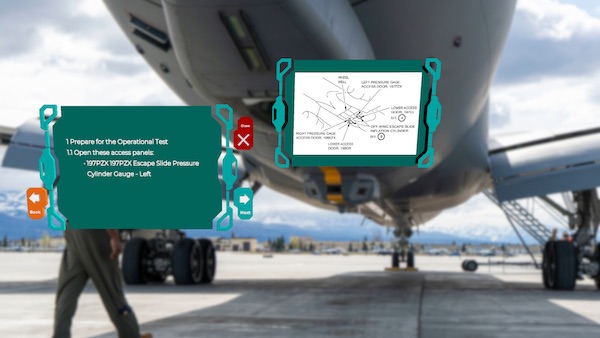
We have two core products: Katana XR, a mixed reality tool for guided workflows, and Aura, a 3D space data visualization tool. I started the business with my cofounder after having done ten years-plus in the engineering, procurement and construction markets. I was tasked with handing off the finished product to customers for these huge infrastructure projects, and I was shocked at how little technology was being used. Everything was very manual. We were doing important work, but not being given great tools to do it with.
I formed Dauntless XR to fix that problem. Katana XR provides mixed-reality, guided workflows that are contextually relevant. You can use it with any headset or any hardware.
We started off serving that industry. During the pandemic, things got shaken up and the Air Force reached out to us. They wanted to know if our technology could be used by pilots working on an air force base and with aircraft. While working with the Air Force we created the Aura application for 4D data visualization. It can bring in dispersed data sets with different formats and cadences, and use that to create 3D holographic images that the Air Force can use for debriefs, for example. You can pull information from an aircraft and do a 4D reconstruction of the mission they flew. It can be used with trainee pilots for flight review.
We are now taking things we developed for the military and releasing them commercially.
What is the role of Dell Technologies in your business?
We needed to accelerate our development. This was developed on Dell computers, and we started getting into artificial intelligence (AI) integration with our apps.
When we first launched Katana out in the field, we had users on construction sites installing pipework, and what they wanted Katana to do was to look at a valve, for example, and tell them what specific valve it was using image recognition. This was in 2017. When the technology caught up and the image recognition and AI boom got us to a place where it was feasible, we used Dell hardware and NVIDIA GPUs for the model training.
We debuted that functionality at Dell Technologies World. At the show, we gave attendees a handful of Lego bricks to build a mini AI factory. The app would identify the Lego bricks and tell you which one you needed for each step, and then provide that step.
We are not restricted to object recognition or detection for any one particular data set. We train recognition models across the board so you aren’t locked into one type of content. When we were testing this on construction sites, we had people ask us to create instructions on how to change a tire or use a tow hitch for their vehicle. Once the object is identified, our software can tell you what to do with it.
What type of data is used for training with Katana XR?
We have a lot of legacy data, procedures, checklists, and workflows that inform our training modules. We also work with JSON streams, SQL databases, and historical CSVs. Our customers already have data in formats that are difficult to utilize. We have an authoring platform in our application that takes those sets of data and turns them into XR-ready content.
How are you working with Dell and NVIDIA to enable these workflows?
We’re not an AI company, and when we started working on training these models, we initially looked at using our standard issue Dell laptops to do that model training, and it was time intensive. So we got our hands on a Dell Pro Max, accelerated by NVIDIA RTX PRO GPUs, and that took our training time from days to just a few hours. It allowed us to move so much faster with each training cycle. It allowed us to put out a better quality product in a shorter amount of time.
You can learn more about Dauntless XR on the company website, and read a case study about the technology here.


Brian Albright is the editorial director of Digital Engineering.
Contact him at [email protected].






About Us · Contact Us · Editorial Team · Advertising · Privacy Policy · Subscriber Services · © 2026 Digital Engineering 24/7 · Peerless Media