Helping design and engineering professionals discover, evaluate and specify technologies and processes that shorten the design cycle and enable success.


Alert!
Digital Engineering ceased publication on July 1, 2026. This website remains available as an archive of engineering content.
For inquiries or information, please email [email protected].
Sponsored
Artificial Intelligence for Design and Engineering Workflows
In this white paper, learn how artificial intelligence and machine learning can improve design and simulation.

Technology Focus: Designing for Optimization & Simulation
Simulation is pervasive, with people from different departments and backgrounds discovering new ways to put it to use, in all of its varied forms.
InfinitForm offers an artificial intelligence (AI) powered design optimization platform that can rapidly run advanced simulations and improve its customers’ ability to improve design for manufacturability and performance.
In 2024, the company was accepted into the NVIDIA Inception Program, which offers startups access to advanced NVIDIA GPUs and developer resources.
We spoke to Michael Bogomolny, founder and CEO at InfinitForm, to learn more about the platform, how the software leverages GPU acceleration from NVIDIA, and more.
Can you tell us about the background of the InfinitForm platform, and how it works?
Michael Bogomolny: We developed engineering software to optimize product designs and improve quality. Our first version was cloud-based, but we have since developed an on-premises version for workstations. Both provide tremendous speedup with GPU compute.
In current engineering workflows, each department works separately. These siloed workflows in each department use different sets of software packages. If you look at the typical workflow, it starts with the design department, where engineers draft the shape in CAD. Then the design is transferred to the simulation department, where they apply the mesh, run the simulation and look at the results, and then they go back to the design department and tell them the results, and then they create new iterations to optimize the part. After that, the design goes to the manufacturing department to see if the design can be produced in the most cost-effective way. This is a manual process. It often takes a few weeks to make sure the design is manufacturable and performs well under different conditions.
What InfinitForm is doing is in the early design stage, we incorporate performance and manufacturing constraints. Our software generates designs based on simulation and manufacturability data, and it takes just minutes.
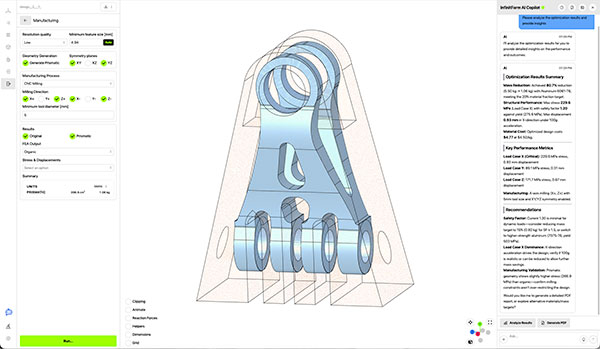
We are a layer of intelligence sitting inside the existing workflow. When our software gets the initial CAD file from the engineers, users supply design goals and loading conditions, manufacturing constraints, and other requirements. Once the CAD file is imported, we use material properties, geometry classification, loads, and manufacturing information to balance tradeoffs between manufacturability and performance. The software generates designs that not only include the shape, but also finite element simulations. Our software generates the mesh, and runs the FEA simulations and optimization in the background.
You focus a lot on manufacturability. Can the software help compare between different manufacturing methods like injection molding, machining and 3D printing to pick the most effective approach?
Our manufacturing exploration features can help users compare production-ready optimized designs for all modes of manufacturing. As you change the manufacturing method, the design changes as well. You can clone the project, change the manufacturing technique and get multiple designs to compare. Once you see the designs, you can make a decision about the preferred manufacturing technology, and you have metrics to make an educated decision.
How does the software work in conjunction with existing CAD tools?
InfinitForm software accepts STEP models from all the major providers, including SOLIDWORKS, Autodesk and Siemens. We have other CAD partnerships in the works. We use our own solvers for the simulation. Once the design is ready, it can be put back into SOLIDWORKS, for example, including the feature tree for the entire model.
If users want to validate our simulation, it’s very straightforward to run the model through Ansys, for example.
Describe your relationship with NVIDIA and the role of the GPU in making the solution work.
We were accepted into the Inception Program, and they provided us with credits for utilizing their GPUs in the cloud while we developed the solution. We developed our own solvers from scratch based on GPU computing, and we only support NVIDIA GPUs.
We have achieved tremendous speedup compared to CPU-based solvers. We see 70x to 100x acceleration. For a model with 1 million elements or 3 million degrees of freedom, we can solve that 0.5 seconds.
Are there any differences between the cloud version of the solution and workstation-based on-premises version?
Not really. On the cloud, you may need to wait a few minutes until an instance is available. The on-prem version is instantaneous. The entire process takes just a few minutes to optimize a part, solve 60 to 70 simulations, and do post processing.
In addition to speed, what other benefits can using InfitiForm provide?
When we compare our platform to manually-generated designs, we consistently beat those designs in terms of performance. You can have design generated by a human, based on a certain weight and performance requirements, and our optimized results always outperform the human-generated designs. You not only see speedup, but also the quality of the output improves. You can obtain better designs in just a few minutes than could generate using existing workflows that take days or weeks.


Brian Albright is the editorial director of Digital Engineering.
Contact him at [email protected].






About Us · Contact Us · Editorial Team · Advertising · Privacy Policy · Subscriber Services · © 2026 Digital Engineering 24/7 · Peerless Media