Helping design and engineering professionals discover, evaluate and specify technologies and processes that shorten the design cycle and enable success.


Sponsored
 Dear Desktop Engineering Reader:
Whenever I squirt water everywhere while opening one of those flimsy house-brand bottles you get at a mega gas station mini mart, I imagine Blanche DuBois, desperate to quench her fevered brow, saying “Deliberate cruelty is not forgivable!”
OK, it’s actually an engineering failure, probably with an assist from corporate. Today’s Check it Out link takes you to a Web page ANSYS built that has some terrific information on how you can design blow-molded containers and packages the right way. The right way means keeping end users and your penny pinchers happy.
Now, it’s a difficult, multiphysics challenge designing plastic packaging and containers for consumer and industrial products. You want to use as little material as possible to control costs and save big bucks. If you muff it, the package lacks structural soundness, which gets you big distributors complaining about the complaints they get from clients about troubles stacking it, bottles with weak spots that burst and so on.
You also want to optimize the filling process for issues like time to fill and gas accumulation. And you want to provide the ultimate end user a boring, routine experience by designing a bottle that dispenses product correctly and doesn’t squirt stuff everywhere the moment it’s grasped.
This Web page demonstrates ANSYS’ solution set for virtually prototyping the design and manufacture of plastic bottles. One of the tools in the spotlight is ANSYS Polyflow, a fluid dynamics technology-based solution for designing and optimizing processes like blow molding. Polyflow can also handle processes for industries working with polymers, glass, metals and cement processing. The ANSYS structural analysis software suite also figures in heavily into this demonstration.
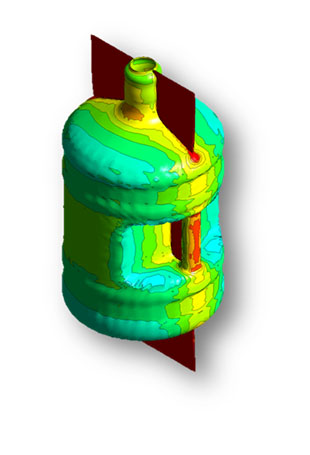 ANSYS Polyflow allows you to predict material distribution when using processes such as blow molding, such as with this 5-gallon blow-molded water cooler bottle. Image courtesy of ANSYS Inc.
The highlight of the page is a short video (registration free) providing a step-by-step demo on how to use ANSYS CFD (computational fluid dynamics) software to simulate the blow molding process of a plastic bottle that’s structurally sound, cost effective and works right. Topics covered include predicting material distribution, thickness variation, deformation and shock resistance. A whole bunch of cool visualizations of liquid filling, drop tests and so on make it visually very appealing.
You can also register for an in-depth, on-demand webinar called “Virtual Prototyping in the Manufacture and Design of Plastic Packaging.” There are links to further details on Polyflow and other ANSYS applications.
This ANSYS Tech Tip is good stuff. Highly recommended. Hit today’s Check it Out link and enjoy.
Thanks, Pal. – Lockwood
Anthony J. Lockwood
Editor at Large, Desktop Engineering


Anthony J. Lockwood is Digital Engineering's founding editor. He is now retired. Contact him via [email protected].
Follow DE
Join over 90,000 engineering professionals who get fresh engineering news as soon as it is published.






About Us · Contact Us · Editorial Team · Advertising · Privacy Policy · Subscriber Services · © 2026 Digital Engineering 24/7 · Peerless Media