Helping design and engineering professionals discover, evaluate and specify technologies and processes that shorten the design cycle and enable success.


Alert!
Digital Engineering ceased publication on July 1, 2026. This website remains available as an archive of engineering content.
For inquiries or information, please email [email protected].


May 2026 Special Focus: Artificial Intelligence in Design and Simulation
In this Special Focus Issue, learn about the latest developments in the integration of artificial intelligence into engineering workflows.

April 2026 Special Focus Issue: Generative Design
In this Special Focus Issue, Digital Engineering takes a look at how generative design solutions can be used across different types of design problems and with a variety of manufacturing approaches to accelerate design space exploration, and…
Let’s have a shotgun start for today’s Roundup. Firearms manufacturer, Remington, has acquired TAPCO, manufacturer of firearms accessories and replacement parts. TAPCO has been in business for more than 25 years, so why has Remington just purchased the company? The answer is 3D printing.
Remington is looking to incorporate TAPCO’s 3D modeling and rapid prototyping expertise into the larger business. I’d expect to see other established companies with additive manufacturing (AM) experience get snapped up by bigger entities looking for a quick way to add AM to the design process.
“TAPCO has been in business for more than 25 years and has established market strength through its high quality U.S.-made products,” said George Kollitides, chairman and CEO of Freedom Group. “This acquisition will enhance our positioning in the accessories market and allow us to further our research and development capabilities.”
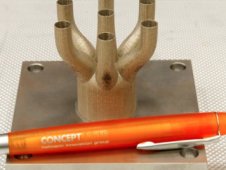
Moving on, Rapid Ready has previously covered NASA’s interest in AM, and the scientific organization continues to find new ways to utilize the technology. The Marshall Space Flight Center in Huntsville, AL, has purchased a selective laser melting (SLM) system from Concept Laser to produce end-use parts for its J-2X engine, which is still in development.
"This process significantly reduces the manufacturing time required to produce parts from months to weeks or even days in some cases," said Andy Hardin, integration hardware lead. "It's a significant improvement in affordability, saving both time and money. Also, since we're not welding parts together, the parts are structurally stronger and more reliable, which creates an overall safer vehicle."
Zooming back down to Earth, the U.S. Army Space and Missile Defense Command/Army Forces Strategic Command Future Warfare Center's Innovative Ventures Office (that title is longer than some of my articles) has developed a lightweight and inexpensive 3D printer that fits in a backpack and can used in the field. Rapid Ready looked at a different use of AM by the Army earlier this year.
"The ability to replicate parts quickly and cheaply is a huge benefit to the warfighter," said D. Shannon Berry, operations research analyst with the Innovative Ventures Office. "Instead of needing a massive manufacturing logistics chain, a device that generates replacement parts is now small and light enough to be easily carried in a backpack or on a truck."
Last we come to Bond. James Bond. Skyfall is currently in theaters (I quite enjoyed it), and along with new villains, the movie sports an old friend in the form of an Aston Martin DB5. The production team was, quite reasonably, unwilling to risk damage to the nearly priceless original, so they contacted voxeljet to build a 1:3 model using AM.

In all, pieces for three different models were created and shipped to the UK, where Propshop Modelmakers Ltd. constructed and painted the models, including functional doors, chrome detailing and faux bullet holes. While I won’t risk spoiling anyone who hasn’t yet seen the movie, one model was later auctioned at Christie’s for nearly $100,000.
Below you’ll find a couple of videos. The first covers NASA’s newest use for AM, and the second takes a look at the Aston Martin DB5.
Sources: NASA, Military Times, New York Daily News, U.S. Army


John Newman is a Digital Engineering contributor who focuses on 3D printing. Contact him via [email protected] and read his posts on Rapid Ready Technology.
Follow DE






About Us · Contact Us · Editorial Team · Advertising · Privacy Policy · Subscriber Services · © 2026 Digital Engineering 24/7 · Peerless Media