Helping design and engineering professionals discover, evaluate and specify technologies and processes that shorten the design cycle and enable success.


Alert!
Digital Engineering ceased publication on July 1, 2026. This website remains available as an archive of engineering content.
For inquiries or information, please email [email protected].


Sponsored
Artificial Intelligence for Design and Engineering Workflows
In this white paper, learn how artificial intelligence and machine learning can improve design and simulation.
Technology Focus: Designing for Optimization & Simulation
Simulation is pervasive, with people from different departments and backgrounds discovering new ways to put it to use, in all of its varied forms.
In the recent Hexagon LIVE Conference (June 16-19, Las Vegas, NV), Yannick Stenger, VP of Software for Hexagon’s Reality Capture Division, participated in a roundtable, seated alongside technologists from Dell and NVIDIA. The discussion centered around the use of Hexagon’s Cyclone 3DR software on a Dell Pro Rugged 14 laptop, equipped with the NVIDIA RTX 500 Ada-generation GPU.
“Data from laser scanners is very complex, difficult to handle. With this combination, we are removing a barrier in using reality capture data,” noted Stenger.
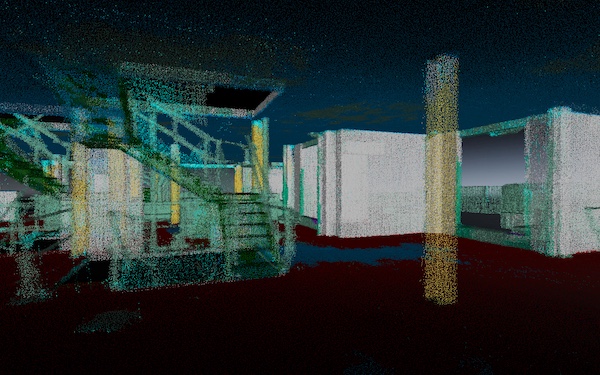
The term reality capture refers to the means and methods of digitizing real-world products, buildings, structures, and terrains. It’s an integral part of reverse-engineering, which involves creating a faithful digital replica of an object for analysis or redesign. For this process, engineers usually employ 3D scanners to capture the topology and dimensions in point-cloud data, comprising clusters of pixels in 3D space.
In 2005, when Hexagon acquired Leica Geosystems, the Leica portfolio became part of Hexagon offerings. Formerly called 3DReshaper, Cyclone 3DR is part of the Cyclone-branded product suite from Hexagon. The lineup includes Leica Cyclone Register 360, to automatically register and process point-cloud data; Leica Cyclone Field 360, to automatically pre-register and align point-cloud data; Leica Cyclone Enterprise, to manage reality-capture data; and more.
Leica Cyclone 3DR is a software package to convert point-cloud data into editable 3D models. Its strength is the AI-powered classification tools that speed up the process. Hexagon wrote, “Cyclone 3DR uses smart automation to streamline common tasks … Cyclone 3DR includes a range of adaptable tools for inspection, modelling and meshing that can be leveraged to create an assortment of 3D deliverables and reports applicable across industries.”
“Scanners capture everything in front of you. For example, pedestrians along with buildings. So after getting the point-cloud data, you need to clean it up. The software includes manual tools for that, but more and more, it’s moving toward AI,” noted Stenger.

Hexagon Geosystems Division offers hardware and software that caters to various industries, including mining, oil & gas, general manufacturing, and energy and power plants. Depending on the industrial use case, engineers may target different objects for detection and classification. “For instance, if the point-cloud data comes from a plant, you may want to detect pipes and piping structures. In another case, you may want to detect vegetations,” explained Stenger.
One critical task AI now performs inside Leica Cyclone 3DR is automatic classification of point-cloud data, by assigning labels that identify where they belong and how they should be treated (for example, buildings, trees, and terrain data).
“To do this, the hardware needs to have enough power to run the pre-trained AI program embedded in 3DR Cyclone,” explained Stenger. “As a joint initiative with NVIDIA and Dell, we decided to test it using a Dell Pro Rugged 14, equipped with an NVIDIA RTX 500 GPU.
The AI classification engine requires processing power from an NVIDIA GPU; it cannot run solely on the CPU. Most professional workstations can meet the hardware requirements, but can a rugged PC satisfy the software’s requirements?
Stenger confirmed, “The AI classification on the rugged device was as good as my professional laptop, designed to process reality capture data. So surveyors and engineers may capture the data in the field, then perform classification with Cyclone 3DR on the Dell Pro Rugged 14 laptop, even offline.”
The NVIDIA RTX 500 GPU benefits from both a neural processing unit (NPU) and NVIDIA’s Tensor Cores for AI processing. Leica Cyclone 3DR’s classification algorithm is GPU-accelerated, making a GPU-equipped machine ideal for this particular task.
The Dell Pro Rugged 14 meets the MIL-STD-810H (military standard by the Department of Defense) environmental testing. David Plourde, Dell’s Strategist for Special Products, noted, “The system we tested in this project was with the highest end i7 Intel processor and the NVIDIA Ada Generation 500 GPU. You would be able to use this machine in extremely high or low temperatures (-20F (-29C) to 145F (63C). It comes with water and dust resistance (IP53 rated), a bright daylight-readable screen (1100 Nit with touchscreen), dual hot-swappable batteries to stay powered on where you may not have a source to recharge, integrated (optional) 5G modem and (optional) dedicated GPS module for communication and location, and legacy I/O connections like native serial ports to connect to equipment requiring that type of connection.”
You can learn more about the Dell Pro Rugged 14 laptop here.
:


Brian Albright is the editorial director of Digital Engineering.
Contact him at [email protected].






About Us · Contact Us · Editorial Team · Advertising · Privacy Policy · Subscriber Services · © 2026 Digital Engineering 24/7 · Peerless Media