Helping design and engineering professionals discover, evaluate and specify technologies and processes that shorten the design cycle and enable success.



Digital Engineering April 2026
In the latest issue of Digital Engineering, we take a look at the latest innovations in design for additive manufacturing, including the use of natural language inputs, social media cosplayers, and AI integration. The issue also includes a feature…

January Special Focus Issue: Design for Additive
In this Special Focus Issue of Digital Engineering, learn about the latest advancements in design for additive manufacturing, including new software tools, additive in automotive, custom medical devices, and more.
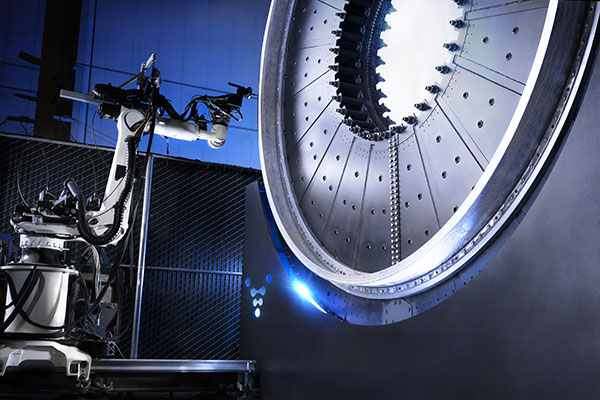
Relativity Space, builder of 3D printed rockets and large metal 3D printers, has unveiled the latest iteration of its manufacturing platform, Stargate 4th Generation metal 3D printers. These printers will underpin the development and rate production of Terran R, Relativity’s fully reusable, 3D printed rocket that will be capable of launching 20,000 kg to low Earth orbit (LEO).
The newest Stargate printer technology moves horizontally as it feeds multiple wires into a single print head to print orbital rockets. Relativity is developing customized software and machine learning techniques to allow these printers to print complex and larger metal products.
Most immediately, Stargate 4th Generation printers will serve as the primary manufacturing infrastructure for Terran R production.
Lighter, more cost-effective aerospace product production through rapid iteration is generated by leveraging Stargate printers and material science advancements developed in Relativity’s in-house metallurgical laboratory, according to the company. Most immediately, Terran R will be the first product in a series of products to benefit from use of lighter materials and a faster production time.
“Large-scale products that are designed to fly will inevitably be 3D printed,” says Tim Ellis, cofounder and CEO of Relativity Space. “The lighter a product is, the better it performs, and when 3D printing that product, it’s also faster and more cost-effective to produce with each successive improvement.
"We see 3D printing as an automation technology that has the power to change the pace of innovation in manufacturing, which is why we’ve invested in building our own proprietary tech stack from day one," says Ellis. "Stargate printers are designed to unlock rapid iteration, which opens up opportunities for innovation in large-scale manufacturing products.”
“Iteration empowers innovation not only in our rocket design, but also in our own Stargate printers,” says Scott Van Vliet, SVP of Software Engineering. “We’re fundamentally changing the way our factories are designed and operating, and by flipping the script and going horizontal, we’re radically increasing our capacity for scale. Being a software-driven manufacturing company allows us to achieve unique product features, such as integrated pad-ups and domes, with radical flexibility.”
The majority of Terran R components will be printed inside Relativity’s new 1MM+-sq.-ft. headquarters in Long Beach, named The Wormhole.
The Wormhole, a former Boeing C-17 manufacturing plant, was secured by Relativity to be its new headquarters in 2021. Currently 33% operational, the factory has several Stargate 4th Generation printers online with more than a dozen printers planned to be producing Terran R components in the coming months.
At full capacity forecasted run rate, each Stargate 4thGeneration printer is capable of producing 4 Terran R rockets per year.
Relativity invented a new approach to design, print, and fly its own rockets, starting a 3D printed rocket, Terran 1, and Terran R, a larger, fully reusable, 3D printed launch vehicle.
As a vertically integrated technology platform, Relativity is entrenched in a shift toward software-defined manufacturing. By fusing 3D printing, artificial intelligence and autonomous robotics, Relativity offers a simplified supply chain, building a rocket with much less parts in less than 60 days.
Sources: Press materials received from the company and additional information gleaned from the company’s website.


DE's editors contribute news and new product announcements to Digital Engineering. Press releases may be sent to them via [email protected].
Follow DE
Join over 90,000 engineering professionals who get fresh engineering news as soon as it is published.






About Us · Contact Us · Editorial Team · Advertising · Privacy Policy · Subscriber Services · © 2026 Digital Engineering 24/7 · Peerless Media