Helping design and engineering professionals discover, evaluate and specify technologies and processes that shorten the design cycle and enable success.


Alert!
Digital Engineering ceased publication on July 1, 2026. This website remains available as an archive of engineering content.
For inquiries or information, please email [email protected].

Design & Simulation Software Guide 2025
In this Special Issue, Digital Engineering presents its second annual guide to design and simulation software vendors.

Design & Simulation Software Guide
In this Special Issue, Digital Engineering presents its inaugural guide to design and simulation software vendors, including listings for CAD, CAM, simulation, generative design, PLM, rendering and visualization, design for additive manufacturing,…
A team of researchers at Penn State University (PSU), in conjunction with researchers from industry and other universities, is teaming up to go a step further by developing an advanced framework that will allow engineers to share engineering data as well as leverage design and manufacturing-related knowledge throughout the entire product lifecycle. The 18-month effort, which just received $1.2 million in funding from the Digital Manufacturing and Design Innovation Institute (DMDII), is being pursued by PSU in addition to Rolls Royce, Georgia Tech, Boeing, John Deere and Sentient Science.
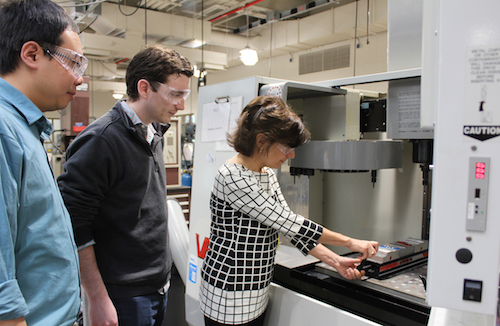 PSU is developing an advanced framework for automating sharing of engineering and manufacturing-related knowledge throughout the product lifecycle. Image Courtesy of Penn State University
Existing tools and methods that support product design have a limited capacity to support automated knowledge sharing and for representing engineering knowledge, says Dazhong Wu, Ph.D, with the Harold and Inge Marcus Department of Industrial and Manufacturing Engineering at Penn State. Because they fall short of representing and automating knowledge sharing, manufacturers are not able to adequately reuse domain knowledge and thus achieve higher operating efficiencies, he explained.
“The objective of the project is to develop an advanced system framework that enables various models at different levels of production to be integrated within an OEM’s product lifecycle feedback loop,” Wu says.
To facilitate this process, the Penn State team, including graduate student Connor Jennings, is working on design and manufacturing ontologies intended to formally define the structure of data and how components can relate to one another. The—goal is to allow experts to more easily share domain expertise on both product designs and manufacturing processes. There is also a decision support tool being developed as a result of this partnership, and the combination should help manufacturers and their supply chains foster more informed and timely decision making through each stage of the product lifecycle, the researchers said.
For example, using the new framework, manufacturers should be able to better predict engineering failures of products along with reducing costs and machine down time by sharing cross-functional knowledge across the different domains. “If we are successful, we will be able to offer manufacturers a general framework that spans from the highest levels to the levels of the product lifecycle,” explains Janis Terpenny, Penn State’s Peter & Angela Dal Pezzo chair and department head of the Harold & Inge Marcus Department of Industrial & Manufacturing Engineering.
The DMDII, launched in 2014, is a collaboration between the U.S. Department of Defense and other partners with the goal of transforming American manufacturing by focusing on the supply chain.


Beth Stackpole is a contributing editor to Digital Engineering. Send e-mail about this article to [email protected].
Follow DE






About Us · Contact Us · Editorial Team · Advertising · Privacy Policy · Subscriber Services · © 2026 Digital Engineering 24/7 · Peerless Media