Helping design and engineering professionals discover, evaluate and specify technologies and processes that shorten the design cycle and enable success.


Alert!
Digital Engineering ceased publication on July 1, 2026. This website remains available as an archive of engineering content.
For inquiries or information, please email [email protected].

Digital Engineering April 2026
In the latest issue of Digital Engineering, we take a look at the latest innovations in design for additive manufacturing, including the use of natural language inputs, social media cosplayers, and AI integration. The issue also includes a feature…

January Special Focus Issue: Design for Additive
In this Special Focus Issue of Digital Engineering, learn about the latest advancements in design for additive manufacturing, including new software tools, additive in automotive, custom medical devices, and more.
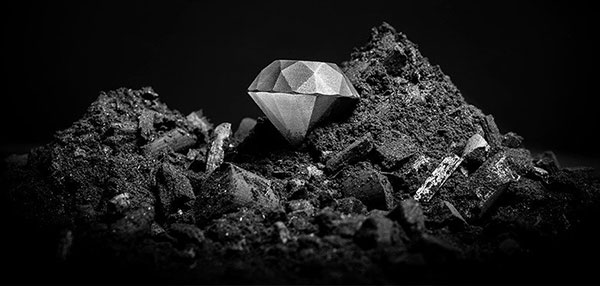
Sandvik Additive Manufacturing says it has created the first ever 3D-printed diamond composite for a range of industrial uses.
The hardness of diamond makes it a key component in a range of wear-resistant tools in industry, from mining and drilling to machining, and it's also used for medical implants. Since 1953, it has been possible to produce synthetic diamond, but because it’s so hard and complicated to machine, it is almost impossible to form into complex shapes.
By using additive manufacturing, Sandvik has managed to 3D-print diamond composites that can be formed in almost any shape. This opens the possibility of using it in applications that were previously considered impossible.
“We now have the ability to create strong diamond composites in very complex shapes through additive manufacturing, which fundamentally will change the way industries will be able to use this material. As of now, the only limit to how this super-hard material can be shaped and used is down to the designer’s imagination,” says Mikael Schuisky, head of R&D and Operations at Sandvik Additive Manufacturing.
The difference between Sandvik’s diamond and natural or synthetic diamond is that Sandvik’s is a composite material. Most of the material is diamond, but to make it printable and dense it needs to be cemented in a matrix material.
“Sandvik’s 3D printed diamond composite is a true innovation. It means that we can begin to use diamond in applications and shapes never conceived possible before,” said Susanne Norgren, adjunct professor in Applied Materials Science at Uppsala University. “Just imagine what it could do to industries, when it is possible to print anything, in any shape—in diamond.”
Sandvik says the diamond composite has been tested and found to have extremely high hardness, exceptional heat conductivity, low density, very good thermal expansion and corrosion resistance.
Sources: Press materials received from the company and additional information gleaned from the company’s website.


DE's editors contribute news and new product announcements to Digital Engineering. Press releases may be sent to them via [email protected].
Follow DE






About Us · Contact Us · Editorial Team · Advertising · Privacy Policy · Subscriber Services · © 2026 Digital Engineering 24/7 · Peerless Media