Helping design and engineering professionals discover, evaluate and specify technologies and processes that shorten the design cycle and enable success.


Alert!
Digital Engineering ceased publication on July 1, 2026. This website remains available as an archive of engineering content.
For inquiries or information, please email [email protected].

Cut Retrieval-Augmented Generation (RAG) Hallucinations by 50%
Most teams hit the same wall with enterprise AI: LLMs that hallucinate, pipelines that don’t scale, and infrastructure that’s harder to design than the models themselves.

What Is Intelligent BOM Management? A Guide to Smarter Product Development
Learn how intelligent Bill of Materials (BOM) management helps teams collaborate, reduce errors, and bring innovative products to market faster with cloud-based PLM tools.

In November 2009, when he brought the New Orleans Saints their first 10-0 start in 42 years, the team's quarterback Drew Brees suddenly got a new nickname, "Breesus." But this Godsend to the Big Easy isn't immune to bodily harms. He's had nearly half dozen surgeries during his career. So what would Breesus do to protect himself in the field?
He might wear a helmet perfected with Intel-powered technology.
A Saint Amidst the SC2010 Crowd
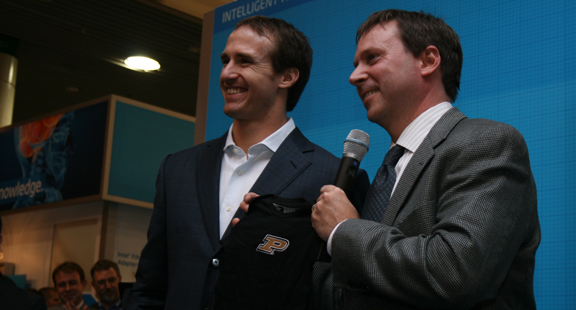
The most sophisticated technological gadgets you'll probably find at his house, revealed Brees, are the nanny cams he'd installed to keep an eye on his four-week-old son. So why was he at Supercomputing 2010 (SC2010), sitting next to Intel's data center group VP Kirk Skaugen?
Brees was there to preach the importance of using safe equipment to prevent injuries, the same mission that has brought Intel together with Riddell, a helmet and protective gear maker, and researchers from the Thayer School of Engineering (Dartmouth), Wayne State University, University of Northern Colorado, and Texas State University-San Marcos.
According to a 2000 study of 1,090 former N.F.L. players, "more than 60 % had suffered at least one concussion in their careers and 26 % had had three or more" ("Concussions and Head Injuries in Football," Nov. 16, 2010, The New York Times).
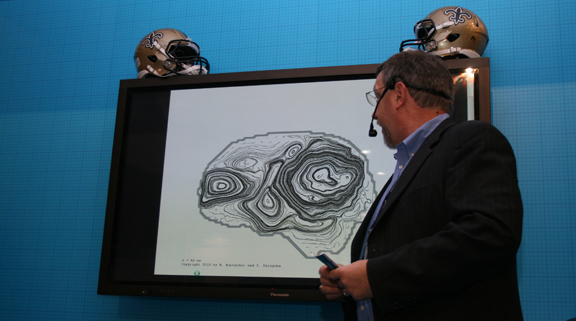
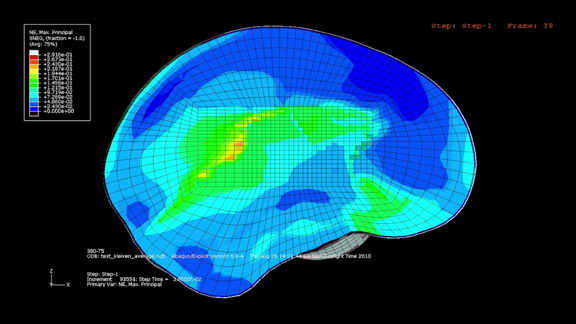
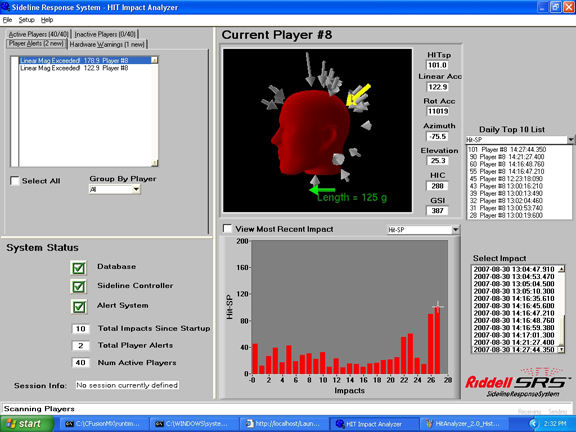
Riddell has been using its proprietary HITS (Head Impact Telemetry System) in-helmet sensors to collect and display head impacts in real time. The computer-generated models show the stresses on the brain, making it possible to compare concussion-causing impacts and those that are less harmful. Researchers hope to use the study to design new football helmets that reduce the risk of short- and long-term injuries.
"Computer simulations have been instrumental in designing improved brain injury criteria,” said Dr. Igor Szczyrba, University of Northern Colorado. “In the near future, they can also help doctors diagnose actual brain injuries.”
At SC2010, Intel demonstrated impact-simulation using Intel Xeon-based workstations and clusters. The company's hardware let gear makers and researchers rapidly compute, visualize, and assess the risk of injury in an impact event.
"The advances in equipment have been good," Brees said. "But the awareness level of what hits actually do to you in the short- and long term take safety to the next level."
Bragging Rights for Intel
More than 7,000 miles from where SC2010 is taking place, a new supercomputer has just unseated the Cray Jaguar of Oak Ridge National Lab to become the world's fastest. Poised to deliver 2.57 petaflops (quadrillions of calculations per second), the Tianhe-1A sits inside the National Supercomputing Center in Tianjin, China.
The new high-performance computing champion is running on 14,396 Intel Xeon 5600 processors. As the 36th edition of the TOP500 supercomputers is released, Intel takes pride to announce, "Nearly 80 % of the world’s top 500 systems have Intel processors inside."
Intel is currently developing what it calls many-integrated core (MIC) architecture, which could become a fierce rival to GPU maker NVIDIA's lines of coprocessors. Though GPUs were originally developed as coprocessors for graphic applications, in the last several years NVIDIA began promoting the use their parallel-processing power for general purpose computing.


Kenneth Wong is Digital Engineering's resident blogger and senior editor. Email him at [email protected] or share your thoughts or suggestions at digitaleng.news/facebook.
Follow DE






About Us · Contact Us · Editorial Team · Advertising · Privacy Policy · Subscriber Services · © 2026 Digital Engineering 24/7 · Peerless Media