Helping design and engineering professionals discover, evaluate and specify technologies and processes that shorten the design cycle and enable success.


Alert!
Digital Engineering ceased publication on July 1, 2026. This website remains available as an archive of engineering content.
For inquiries or information, please email [email protected].

May 2026 Special Focus: Artificial Intelligence in Design and Simulation
In this Special Focus Issue, learn about the latest developments in the integration of artificial intelligence into engineering workflows.

April 2026 Special Focus Issue: Generative Design
In this Special Focus Issue, Digital Engineering takes a look at how generative design solutions can be used across different types of design problems and with a variety of manufacturing approaches to accelerate design space exploration, and…
It's a scenario all too familiar to emergency room physician Dr. Graham Snyder, who decided to take action with his new company, Thermocline Ventures, and its soon-to-be-announced product, the SEAL Swim Monitoring system. The crux of the SEAL Swim Band system is pretty simple: Because most kid-related drowning incidents involve a child who is out of sight and very still (not thrashing around as conventional wisdom would have it), the system aims to draw attention to the child when there is prolonged submersion that is out of the ordinary.
"People think kids drown under water because no one can find them, but the reason that they drown is because they are under water and no one knew to search for them," Dr. Snyder explains. "This technology eliminates that."
The system comprises a number of components—the SEAL monitor, which fits around a child's neck like a necklace, a similar band for the guardian or lifeguard, and a wireless hub that serves as a communications network, connecting the bands on the kids swimming in the pool with the bands worn by supervising adults. Custom tuned to an individual's swimming abilities and tolerance for submersion, the SEAL monitor employs onboard sensors to determine if a child has been submerged for too long, and if so, it delivers an alert by activating LED strobe lights on the child's necklace as well as issuing a siren call from the hub.
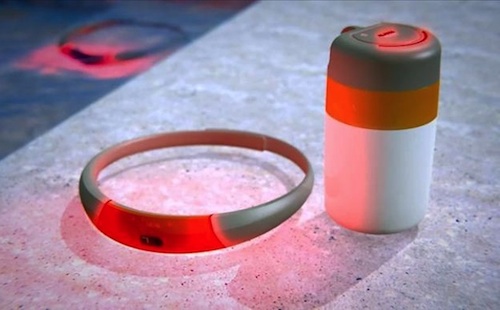
Based on Snyder's premise, the SEAL design team had to tackle a number of challenges unique to this type of device. For one thing, the SEAL system, particularly the Swim Band component, had to have an aesthetic appeal so kids would be enticed to wear it. There were also materials challenges to find a mix of rubber and plastic materials that could function properly in an aquatic environment, but at the same time, was cosmetically pleasing and easy to wear. "When you are creating any wearable device, if it's not comfortable, doesn't look right, or it impacts mobility, people won't have interest in it," notes Charlie Hunt, the company's head of design. "With this device, in particular, you have to wear it to have the security."
Marrying the functional requirements for the board that holds the sensors and other electronics with the curved surfaces and shapes necessary for a desirable design demanded a 3D modeling tool with a high degree of flexibility—in this case, Autodesk's Alias industrial design software, Hunt says. "Creating electronics that fit to the curve was key, and our hardware team was successful in creating a board that gave us the flexibility to maintain the design curvature," he explains. "Using Alias, we were able to create a tight package that distributed components around and minimized size as much as possible."

The realism of the Alias 3D renderings also helped the team get buy in and make design decisions quickly—a critical capability considering the company is aiming to get the SEAL Swim System into production and to the market for next year's swim season. "We found working in 3D gave more insight into what we were really dealing with in terms of challenges as well as insight into all the human factors," Hunt explains.
Currently, the SEAL Swim System is in the prototype phase, but it is being offered up for pre-order on Indiegogo, a crowdfunding site. Pricing will be around $400 to $600 for a backyard pool system; a commercial system with around 100 bands would sell for around $13,000.
Below is a video on how the SEAL Swim system works.


Beth Stackpole is a contributing editor to Digital Engineering. Send e-mail about this article to [email protected].
Follow DE






About Us · Contact Us · Editorial Team · Advertising · Privacy Policy · Subscriber Services · © 2026 Digital Engineering 24/7 · Peerless Media