Helping design and engineering professionals discover, evaluate and specify technologies and processes that shorten the design cycle and enable success.


Alert!
Digital Engineering ceased publication on July 1, 2026. This website remains available as an archive of engineering content.
For inquiries or information, please email [email protected].

Design & Simulation Software Guide 2025
In this Special Issue, Digital Engineering presents its second annual guide to design and simulation software vendors.

Design & Simulation Software Guide
In this Special Issue, Digital Engineering presents its inaugural guide to design and simulation software vendors, including listings for CAD, CAM, simulation, generative design, PLM, rendering and visualization, design for additive manufacturing,…
Siemens is accelerating development of defect detection models with 3D synthetic data generation from NVIDIA Omniverse, one of the results from the extended partnership for the industrial metaverse that aims to advance digital twins.
The Siemens Xcelerator and NVIDIA Omniverse platforms are enabling full-design-fidelity, live digital twins that connect software-defined AI systems from edge to cloud.
Siemens has begun tapping into NVIDIA Omniverse Replicator running on Amazon G5 instances for synthetic data generation, accelerating its AI model development times from taking “months” to “days,” according to the company.
Synthetic data is turbocharging model development. At Siemens, synthetic data generation is being used beyond defect detection to assist in areas including, but not limited to, robotic bin picking, safety monitoring, welding and wiring inspections, and checking kits of parts.
“The better the synthetic data you have, the less real data you need—obtaining real data is a hassle, so you want to reduce that as much as possible without sacrificing accuracy,” says Alex Greenberg, director of advanced robotics simulation at Siemens Digital Industries Software.
The Siemens Motion Control Business Unit produces inverters, drive controllers and motors for more than 30,000 customers worldwide. The lead electronics plant, GWE, based in Erlangen, Germany, has been working on AI-enabled computer vision for defect detection using custom methods and different modes of synthetic data generation.
GWE worked with the Siemens’ Digital Industries Software division to find a better way to produce datasets.
“For many industrial use cases, products are changing rapidly. Materials are changing rapidly. It needs to be automated in a fast way and without a lot of know-how from the endpoint engineer,” says Zac Mann, advanced robotics simulation lead at Siemens Digital Industries Software.
The challenge at GWE is to catch defects early in the ramp-up of new products and production lines.
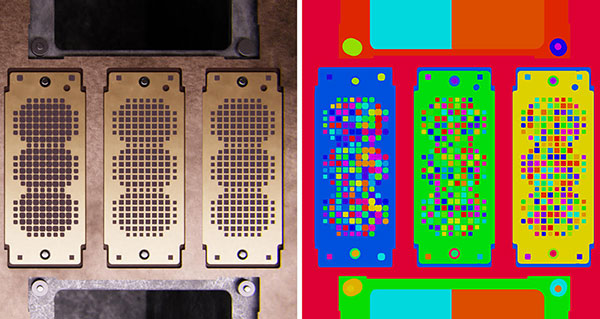
One area of focus for defects in a printed circuit board (PCB) is examining the thermal paste that’s applied to some components on the PCB to help transfer heat quickly to the attached heatsink, away from the components.
To catch PCB defects, the Siemens Digital Industries Software team relied on synthetic data driven by Omniverse Replicator.
With Omniverse, a platform for building custom 3D pipelines and simulating virtual worlds, Siemens can generate scenarios and more realistic images easily, aided with RTX technology-enabled physics-based rendering and materials.
This enables Siemens to move more quickly and smoothly at developing to close the gap from simulation to reality, says Mann.
“Using Omniverse Replicator and Siemens SynthAI technology, we can procedurally generate sets of photorealistic images using the digital models of our products and production resources and an integrated training pipeline to train ready-to-use models. This speeds up our set-up time for AI inspection models by a factor of five and increases their robustness massively,” says Maximilian Metzner, global lead for autonomous manufacturing systems for electronics at GWE.
GWE engineers can now take a 3D CAD model of the PCB and import that into Siemens’ SynthAI tool. SynthAI is designed to build data sets for training AI models.
Tapping into Replicator, SynthAI can access its randomization features to vary the sizes and locations of defects, change lighting, color and texture to develop a dataset.
Once data is generated with Replicator, it can be run through a defect detection model for initial training. This enables GWE engineers to quickly test and iterate on models.
Click here to get started using NVIDIA Omniverse Replicator.
Sources: Press materials received from the company and additional information gleaned from the company’s website.


Since its founding in 1993, NVIDIA (NASDAQ: NVDA) has been a pioneer in accelerated computing. The company’s invention of the GPU in 1999 sparked the growth of the PC gaming market, redefined computer graphics, ignited the era of modern AI and…

Cut Retrieval-Augmented Generation (RAG) Hallucinations by 50%
Most teams hit the same wall with enterprise AI: LLMs that hallucinate, pipelines that don’t scale, and infrastructure that’s harder to design than the models themselves.

DE's editors contribute news and new product announcements to Digital Engineering. Press releases may be sent to them via [email protected].
Follow DE






About Us · Contact Us · Editorial Team · Advertising · Privacy Policy · Subscriber Services · © 2026 Digital Engineering 24/7 · Peerless Media