Helping design and engineering professionals discover, evaluate and specify technologies and processes that shorten the design cycle and enable success.


Alert!
Digital Engineering ceased publication on July 1, 2026. This website remains available as an archive of engineering content.
For inquiries or information, please email [email protected].

May 2026 Special Focus: Artificial Intelligence in Design and Simulation
In this Special Focus Issue, learn about the latest developments in the integration of artificial intelligence into engineering workflows.

Design & Simulation Software Guide 2025
In this Special Issue, Digital Engineering presents its second annual guide to design and simulation software vendors.
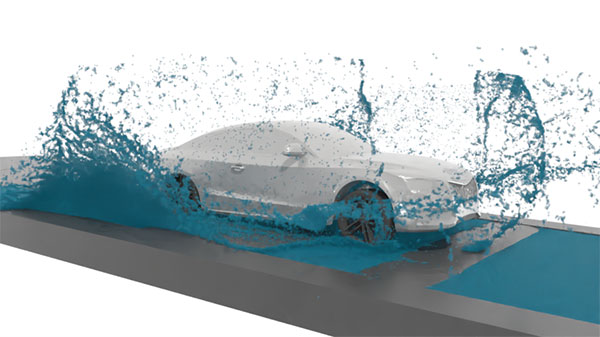
With the new release of Siemens Simcenter SPH Flow 2202, designers and computational fluid dynamics analysts across industries can leverage new capabilities and enhancements to model complex dynamic fluid body interactions while going faster. The new release delivers an enhanced user experience to boost productivity while reducing the time to market, the company says.
New enhancements in Simcenter SPH Flow are aimed at helping users model the complexity and go faster.
The addition of a spring model within Simcenter SPH Flow 2202 helps model dynamic fluid body interaction.
For vehicle wading, the vehicle motion on a complex road can now be modeled by setting the rotation speed of the wheels, their contact on the road, and the suspension of the vehicle. This new feature increases accuracy and user control on the vehicle motion, the company reports. It also improves ease of use for the entire workflow of dynamic movements. In addition, the spring model allows simulation of applications that involve mechanical springs such as valves.
In Simcenter SPH Flow 2202, with the new surface tension model in the implicit solver, you can now set up surface contact angles to define either hydrophilic (high contact angle) or hydrophobic (low contact angle) surfaces.
Compared to the existing surface tension model in the explicit solver, the extension in the implicit solver reduces the simulation time up to a factor of 35 (without free surface generation) with equivalent accuracy, Siemens reports.
Sources: Press materials received from the company and additional information gleaned from the company’s website.


Simcenter™ software, from Siemens Digital Industries Software, uniquely combines system simulation, 3D CAE and test to help you predict performance across all critical attributes earlier and throughout the entire product lifecycle. By combining…
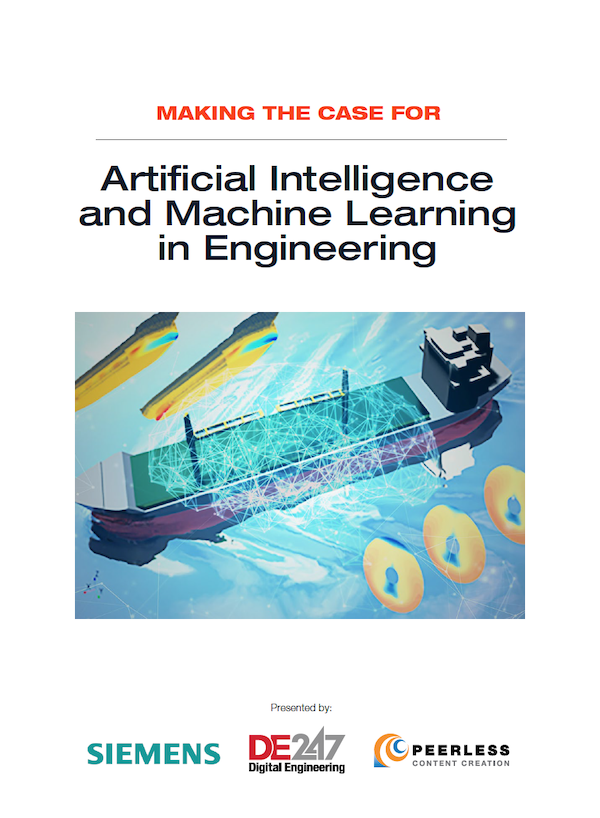
Making the Case for Artificial Intelligence and Machine Learning in Engineering
In this paper, Siemens Digital Industries Software and Digital Engineering will provide an overview of how AI/ML-enabled software can improve design workflows, while also addressing common questions and concerns around implementing this technology in an engineering organization.

DE's editors contribute news and new product announcements to Digital Engineering. Press releases may be sent to them via [email protected].
Follow DE
Join over 90,000 engineering professionals who get fresh engineering news as soon as it is published.






About Us · Contact Us · Editorial Team · Advertising · Privacy Policy · Subscriber Services · © 2026 Digital Engineering 24/7 · Peerless Media