Helping design and engineering professionals discover, evaluate and specify technologies and processes that shorten the design cycle and enable success.


Alert!
Digital Engineering ceased publication on July 1, 2026. This website remains available as an archive of engineering content.
For inquiries or information, please email [email protected].

May 2026 Special Focus: Artificial Intelligence in Design and Simulation
In this Special Focus Issue, learn about the latest developments in the integration of artificial intelligence into engineering workflows.

Design & Simulation Software Guide 2025
In this Special Issue, Digital Engineering presents its second annual guide to design and simulation software vendors.
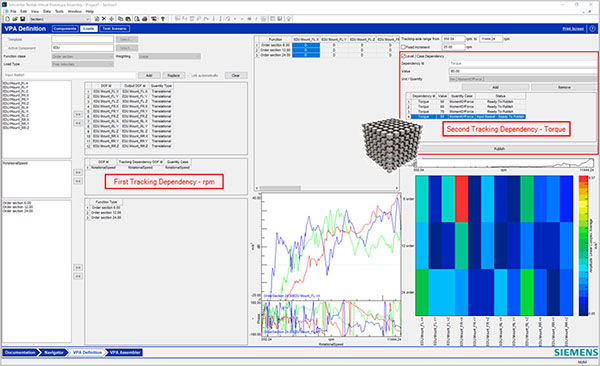
The latest release of Simcenter Testlab from Siemens has the Virtual Prototype Assembly, or simply VPA, as part of the release. With VPA, test and simulation engineers can explore the performance of several assemblies without the need for a physical prototype. This allows for design updates in the early phases of the development cycle.
In the new release of Simcenter Testlab 2206, the capabilities of VPA are expanded, allowing the users to create more detailed Virtual Prototypes, or digital twins.
Take vehicle Road Noise as an example; engineers responsible for this attribute want to investigate not only at the level of the loads exchanged at the interface of tire–knuckle, but at any level of the suspension. To make this possible, in this release a new component type is included, the Passive Component.
The Passive Component is a representation of intermediate structures between sources and receiver. An easy example of such a component is a vehicle sub-frame, rear axle carrier or compressor pump, or transmission brackets. With this component type, it is possible to perform Multi-level Substructuring, which is fundamental for the assessment of complex systems.
With VPA, not only the complexity of assemblies was increased, but the loads and test scenarios are also supporting multiple tracking dependencies. This means that the forces and moments can depend on multiple variables, such as rpm, torque, preload, etc. Taking as an example an Electric Drive Unit (EDU), the blocked forces can be modeled as orders in the function of the EDU rpm, as well as the discrete torque levels. The data set is stored in a single Load component and is accessible in the virtual assembly based on the used test scenarios.
This additional feature in VPA is suited to evaluate nontrivial driving scenarios, typically resulting from the control logic, for example in Hybrid-Electric vehicles.
Sources: Press materials received from the company and additional information gleaned from the company’s website.


Simcenter™ software, from Siemens Digital Industries Software, uniquely combines system simulation, 3D CAE and test to help you predict performance across all critical attributes earlier and throughout the entire product lifecycle. By combining…
Making the Case for Artificial Intelligence and Machine Learning in Engineering
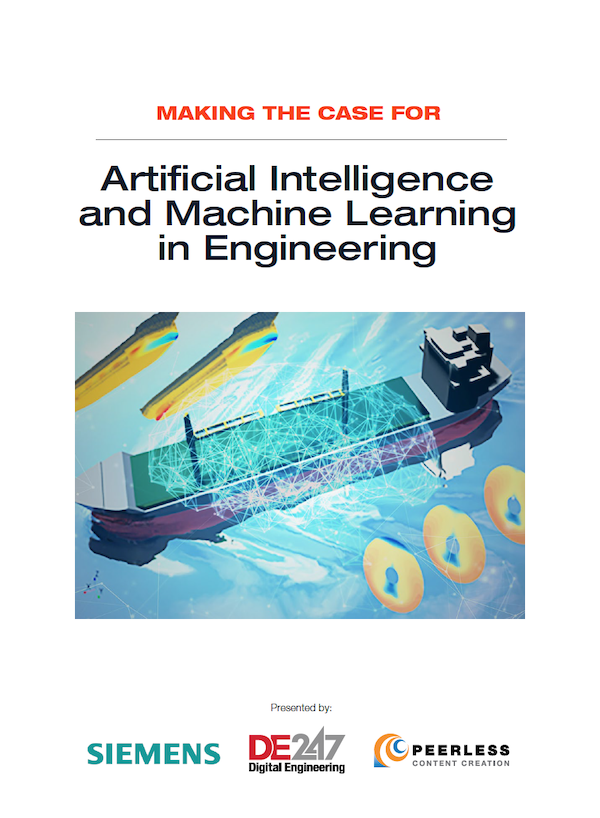
In this paper, Siemens Digital Industries Software and Digital Engineering will provide an overview of how AI/ML-enabled software can improve design workflows, while also addressing common questions and concerns around implementing this technology in an engineering organization.

DE's editors contribute news and new product announcements to Digital Engineering. Press releases may be sent to them via [email protected].
Follow DE
Join over 90,000 engineering professionals who get fresh engineering news as soon as it is published.






About Us · Contact Us · Editorial Team · Advertising · Privacy Policy · Subscriber Services · © 2026 Digital Engineering 24/7 · Peerless Media