Helping design and engineering professionals discover, evaluate and specify technologies and processes that shorten the design cycle and enable success.



Cut Retrieval-Augmented Generation (RAG) Hallucinations by 50%
Most teams hit the same wall with enterprise AI: LLMs that hallucinate, pipelines that don’t scale, and infrastructure that’s harder to design than the models themselves.

What Is Intelligent BOM Management? A Guide to Smarter Product Development
Learn how intelligent Bill of Materials (BOM) management helps teams collaborate, reduce errors, and bring innovative products to market faster with cloud-based PLM tools.
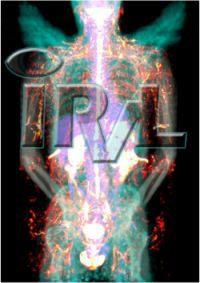 Fusion of separate whole body CT (gray), PET (cyan) and MR (orange) after registration. Such high-dimensional merging of information is key to improving the detection and understanding of diseases as complex as cancer. |
Interactive Supercomputing Inc. (Waltham, MA) announced that Star-P, which delivers interactive parallel computing power to the desktop and enables faster prototyping and problem solving across a range of biomedical — as well as financial, scientific, and engineering — applications, is being put to use by researchers at The University of Texas' M. D. Anderson Cancer Center. They are applying the new supercomputing technology to biomedical imaging in the quest to detect and eliminate cancer.
M. D. Anderson's Department of Imaging Physics is experimenting with advanced image registration, reconstruction, and segmentation techniques that combine different imaging modalities to create multidimensional image representations with the ultimate goal of improving diagnosis and treatment of disease.
As a stepping stone toward more advanced infrastructures such as large scale clusters and SMPs, M. D. Anderson's Department of Imaging Physics' staff will first address this computational hurdle by parallelizing their imaging software to run on a Sun Fire X4600, a powerful server with eight multi-core Opteron processors and 32 gigabytes of memory. The researchers' primary interest is the development of improved algorithms and techniques that lead to useful clinical discovery, which is why they have chosen to do their development in a very high level language (VHLL). The algorithms will be developed on desktop PCs using MATLAB, and then migrated and run transparently on the departmental server using Star-P. When the need for more speed comes up, the same code will then be directly translated to the institutional cluster that also runs MATLAB and Star-P.
For more information, visit Interactive Supercomputing Inc.
Sources: Press materials received from the company and additional information gleaned from the company’s website.


DE's editors contribute news and new product announcements to Digital Engineering. Press releases may be sent to them via [email protected].
Follow DE
Join over 90,000 engineering professionals who get fresh engineering news as soon as it is published.






About Us · Contact Us · Editorial Team · Advertising · Privacy Policy · Subscriber Services · © 2026 Digital Engineering 24/7 · Peerless Media