Helping design and engineering professionals discover, evaluate and specify technologies and processes that shorten the design cycle and enable success.


Alert!
Digital Engineering ceased publication on July 1, 2026. This website remains available as an archive of engineering content.
For inquiries or information, please email [email protected].

Digital Engineering April 2026
In the latest issue of Digital Engineering, we take a look at the latest innovations in design for additive manufacturing, including the use of natural language inputs, social media cosplayers, and AI integration. The issue also includes a feature…

January Special Focus Issue: Design for Additive
In this Special Focus Issue of Digital Engineering, learn about the latest advancements in design for additive manufacturing, including new software tools, additive in automotive, custom medical devices, and more.
What Stratasys CEO Scott Crump called "an exciting day for Stratasys and Objet" began around 7:30 AM Central Time this Monday, April 16. It was the day the two companies announced their handshakes to come together and form a 3D printing powerhouse, estimated to be valued at $1.4 billion.
"We are bringing together two of the most innovative and respected players in the field to create a global leader in a high-growth industry," noted Crump in the announcement to the press. Together, Stratasys and Objet would account for an installed base of 20,000 3D printing systems, supported by more than 260 distributors, resellers, and agents, Crump said in the webinar on the same day. "Together, we aim to remain at the forefront of innovation," he vowed.
The merger will take place as a 100% stock-for-stock transaction. Upon completion of the merger, Stratasys shareholders will own 55% of the new firm, and Objet shareholders 45%. The new company will operate under the name Stratasys Ltd. It will operate with dual headquarters in the U.S. and Israel.
In March, Objet filed documents with U.S. regulators to raise $75 million through an IPO, but the merger now takes precedence over its previously planned IPO.
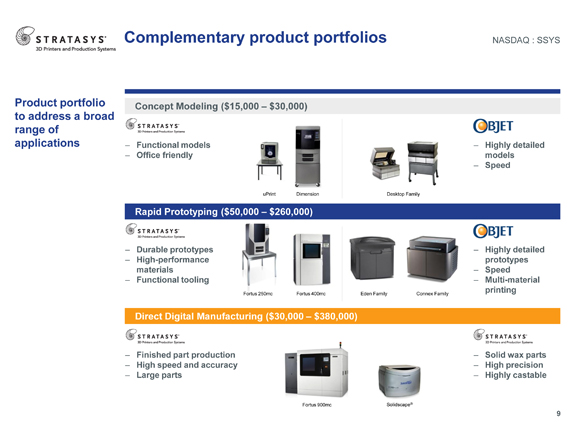
Stratasys' product line includes high-end 3D production systems (Fortus line), midrange 3D printers (Dimension line), and affordable 3D printers (uPrint line). In addition, Stratasys also operates the RedEye division, which offers on-demand rapid prototyping services.
Objet offers no equivalent to Stratasys' RedEye services. Its product lines include the Connex, Eden, and desktop 3D printer families. Its most affordable products, the desktop printers, are priced beginning at $19,900. By contrast, Stratasys' uPrint series, the lowest priced of the company's offerings, begin at $15,900. It's unclear if the new company plans to offer both product lines, which used to compete with each other.
In the webinar announcing the pending merger, both Stratasys and Objet managements expressed their desire to pursue cost-avoidance and cross-selling opportunities, but no specific details were revealed.
The merger of Stratasys and Objet is preceded by a similar one between 3D Systems and Z Corp., completed in January 2012. In a market dominated by relatively few players, the Stratasys-Objet merger and the 3D Systems-Z Corp merger set the stage for the emergence and confrontation of two powerhouse 3D prototyping systems makers.
As 3D printer manufacturers like Stratasys and 3D Systems explore additional revenue opportunities beyond the professional market, they've also begun courting the consumer market, specifically the maker market.


Kenneth Wong is Digital Engineering's resident blogger and senior editor. Email him at [email protected] or share your thoughts or suggestions at digitaleng.news/facebook.
Follow DE






About Us · Contact Us · Editorial Team · Advertising · Privacy Policy · Subscriber Services · © 2026 Digital Engineering 24/7 · Peerless Media