Helping design and engineering professionals discover, evaluate and specify technologies and processes that shorten the design cycle and enable success.


Alert!
Digital Engineering ceased publication on July 1, 2026. This website remains available as an archive of engineering content.
For inquiries or information, please email [email protected].

Digital Engineering April 2026
In the latest issue of Digital Engineering, we take a look at the latest innovations in design for additive manufacturing, including the use of natural language inputs, social media cosplayers, and AI integration. The issue also includes a feature…

January Special Focus Issue: Design for Additive
In this Special Focus Issue of Digital Engineering, learn about the latest advancements in design for additive manufacturing, including new software tools, additive in automotive, custom medical devices, and more.
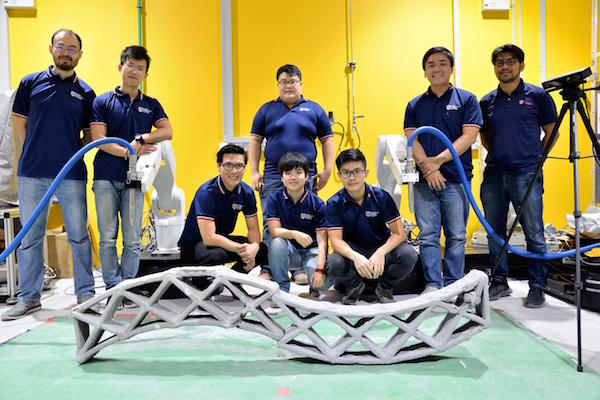
Researchers at Nanyang Technological University (NTU Singapore) are using a “swarm printing” approach for creating concrete structures that use two robotic 3D printers working in unison.
Potentially, the technology could be expanded to create teams of mobile robots that print larger concrete forms and structures. According to the researchers, the approach allows companies to print structures on demand, and to do so much faster.
The research, from Assistant Professor Pham Quang Cuong and the NTU Singapore Centre for 3D Printing, was published in Automation in Construction earlier this year.
The robots printed a concrete structure that measured 1.86 x 0.46 x 0.13m in just eight minutes. The structure achieved full strength after one week of hardening. A computer maps out the design and assigns parts of the structure to each robot. The system also sets out a path for each robot to ensure the printing arms won’t collide during production. The computer also uses precision location positioning to ensure proper alignment and printing joints are overlapped.
"We envisioned a team of robots which can be transported to a work site, print large pieces of concrete structures and then move on to the next project once the parts have been printed," Pham said. "This research builds on the knowledge we have acquired from developing a robot to autonomously assemble an Ikea chair. But this latest project is more complex in terms of planning, execution, and on a much larger scale."
The researchers plan to expand the system to include more robots, which will allow them to print larger structures.
Professor Pham was in the news earlier in 2018 when two of his robots assembled an Ikea chair in less than 9 minutes.
You can see the concrete printing robots in action in the video at the top, and read more about concrete printing in our previous coverage.
Source: NTU Singapore


Brian Albright is the editorial director of Digital Engineering.
Contact him at [email protected].

Join over 90,000 engineering professionals who get fresh engineering news as soon as it is published.






About Us · Contact Us · Editorial Team · Advertising · Privacy Policy · Subscriber Services · © 2026 Digital Engineering 24/7 · Peerless Media