Helping design and engineering professionals discover, evaluate and specify technologies and processes that shorten the design cycle and enable success.



May 2026 Special Focus: Artificial Intelligence in Design and Simulation
In this Special Focus Issue, learn about the latest developments in the integration of artificial intelligence into engineering workflows.

April 2026 Special Focus Issue: Generative Design
In this Special Focus Issue, Digital Engineering takes a look at how generative design solutions can be used across different types of design problems and with a variety of manufacturing approaches to accelerate design space exploration, and…
As we reach the end of 2023, Digital Engineering has asked its readers once again to provide insight into their use of design and simulation technology.
Economic indicators heading into the new year have improved, with inflation subsiding, unemployment low and supply chain issues stabilizing. However, global instability and a volatile political environment in the United States may affect conditions. In general, demand seems to be strong for design and simulation software based on earnings reports from most of the major vendors. While demand for workstations has dropped back to prepandemic levels, companies like NVIDIA are reporting massive revenue gains. The additive manufacturing remains in flux, with a lot of merger/acquisition activity, but declining sales, for some vendors.
The big story this year, both in the press and in our survey results, is the emergence of artificial intelligence (AI) and machine learning (ML) in design and simulation workflows.
We received responses from more than 200 readers. The largest group of respondents described their primary role as product or system design engineering (32%), followed by engineering management (13%), research & development (12%) and corporate management (9%). Respondents were spread among market sectors, with the majority working in aerospace/aviation/defense, industrial machinery and products, electronic products and equipment, and automotive.
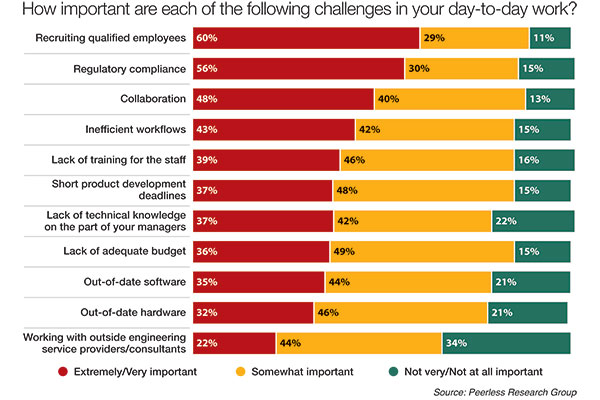
Recruitment emerged as the biggest challenge cited by our readers, and was considered an extremely or somewhat important challenge by 89% of respondents, up from 85% last year and supplanting collaboration (which dropped to second place at 88%). Inefficient workflows were the third most common challenge (85%). Regulatory compliance, short development deadlines and lack of budget tied for fourth place in the ranking.
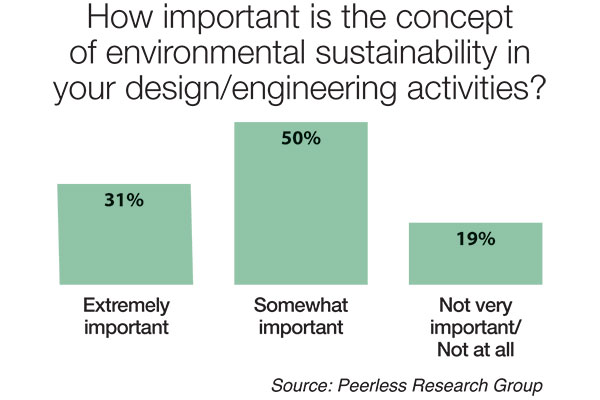
This is our third year asking readers about the importance of sustainability in design. In the current survey, 31% of respondents said that sustainability was extremely important in their design/engineering activities, compared to 35% in 2022 and 30% in 2021. Fifty percent consider it somewhat important (compared to 46% last year). Just 19% said sustainability was not important at all.
Below are a few representative reader comments from respondents that cited sustainability as very important.
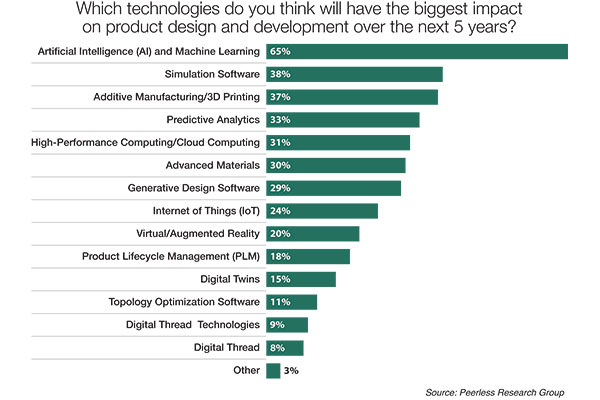
When we have previously asked which technologies readers thought would have the biggest impact on product development in the next 5 years, AI and additive manufacturing have traded the No. 1 and No. 2 spots for several years. This year, however, AI was the clear winner in this category, with 65% of respondents citing it as the technology to watch, compared to 42% last year. Simulation was a distant second at 38%, followed by additive (37%), predictive analytics (33%), and high-performance computing (31%).
AI, of course, has been big news across industries thanks to the emergence of ChatGPT and controversies around AI being used for everything from writing term papers and novels, to creating images and even generating impossible music mash-up videos and entire songs. In engineering, new tools have emerged to help engineers explore the design space using AI and perform rapid simulation and analysis.
Generative design, which had dropped to 19% on this list last year, rose back up to 29% in the current survey.
Reader comments indicated a wide variety of opinions on AI, from highly enthusiastic to cautious. A few examples:
As in previous surveys, we asked readers what technologies they were currently using or developing products for, as well as which technologies they expected to adopt in the next 2 years. Simulation software once again ranked as the top technology that most readers were currently using, with 50% reporting that they were doing so (down from 53% last year). Additive manufacturing/3D printing was second again at 43% (up from 42%).
Those were followed by product lifecycle management (PLM; 38%), IoT (28%), advanced materials (28%) and predictive analytics (24%).
In the next 2 years, 35% of respondents plan to incorporate AI/machine learning in their design/development processes, with 24% planning to use both HPC/cloud computing and predictive analytics. Generative design was the third-ranked category for future use (22%), followed by simulation (21%), advanced materials (20%) and augmented/virtual reality (20%).
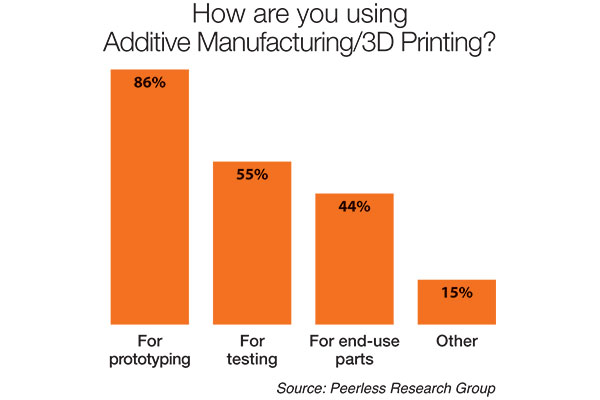
The number of additive manufacturing users that focus primarily on prototyping dropped slightly this year to 86% from 89%. Testing applications were down slightly from 56% in 2022 to 55% this year. End-use part printing rose from 42% of current users to 44%.
The cost justification for additive manufacturing shifted significantly in the current survey with 72% of respondents citing discovering new designs as a top objective, followed by shortening product development schedules (67%), improving quality (65%) and fostering innovation (61%) tied with productivity (also 61%). Reducing development costs, which was the second-ranked category last year, dropped all the way down to sixth place.
While interest in AI is expanding quickly, its algorithmic cousin in engineering, generative design, is still stalled among our readers. Only 14% reported that they are currently using generative design, down from 16% last year. In the future, 22% of respondents plan to deploy generative design, down from 24% last year.
Satisfaction with generative design among current users was high for helping engineers be more productive, with 69% of users again saying they were extremely/very satisfied with the technology’s performance. Fifty-four percent of users were also extremely satisfied with the technology’s ability to shorten product development schedules, reduce product manufacturing costs, reduce weight, foster innovation and discover new designs — results that were flat compared to last year.
Thoughts on generative design were mixed.
A few user comments:
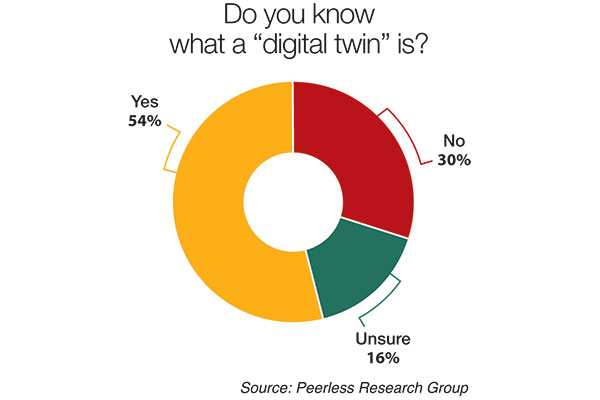
Digital twins appear to be treading water a bit, with 54% of respondents reporting that they know what a digital twin is (compared to 56% last year). More readers claim to be unfamiliar with digital twins (30%, compared to 21% last year). Reported use of digital twins grew slightly from 13% to 14%, with those planning to deploy the technology in 2 years dropping from 25% to 18%.
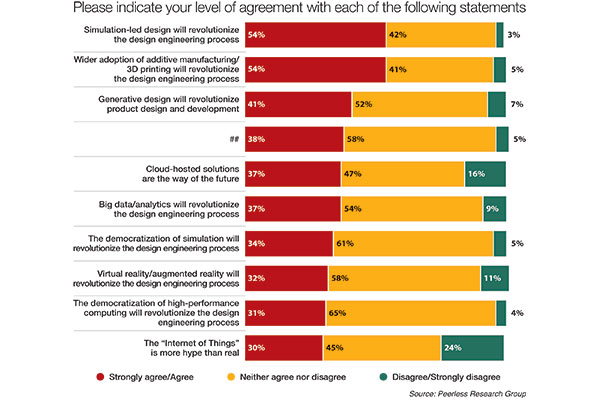
When asked what technologies would revolutionize the design engineering process, 54% strongly agreed that it would be additive manufacturing/3D printing (compared to 58% last year). Simulation-led design tied with additive at 54%. At third, generative design was cited by 38% of respondents.
Asked about familiarity with various technologies, simulation again led with 83% of respondents being very or somewhat familiar, followed by additive manufacturing (80%), product lifecycle management (PLM) (75%) and the Internet of Things (72%).
Readers were least familiar with digital thread technology (32% claimed to not be familiar with it at all). Topology optimization and digital twins also had very low reader familiarity.


Since its founding in 1993, NVIDIA (NASDAQ: NVDA) has been a pioneer in accelerated computing. The company’s invention of the GPU in 1999 sparked the growth of the PC gaming market, redefined computer graphics, ignited the era of modern AI and…

Cut Retrieval-Augmented Generation (RAG) Hallucinations by 50%
Most teams hit the same wall with enterprise AI: LLMs that hallucinate, pipelines that don’t scale, and infrastructure that’s harder to design than the models themselves.

Brian Albright is the editorial director of Digital Engineering.
Contact him at [email protected].

Join over 90,000 engineering professionals who get fresh engineering news as soon as it is published.






About Us · Contact Us · Editorial Team · Advertising · Privacy Policy · Subscriber Services · © 2026 Digital Engineering 24/7 · Peerless Media