Helping design and engineering professionals discover, evaluate and specify technologies and processes that shorten the design cycle and enable success.


Alert!
Digital Engineering ceased publication on July 1, 2026. This website remains available as an archive of engineering content.
For inquiries or information, please email [email protected].

May 2026 Special Focus: Artificial Intelligence in Design and Simulation
In this Special Focus Issue, learn about the latest developments in the integration of artificial intelligence into engineering workflows.

April 2026 Special Focus Issue: Generative Design
In this Special Focus Issue, Digital Engineering takes a look at how generative design solutions can be used across different types of design problems and with a variety of manufacturing approaches to accelerate design space exploration, and…
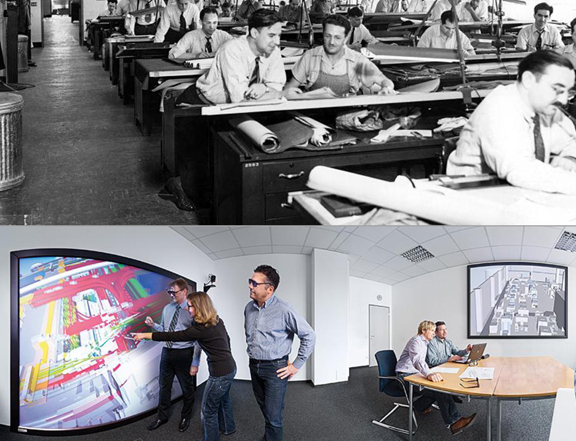

Bill Boswell, Siemens PLM Software's senior director of partner strategy, thinks manufacturing has an image problem -- one that poses a hindrance in attracting new blood.
"Dark, dirty, dangerous -- that's what most people's perception of manufacturing is," observed Boswell. "To convince students to go into manufacturing, we have to change that perception. That's not what manufacturing is today."
Boswell points to Volkswagen's Transparent Factory in Dresden, Germany, designed by architect Gunter Henn. Complete with polished hardwood floor and curved glass surfaces, the building looks more like a modern art museum or a high-tech firm's headquarter than an automotive plant. "Not every plant is going to look like this one," Boswell acknowledged, "but that's what the future of manufacturing is -- certainly not dark, dirty, and dangerous."
Similarly, the skills needed for manufacturing have also changed, he pointed out. Anybody can be trained to turn a wrench, push a button, or lift an engine block, but that's not what you need to know to design and build today. "They need to know industrial automation, need to know their iPads can be used for design," Boswell said. He meant the state-of-the-art digital prototyping technologies (CAD/CAM/CAE for the insiders), along with emerging products that mix physical and digital realities.
Siemens recently issued a free student version of its Tecnomatix Jack and Jill software, which lets you simulate and identify ergonomic issues using digital humans. The company has also begun exploring mobile tablet applications. Its Teamcenter PLM software is now available as a mobile app.
According to "The Future of Manufacturing: Opportunities to Drive Growth," a report by the World's Economic Forum, there's roughly 10 million unfilled manufacturing jobs globally -- an indicator of a serious skill shortage. The report states, "Stories of shortages abound, including 600 openings for skilled tradespeople at AAR, a Chicago-based aviation parts maker. Indian firms have imported tens of thousands of Chinese workers to build and operate power plants, steel mills and telecommunications towers. Due in part to labour shortages, Brazilian wages and inflation are rising as the country struggles to sustain its rapid growth. The China Daily reports that the city of Dongguan, where most of the world’s toys are made, is a million workers short, while other Chinese cities have been offering health benefits and housing subsidies to attract workers."
If U.S. doesn't make concerted efforts to invest in education to train and produce skilled graduates to fill these roughly 10 million positions, its major global competitors will. "The Competition that Really Matters," a report by Center for American Progress, observed, "In 2007 [China] surpassed the U.S. in the number of science and engineering doctoral degrees awarded. As of 2008 Chinese institutions of higher education produced 1.14 million STEM bachelor degree graduates a year, up from about 360,000 in 2000."
Siemens is on a multi-city initiative to foster skilled graduates that would be ready for employment in major U.S. manufacturing firms, many of whom happen to be Siemens customers. It involves both schools and universities and potential employers in Richmond, VA; Worcester, MA; Detroit, MI; and Norwood, OH. "The secret sauce is industry leaders providing internships," said Boswell, "so when the students come out of school, they'll be ready." Proctor & Gambol and GE Aviation are among the manufacturers are participating in the program, Boswell noted.
A few weeks ago, when Boswell went to Washington D.C. to be a judge for the EcoCar2 design contest, he too got a reminder of the different skills now needed in engineering. "On those teams, there are kids working on control systems, antilock brakes, and so on. For them, the control software is as much a part of the design as the brake pedal is," he observed. The prevalence of microprocessors and the associated control software may also be changing what constitutes engineering education. (The topic is part of August issue's coverage of electronic design trends in my article.)
During my meeting with Bill Boswell at the company's user gathering (PLM World 2014, June 16-19, Orlando, FL), I forgot to take a photo. But Boswell in good humor agreed to let me chronicle the meeting via a digital composite photo. So here's the photo that's created of our meeting, posted to Twitter with Boswell's blessing.
@dorasmith #plmconx Siemens's @BBoswell1 and DE's @KennethwongSF discuss education outreach. Blog post coming soon! pic.twitter.com/sE47gJsdLs— KennethwongSF (@KennethwongSF) June 20, 2014


Kenneth Wong is Digital Engineering's resident blogger and senior editor. Email him at [email protected] or share your thoughts or suggestions at digitaleng.news/facebook.
Follow DE






About Us · Contact Us · Editorial Team · Advertising · Privacy Policy · Subscriber Services · © 2026 Digital Engineering 24/7 · Peerless Media