Helping design and engineering professionals discover, evaluate and specify technologies and processes that shorten the design cycle and enable success.


Alert!
Digital Engineering ceased publication on July 1, 2026. This website remains available as an archive of engineering content.
For inquiries or information, please email [email protected].

Digital Engineering April 2026
In the latest issue of Digital Engineering, we take a look at the latest innovations in design for additive manufacturing, including the use of natural language inputs, social media cosplayers, and AI integration. The issue also includes a feature…

January Special Focus Issue: Design for Additive
In this Special Focus Issue of Digital Engineering, learn about the latest advancements in design for additive manufacturing, including new software tools, additive in automotive, custom medical devices, and more.
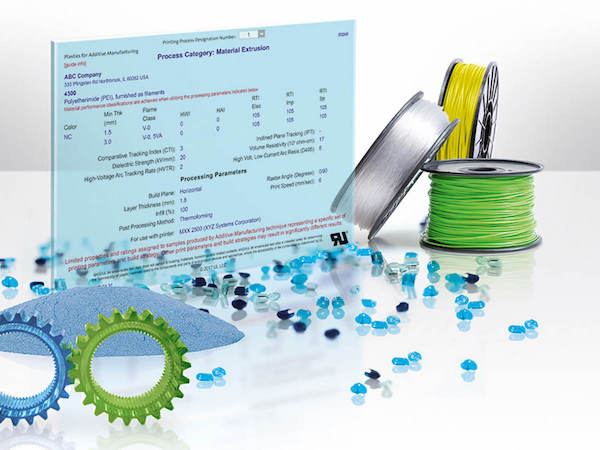
Safety science company UL has published research findings detailing the effects of 3D printing on safety-critical polymer performance properties. The findings have been used to develop a framework for evaluating and qualifying materials, which UL says will help stakeholders across the additive manufacturing (AM) supply chain "to mitigate risk and deliver quality and performance."
UL investigated the flammability, ignition and electrical properties of samples that were 3D printed against samples manufactured using conventional, injection-molded methods. Researchers identified significant safety and performance variations and concluded that performance ratings from traditional manufacturing techniques cannot be applied when the same material is used in a 3D printing process to print a 3D part.
In response, UL has developed a certification program for plastics for additive manufacturing called Blue Card. According to UL, the Blue Card presents the data necessary to ensure the integrity and usefulness of materials intended for 3D printing and 3D printed components and products. A Blue Card is automatically issued when a material intended for 3D printing receives a UL Recognized Component Mark.
UL Certified AM materials are published in UL's publicly available and searchable Product iQ database. As Blue Cards are specific to a 3D printer, a 3D printer manufacturer can also certify material for explicit use on his equipment.
According to the research, safety properties of these materials can be affected in a number of ways. Air gaps/voids can have differnet dielectric properties than a polymer and could act as an insulator to electric current, for example. These gaps can also reduce the thermal mas of the exposed surface and increase ignitability. 3D printined parts may also have greater surface area density or vertically oriented channels that can further increase flammability or lower a specimen's flame rating.
UL tested frABS flame retardent poly filament and PEI polyetherimide filament. By comparing 3D printed and injection molded specimens, the researchers found that the printed items had lower dielectric strength/resistance, worse flame ratings, and longer burn times.
The UL 94 Flammability Test found that 3D-printed frABS specimens scored lower than injection molded specimens; however, printed PEI had comparable or slightly better scores than injection-molded PEI.
The full study can be downloaded here. A white paper based on the findings is also available here.


DE's editors contribute news and new product announcements to Digital Engineering. Press releases may be sent to them via [email protected].
Follow DE






About Us · Contact Us · Editorial Team · Advertising · Privacy Policy · Subscriber Services · © 2026 Digital Engineering 24/7 · Peerless Media