Helping design and engineering professionals discover, evaluate and specify technologies and processes that shorten the design cycle and enable success.


Alert!
Digital Engineering ceased publication on July 1, 2026. This website remains available as an archive of engineering content.
For inquiries or information, please email [email protected].

Digital Engineering April 2026
In the latest issue of Digital Engineering, we take a look at the latest innovations in design for additive manufacturing, including the use of natural language inputs, social media cosplayers, and AI integration. The issue also includes a feature…

January Special Focus Issue: Design for Additive
In this Special Focus Issue of Digital Engineering, learn about the latest advancements in design for additive manufacturing, including new software tools, additive in automotive, custom medical devices, and more.
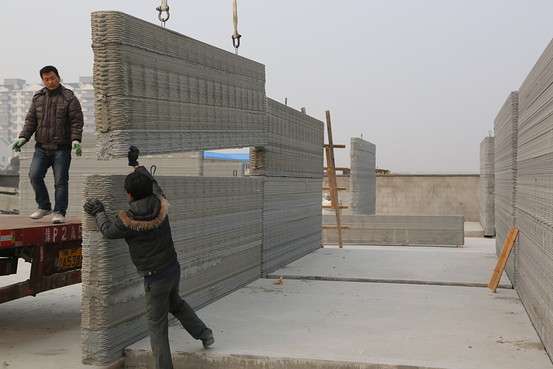
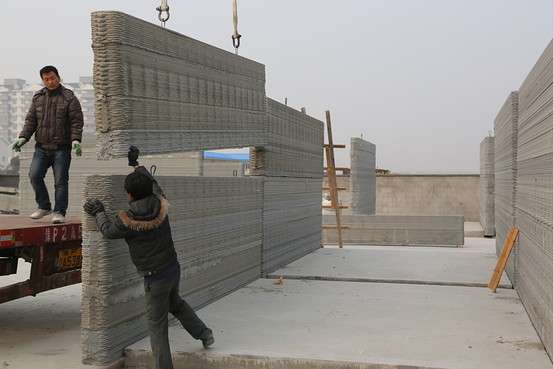 Workers install 3D-printed panels on a house in China. This type of large form printing and construction was the topic of a recent conference at Vanderbilt. Image: Wall Street Journal
3D printing is going big — and not just because of the positive sales forecast. Both private sector companies and universities are exploring how to print very large structures to help boost efficiency and reduce the cost of construction.
Case in point: Experts on creating large structures using 3D printing converged at Vanderbilt University in mid-July to discuss the prospect of the technology in construction.
Florence Sanchez, associate professor of civil and environmental engineering at Vanderbilt, organized the meeting along with Jan Olek of Purdue University and Joseph Biernacki of Tennessee Technical University.
Traditionally, cement, sand and water are mixed together and poured into wood or metal forms to create concrete structures. That process is slow and expensive. The researchers at the event believe 3D printing could provide better way.
“We’ve actually made tremendous progress in recent years coming up with new types of concrete with improved properties,” said Henri Van Damme of the Massachusetts Institute of Technology-French National Center for Scientific Research joint research unit, “but we are still stuck working with forms, which account for most of the labor and the cost.”
There have been some positive developments. Rael San Fratello, a California architecture firm, made a 12-x-12-ft. pavilion using 3D printed blocks, and Win Sun Decoration Design Engineering in Shanghai used the technology to build a six-story apartment complex out of recycled concrete, as well as printing several small houses in 24 hours. In Minnesota, contractor Andrew Rudenko built a cement castle with 3D-printed components.
Oak Ridge National Laboratory has also been involved in a project to develop a way to use 3D printing to construct low-rise residential and commercial buildings.
By printing components rather than using forms, architects could include more complex shapes in their designs. It could also allow for the use of cheaper materials for certain types of construction projects.
Other attendees and presenters included representatives from NASA's Marshall Space Flight Center and the National Institute of Standards and Technology.
Source: Vanderbilt


Brian Albright is the editorial director of Digital Engineering.
Contact him at [email protected].






About Us · Contact Us · Editorial Team · Advertising · Privacy Policy · Subscriber Services · © 2026 Digital Engineering 24/7 · Peerless Media