Helping design and engineering professionals discover, evaluate and specify technologies and processes that shorten the design cycle and enable success.



Digital Engineering April 2026
In the latest issue of Digital Engineering, we take a look at the latest innovations in design for additive manufacturing, including the use of natural language inputs, social media cosplayers, and AI integration. The issue also includes a feature…

January Special Focus Issue: Design for Additive
In this Special Focus Issue of Digital Engineering, learn about the latest advancements in design for additive manufacturing, including new software tools, additive in automotive, custom medical devices, and more.
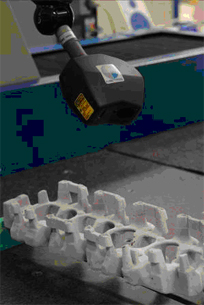 In one second, the CMM mounted Metris LC50 laser scanner captures 20000 point locations. |
Hannover,Germany, is home to Volkswagen’s foundry, which annually produces 1.5 million cylinder heads and 1.3 million intake manifolds, as well as other parts, for Bentley, Volkswagen, and Audi engine manufacturing. Volkswagen’s aluminum engine parts are built using the “hot box” sand-core production method. With this process, the persistent use of the same casting molds for thousands of sand-core units leads to slight wear and tear. Quality-assurance engineers at Volkswagen must regularly verify the geometry of sand-core parts to make sure the sand-core production equipment operates correctly.
Volkswagen verifies and optimizes engine sand-core parts used in the production of molded aluminum engine parts using Metris laser scanning. A CMM-mounted Metris LC50 laser scanner accurately scans the entire surface of the inspected parts by capturing tens of thousands of point measurements a second. Any geometric deviations are picked up by the laser scanner. Additionally, the laser scanner can inspect complex freeform parts, which saves time and costs in optimizing sand core geometry.
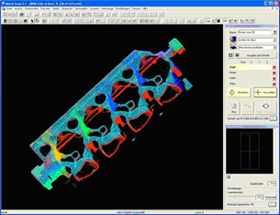 A view on a scanned image of an engine water jacket sand core in Metris Focus Scan software. | 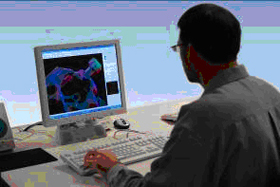 The result is a point cloud, a digital 3D representation of the scanned surface. |
Metrology engineers at Volkswagen then employ Metris Focus software to follow the linear and polygon routes the scanner travels during the on-line and offline inspection process.
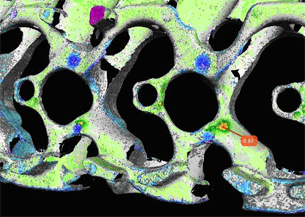 Color-coded areas clearly mark significant geometric deviations for more detailed investigation. |
The laser scanner offers measurement accuracy of approximately 20 micron, a greater measurement that the 200 micron diameter of a single grain of sand, according to company materials.
In a specific example of the production of engine water jackets, Volkswagen quality-assurance engineers found slight bending in sand-core structures for producing engine water jackets. As they looked further into the problem, they saw that during sand-core production, water jacket sand cores were prone to bending slightly. The laser-scanning results picked up the bending, and when the engineers were evaluating possible solutions, laser scanning helped in the process of determining a solution. Ultimately, Volkswagen was able to produce accurate and straight engine water jacket sand core units using serial sand-core production.
Metris
Leuven, Belgium
Susan Smith is a contributing editor for Desktop Engineering magazine. Send e-mail about this article to [email protected].


DE's editors contribute news and new product announcements to Digital Engineering. Press releases may be sent to them via [email protected].
Follow DE
Join over 90,000 engineering professionals who get fresh engineering news as soon as it is published.






About Us · Contact Us · Editorial Team · Advertising · Privacy Policy · Subscriber Services · © 2026 Digital Engineering 24/7 · Peerless Media