Helping design and engineering professionals discover, evaluate and specify technologies and processes that shorten the design cycle and enable success.


Alert!
Digital Engineering ceased publication on July 1, 2026. This website remains available as an archive of engineering content.
For inquiries or information, please email [email protected].

Design & Simulation Software Guide 2025
In this Special Issue, Digital Engineering presents its second annual guide to design and simulation software vendors.

Design & Simulation Software Guide
In this Special Issue, Digital Engineering presents its inaugural guide to design and simulation software vendors, including listings for CAD, CAM, simulation, generative design, PLM, rendering and visualization, design for additive manufacturing,…
The resilient thinker realizes that the need for change will never relent, so the only way to manage the future is to design for it. This way the business can always adapt to the best solutions available, not to the ones that are the most convenient to implement.
The first question an enterprise should ask is: “Are we resilient?” This year, companies will spend $1.3 trillion on digital transformation initiatives. Regrettably, more than 70% will fail. The root cause of these failures is a lack of resiliency in software applications, lack of organization and an inability to adapt.
But, the major reason why digital transformation efforts fail is that critical data is locked in out-of-the-box (OOTB) software applications built on rigid technology stacks and fixed schemas.
A typical smart, connected industrial product is made of a complex transdisciplinary system and subsystems that use many different OOTB software applications. Today’s products will include thousands of components, each consisting of about 150 to 250 attributes (that is, part number, description, revision, cost, weight or quantity) that must move across the product lifecycle and traverse one legacy application after another, including a dynamic supply chain.
Each of these software applications was designed to run OOTB. But to meet the businesses needs, they are almost always customized to improve productivity, time to market and other operational benefits. However, once customized on the wrong architecture, the unintended consequence is “instant legacy”—an inability to cost effectively upgrade that application.
The alternative is to suboptimize your processes to fit an OOTB tool. Although this will lower your sustaining costs for an individual application, it fails to consider that a division of a large company can use 500 or more applications, thus creating inefficiencies across your product’s lifecycle. More importantly, it constrains your company’s ability to continuously improve.
In the end, you are either left with customized OOTB applications or suboptimal processes, unable to adapt to the existential threats or opportunities that every enterprise will face.
Instead, these applications accumulate increasing amounts of technical debt—legacy systems stuck in the past amassing the bulk of your IT budget, leaving you with an inflexible IT landscape, reducing your ability to adapt to meet tomorrow’s challenges and making it almost impossible to digitally transform.
Steve Jobs once said, “innovation distinguishes between a leader and a follower.” You cannot spend your time and money striving to meet your future customers’ unmet needs if legacy applications and antiquated processes consume your IT budgets.
Companies that want to sustainably digitally transform cannot continue gluing together OOTB software. They must make buying decisions based on resiliency. Is the application open? Can it be customized? Can it be seamlessly upgraded?
Enterprises are vertically structured, which further exacerbates the issues associated with a rigid IT landscape. The productivity gains from vertical organization are easily offset by a company that self-imposes barriers to moving data across functional silos. The result is conflicting priorities and poor communication and collaboration.
To digitally transform, a company needs to view their organization by ecosystem. As an example, there is one operational ecosystem that cuts across many functions. Everyone involved needs to operate as one team with the ability to easily collaborate and act on the correct data at the right time. Transformations do not occur in vertical silos, but across them.
Organizations that succeed at digital transformation don’t use OOTB, proprietary applications primarily designed for one vertical function, and instead focus on platforms that can drive business results from concept through end of life across functions such as engineering, manufacturing and service. To digitally transform, your strategy and organization must be resilient.
The capacity to adapt is the most important skill a company needs to learn because change is accelerating and no one can predict the future. But, you can be ready for it. Adopt resilient thinking when it comes to your IT landscape, work as a team driving transformation horizontally across your ecosystem and value resiliency in every person, and everything you do.
Mark Reisig is the director of product marketing at Aras. Prior to joining Aras, he was a senior director at General Electric, where he spent 12 years in leadership positions designing and delivering global PLM, Digital Plant Design and Digital Transformation initiatives across several divisions.


Aras provides a resilient platform for digital industrial applications. Only Aras offers open, low code technology that enables the rapid delivery of flexible, upgradeable solutions for the engineering, manufacturing and maintenance of complex…
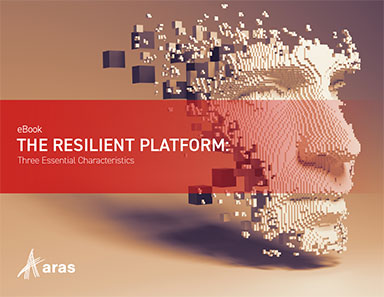
The Resilient Platform: Three Essential Characteristics
Does your current product development platform have thetraits that support you as a resilient thinker, ready to conquer tomorrow’s most complex challenges?

Join over 90,000 engineering professionals who get fresh engineering news as soon as it is published.






About Us · Contact Us · Editorial Team · Advertising · Privacy Policy · Subscriber Services · © 2026 Digital Engineering 24/7 · Peerless Media