Helping design and engineering professionals discover, evaluate and specify technologies and processes that shorten the design cycle and enable success.


Alert!
Digital Engineering ceased publication on July 1, 2026. This website remains available as an archive of engineering content.
For inquiries or information, please email [email protected].

Digital Engineering April 2026
In the latest issue of Digital Engineering, we take a look at the latest innovations in design for additive manufacturing, including the use of natural language inputs, social media cosplayers, and AI integration. The issue also includes a feature…

January Special Focus Issue: Design for Additive
In this Special Focus Issue of Digital Engineering, learn about the latest advancements in design for additive manufacturing, including new software tools, additive in automotive, custom medical devices, and more.
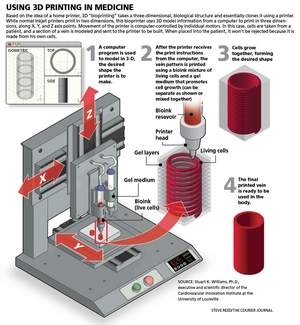
Now researchers in the University's Cardiovascular Innovation Institute are combining 3D printing and biology to create and print parts of an actual human heart using fat and collagen. A robotic six-axis printer uses the mixture of fat cells and collagen to print sections of heart. So far, the team has been able to recreate working pieces of heart muscle. Eventually, they could recreate the blood vessels and valves, and construct a complete organ using the University's one-of-a-kind bioprinter.
3D printing has already shown promise in other medical applications. Nottingham Trent University researchers have developed an implantable, 3D-printed ventricular assist device (VAD) that could help patients waiting for heart transplants. On the bioprinting front, Utrecht Life Sciences has founded a Biofabrication Facility in The Netherlands. And researchers at Mount Sinai produced a bioprinted trachea using a membrane seeded with stem cells. The trachea was implanted in a baby pig.
Dr. Stuart Williams, chief of the Bioficial Heart program in Louisville, is also investigating the potential of printing pancreas, kidney and bone tissue. The lab has already created a human heart "patch" that could be used in patients as an alternative to traditional remedies.
While the group hopes to create a completely bioprinted, functioning human heart, Williams told TechRepublic that the ultimate goal would be to make a better heart.
"We are rethinking what the best design is for the heart and putting that into a computer," Williams said. "What happens if we build a heart basically resistant to problems that can take place?"
You can see Williams explain 3D printed organs in the video below.
Source: TechRepublic


Brian Albright is the editorial director of Digital Engineering.
Contact him at [email protected].






About Us · Contact Us · Editorial Team · Advertising · Privacy Policy · Subscriber Services · © 2026 Digital Engineering 24/7 · Peerless Media