Helping design and engineering professionals discover, evaluate and specify technologies and processes that shorten the design cycle and enable success.


Alert!
Digital Engineering ceased publication on July 1, 2026. This website remains available as an archive of engineering content.
For inquiries or information, please email [email protected].

May 2026 Special Focus: Artificial Intelligence in Design and Simulation
In this Special Focus Issue, learn about the latest developments in the integration of artificial intelligence into engineering workflows.

April 2026 Special Focus Issue: Generative Design
In this Special Focus Issue, Digital Engineering takes a look at how generative design solutions can be used across different types of design problems and with a variety of manufacturing approaches to accelerate design space exploration, and…
Well-established in international circles, Zuken is striking out at the U.S. electronic design automation (EDA) software market with an expansion that includes a campaign to shift the conversation away from single-board PCB design to a systems-level approach that addresses current design challenges.
Key EDA competitors, including Mentor Graphics and Cadence Design Systems, have long dominated the U.S. EDA market with their PCB and custom board design tools. However, those suites have historically focused on single-board design, and Zuken sees an opportunity to break out in the U.S. market because its EDA portfolio is architected on the premise of multi-board systems planning, according to Bob Potock, Zuken's vice president of marketing. Multi-board system planning is a necessity today, Potock maintains, in light of the growing complexity surrounding product development.
"Product development is no longer a single domain process—you really have to consider mechanical, electrical, software design, packaging, and manufacturing as part of the whole thing," he explains. "You have to raise the design abstraction from what has been historically in our world, putting chips on a board, to the product level because boards are no longer designed in a vacuum."
Instead of the PCB board being the centerpiece of the design process, Zuken is focused on what it calls product-level design abstraction, where the software addresses systems planning at a holistic product level, bringing the various engineering silos together early on in the development process with the idea of avoiding problems before the design is fully evolved.
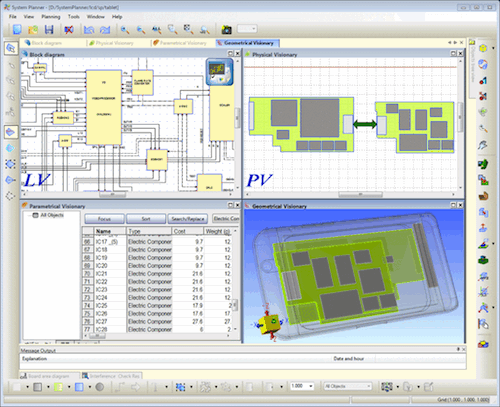
Zuken's flagship product is CR-8000, a multi-board, systems-level design solution that addresses planning from the concept-to-manufacturing stages across multiple domains. The software has been built from the ground up to take advantage of modern-day hardware, including support for 64-bit architectures, multithreading capabilities, and multicore processors as well as the ability to leverage the latest in graphics accelerators. This re-architecting of EDA software is one of the ways Zuken is helping customers better meet their product development challenges, Potock says.
Also central to Zuken and CR-8000's value proposition are sophisticated capabilities around intellectual property (IP) management. Zuken essentially lets you strip out critical bill of material or design constraint information as required, giving customers a higher comfort level when working with external outsourcing partners. There is also the System Planner environment, which supports complete upfront electronic design planning—a capability Potock says has been lacking in competitive EDA platforms. System Planner, which functions as the starting point for concept development, brings together previously disconnected planning steps into a single view, allowing cross-functional design teams to maximize the form, fit, and function of a multi-board system while maximizing design reuse so there is no need to reenter data between systems, he says.
To support its CR-8000 EDA platform and its U.S. push, Zuken plans to invest between $30 and $50 million in an expansion effort over the next three years. One of the anchors of the Americas expansion will be a new Zuken innovation center located in Silicon Valley, slated to open in September, that will provide engineering resources to the local design community while establishing a local R&D presence. Zuken plans to staff the site with more than 30 engineers.
More than anything, what Zuken is attempting to do with its U.S. expansion is to change the discussion around PCB design. "We're trying to change the conversation so we're not butting heads at a PCB level, but are talking about tools for product development—not board development," Potuck says. "We're trying to take it to the next level—that's the new conversation."
Check out this video to get a brief introduction to Zuken's product-level or system-level design philosophy as well as a brief demonstration of the System Planner module in CR-8000.


Beth Stackpole is a contributing editor to Digital Engineering. Send e-mail about this article to [email protected].
Follow DE






About Us · Contact Us · Editorial Team · Advertising · Privacy Policy · Subscriber Services · © 2026 Digital Engineering 24/7 · Peerless Media