Helping design and engineering professionals discover, evaluate and specify technologies and processes that shorten the design cycle and enable success.


Sponsored
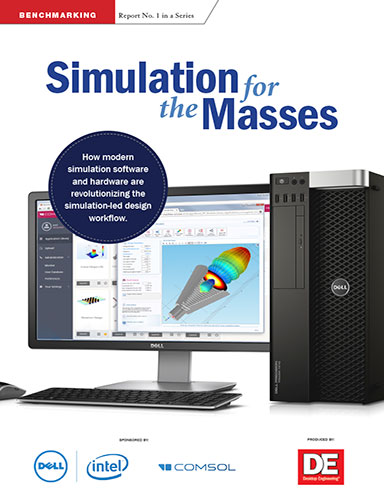
Simulation-led design offers many benefits to design engineering teams. Chief among them: Time and cost savings via less physical product testing, the ability to quickly determine the best initial designs to develop and the freedom to digitally experiment with innovative “what-if” scenarios, particularly with designs for new markets.
Moving simulation further forward in the design process can give engineering teams a decided competitive advantage, but technological, personnel and cultural challenges have kept many companies from reaping the rewards. Three recent developments explored in this paper promise to change that.
As the availability of affordable computing power increases and simulation software is optimized to take advantage of it, more design engineering teams should be able to realize the incredible benefits of a simulation-led design workflow.
We put this notion to the test by benchmarking three-year old COMSOL Multiphysics® software on a three-year-old Dell Precision® workstation against their comparable present-day counterparts. We discovered that modern hardware and software can complete some multiphysics simulations 6X faster.
We also explore licensing options for distributed computing. COMSOL Multiphysics is optimized to support the latest hardware innovations. The software’s hybrid modeling feature and Floating Network License allows you to model large simulations on standard workstations that support parallel processing, or on as many cores and nodes as you want on a cluster.

Dell sells personal computers (PCs), servers, data storage devices, network switches, software, computer peripherals, HDTVs, cameras, printers, MP3 players, and other electronics.
Artificial Intelligence for Design and Engineering Workflows
In this white paper, learn how artificial intelligence and machine learning can improve design and simulation.




About Us · Contact Us · Editorial Team · Advertising · Privacy Policy · Subscriber Services · © 2026 Digital Engineering 24/7 · Peerless Media