Helping design and engineering professionals discover, evaluate and specify technologies and processes that shorten the design cycle and enable success.


Alert!
Digital Engineering ceased publication on July 1, 2026. This website remains available as an archive of engineering content.
For inquiries or information, please email [email protected].
Sponsored
One look at today’s products and it’s pretty clear why engineering workflows and development processes have become so complex. Whether the task is designing a modern vehicle sporting semi-autonomous operation and sophisticated electronics or creating a medical device packed with sensors and circuitry, the lines have blurred between engineering disciplines and require a collection of high-performance tools to get the job done.
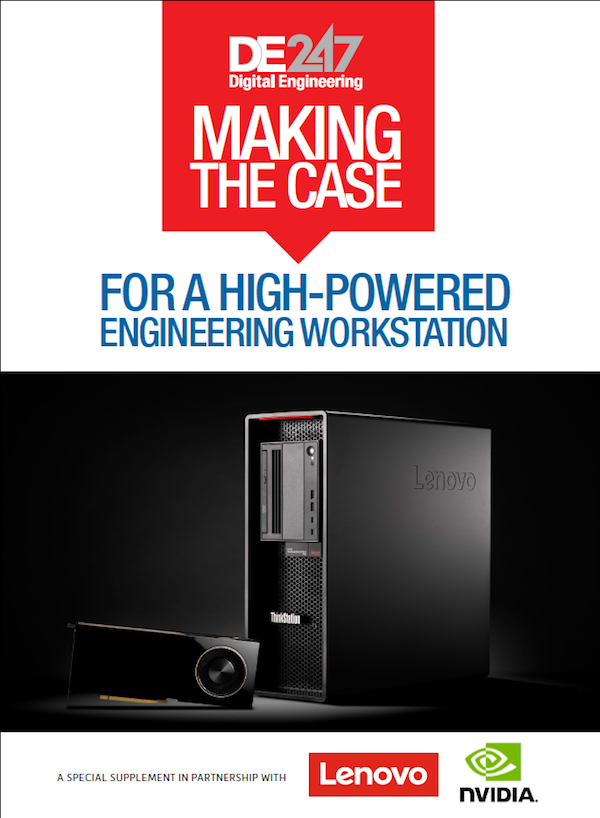
That includes the use of high-performance engineering workstations like the Lenovo ThinkStation P620 armed with more powerful GPUs such as the NVIDIA RTX A6000 to deliver the productivity boost engineers need to keep pace with demanding workflows and advanced multi-tasking.
Making the Case for a High-Powered Engineering Workstation, a new white paper produced by DE in collaboration with Lenovo and NVIDIA, lays out the advantages of investing in a new, more powerful engineering workstation in order to accelerate simulation performance and enable engineers to multi-task across a variety of compute-intensive applications.

Since its founding in 1993, NVIDIA (NASDAQ: NVDA) has been a pioneer in accelerated computing. The company’s invention of the GPU in 1999 sparked the growth of the PC gaming market, redefined computer graphics, ignited the era of modern AI and…

Cut Retrieval-Augmented Generation (RAG) Hallucinations by 50%
Most teams hit the same wall with enterprise AI: LLMs that hallucinate, pipelines that don’t scale, and infrastructure that’s harder to design than the models themselves.




About Us · Contact Us · Editorial Team · Advertising · Privacy Policy · Subscriber Services · © 2026 Digital Engineering 24/7 · Peerless Media