Helping design and engineering professionals discover, evaluate and specify technologies and processes that shorten the design cycle and enable success.



May 2026 Special Focus: Artificial Intelligence in Design and Simulation
In this Special Focus Issue, learn about the latest developments in the integration of artificial intelligence into engineering workflows.

Design & Simulation Software Guide 2025
In this Special Issue, Digital Engineering presents its second annual guide to design and simulation software vendors.
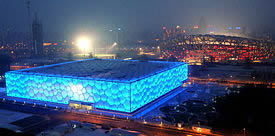 By now, those watching the 2008 Olympics in Beijing have seen glimpses of Beijing’s National Aquatics Centre, known today as the Water Cube. Five years ago, ARRK’s (Melbourne, Australia) Rapid Product Development team employed advanced rapid prototyping technologies to create a 3D physical model of the National Aquatics Centre design for the Olympic swimming and diving competitions.
In preparation for the Olympic Games, in early 2003, the Municipality of Beijing announced a limited design competition for the 2008 Olympic Aquatics Centre.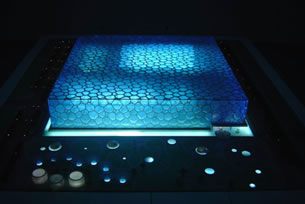 The winning design was submitted by Arup, a global firm of designers, engineers, planners and business consultants, whose “Water Cube” design was based on a natural pattern of organic cells and the formation of soap bubbles. The resulting National Aquatics Centre is a large membrane super structure of aqua bubble walls that house the pools for the Olympic swimming and diving competitions, with accompanying seating for 17,000 spectators.
Prior to the competition, Arup knew they needed to make a physical model for the Water Cube in order to convey the idea to the Jury of International experts, because it was such 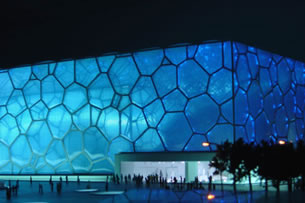 a unique structure, according to Tristram Carfrae, Arup Fellow. “With 22,000 elements and 12,000 joints, there was no way that we could make one manually, so we turned to the rapid prototyping skills of ARRK.” The walls of the Centre are made of an ultra-thin plastic outer surface no more than .02 millimeters thick.
Nothing quite like this had ever been made using a stereolithography machine before, yet the ARRK team were exceptionally determined to make it work. The resulting model was a true success. Carfrae said that in July 2003, the Arup team was determined the winner of the competition and was awarded the design commission.
ARRK
Melbourne, Australia
Arup
Australia
Sources: Press materials received from the company and additional information gleaned from the company's website.


DE's editors contribute news and new product announcements to Digital Engineering. Press releases may be sent to them via [email protected].
Follow DE
Join over 90,000 engineering professionals who get fresh engineering news as soon as it is published.






About Us · Contact Us · Editorial Team · Advertising · Privacy Policy · Subscriber Services · © 2026 Digital Engineering 24/7 · Peerless Media