Helping design and engineering professionals discover, evaluate and specify technologies and processes that shorten the design cycle and enable success.


Alert!
Digital Engineering ceased publication on July 1, 2026. This website remains available as an archive of engineering content.
For inquiries or information, please email [email protected].

Digital Engineering April 2026
In the latest issue of Digital Engineering, we take a look at the latest innovations in design for additive manufacturing, including the use of natural language inputs, social media cosplayers, and AI integration. The issue also includes a feature…

January Special Focus Issue: Design for Additive
In this Special Focus Issue of Digital Engineering, learn about the latest advancements in design for additive manufacturing, including new software tools, additive in automotive, custom medical devices, and more.
The US has an aging infrastructure and a somewhat unreliable power grid. A problem in the wrong place at the wrong time brought down most of the power in the northeast US in 2003. One method of keeping the power flowing is routine inspection of power lines, a process that can be either labor intensive or require the use of expensive robots. Until now.
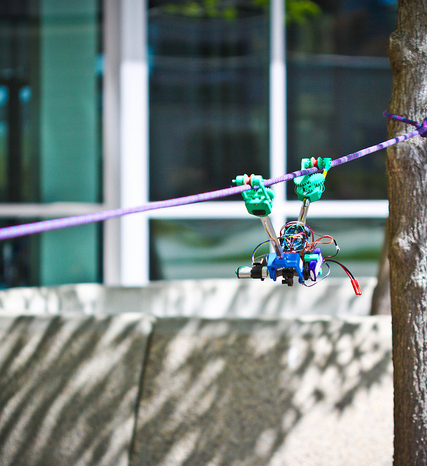
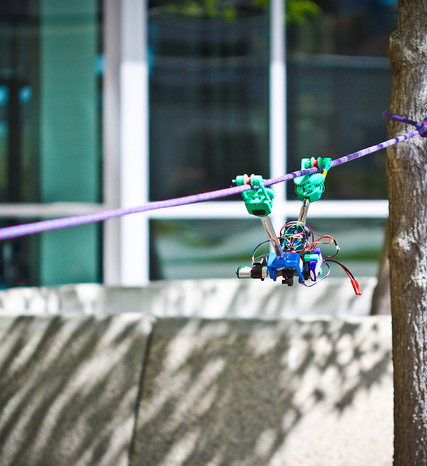
Mechanical engineering students at the University of California, San Diego Jacobs School of Engineering have designed and built a low-cost robot called the SkySweeper that can zip along power (or communication) lines, searching for areas in need of repair. The robot was built using 3D printed parts and off-the-shelf electronic materials, and, according to the design team, could be scaled up for production for under $1,000.
“Current line inspection robots are large, complex, and expensive. Utility companies may also use manned or unmanned helicopters equipped with infrared imaging to inspect lines,” said Nick Morozovsky, a graduate student in mechanical engineering at UC San Diego, who designed the robot. “This is much simpler.”
The SkySweeper is a v-shaped design that propels itself along lines with a movement that is similar to how a biped might swing along a rope. It has a single motor, making it less prone to breakdowns, and AM-built parts that could be easily replaced. Currently, the robot runs on a store bought battery, but the design team at UCSD claims the SkySweeper could be fitted with an induction system allowing it to run primarily on the ambient energy that surrounds power lines.
Along with a more advanced system of power, the robot would need to be fitted with sensors and cameras to fulfill its duty as line inspector, but neither of those systems would require extensive remodeling of the SkySweeper. All in all, the robot seems to be one of those rare, simple designs that people wish they had thought of first.
Below you’ll find a video about the SkySweeper.
Source: UCSD


John Newman is a Digital Engineering contributor who focuses on 3D printing. Contact him via [email protected] and read his posts on Rapid Ready Technology.
Follow DE






About Us · Contact Us · Editorial Team · Advertising · Privacy Policy · Subscriber Services · © 2026 Digital Engineering 24/7 · Peerless Media