Helping design and engineering professionals discover, evaluate and specify technologies and processes that shorten the design cycle and enable success.


Alert!
Digital Engineering ceased publication on July 1, 2026. This website remains available as an archive of engineering content.
For inquiries or information, please email [email protected].

Digital Engineering April 2026
In the latest issue of Digital Engineering, we take a look at the latest innovations in design for additive manufacturing, including the use of natural language inputs, social media cosplayers, and AI integration. The issue also includes a feature…

January Special Focus Issue: Design for Additive
In this Special Focus Issue of Digital Engineering, learn about the latest advancements in design for additive manufacturing, including new software tools, additive in automotive, custom medical devices, and more.
A few people also had fun with the sounds made by 3D printers during the build process, creating bizarre reproductions of the Imperial March and other nerd favorites. New research performed by the University of California, Irvine (UCI) has revealed those same printers were reporting more than Darth Vader’s arrival. The very sound of a AM system can be evaluated to determine what is being printed.
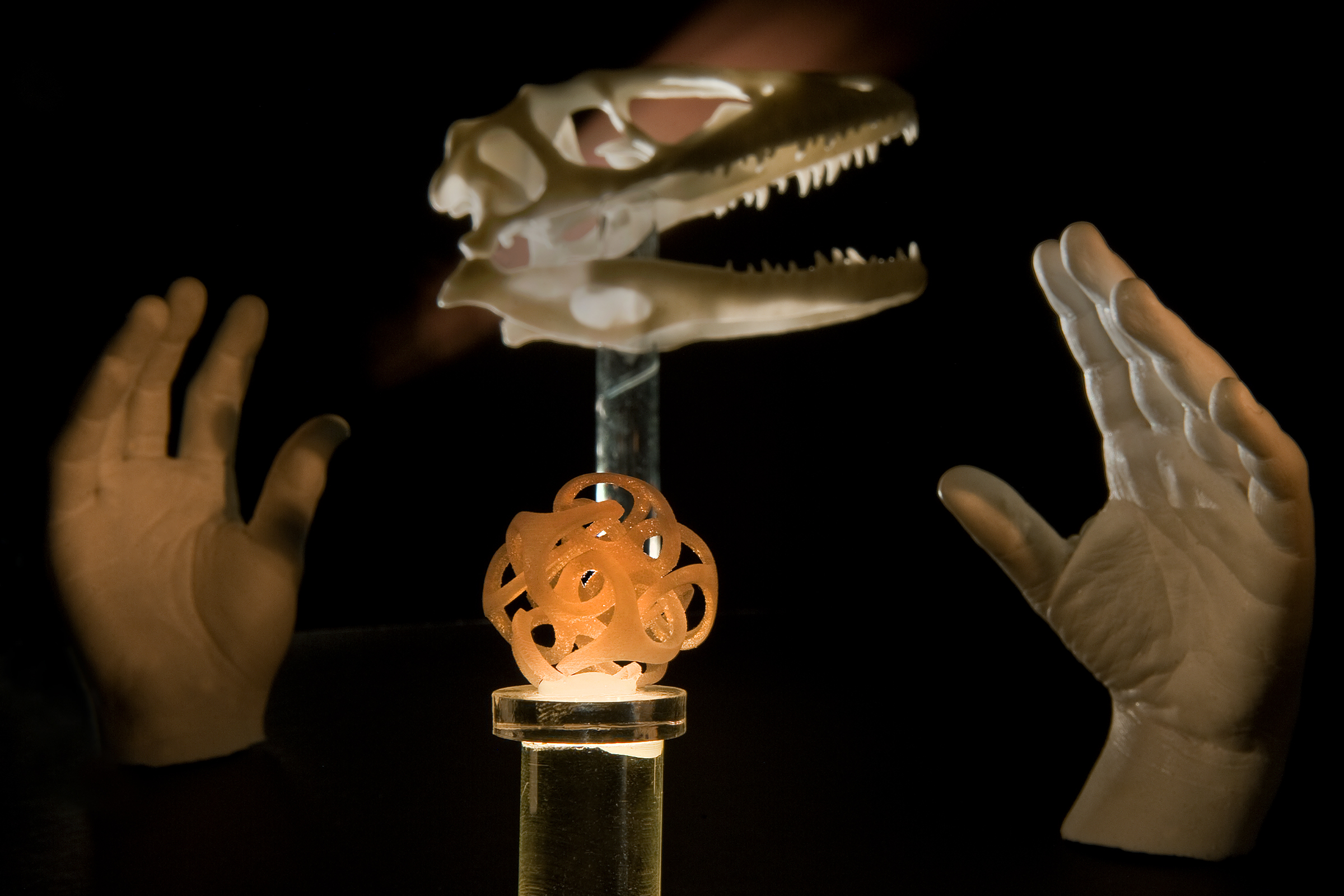
 These 3D creations printed at UCI could be reverse engineered by recording the sounds made during production. Courtesy of UCI
Researchers were able to show that it is possible to determine what a 3D printer is building by recording the sounds made by the print head. Those same sounds can also be reverse engineered to reproduce the object being printed. In testing, the research team was able to recreate a 3D printed object with 90% accuracy just by processing the sounds made during a build.
This, of course, could lead to security issues with 3D printing. In the age of the smartphone, nearly everyone carries an extremely capable recording device at all times.
“In many manufacturing plants, people who work on a shift basis don’t get monitored for their smartphones, for example,” said Mohammad Al Faruque, director of UCI’s advanced integrated cyber-physical systems lab. “If process and product information is stolen during the prototyping phases, companies stand to incur large financial losses. There’s no way to protect these systems from such an attack today, but possibly there will be in the future.”
Al Faruque has suggested engineers begin to research methods of jamming or muffling the sounds of 3D printing in order to maintain operational security. Considering that prototyping still makes up much of the work done by 3D printers, it doesn’t require much imagination to see how industrial espionage might try to take advantage of this particular hole in security.
Below you’ll find a video demonstration of the sounds made by a 3D printer.
Source: UCI


John Newman is a Digital Engineering contributor who focuses on 3D printing. Contact him via [email protected] and read his posts on Rapid Ready Technology.
Follow DE
Join over 90,000 engineering professionals who get fresh engineering news as soon as it is published.






About Us · Contact Us · Editorial Team · Advertising · Privacy Policy · Subscriber Services · © 2026 Digital Engineering 24/7 · Peerless Media