Helping design and engineering professionals discover, evaluate and specify technologies and processes that shorten the design cycle and enable success.


Alert!
Digital Engineering ceased publication on July 1, 2026. This website remains available as an archive of engineering content.
For inquiries or information, please email [email protected].

May 2026 Special Focus: Artificial Intelligence in Design and Simulation
In this Special Focus Issue, learn about the latest developments in the integration of artificial intelligence into engineering workflows.

Design & Simulation Software Guide 2025
In this Special Issue, Digital Engineering presents its second annual guide to design and simulation software vendors.
Altair has released its latest simulation solutions, including comprehensive computational fluid dynamics (CFD) and expanded capabilities in electronic system design (ESD). Updates include all major CFD solutions under a single license, expanded end-to-end electronic system design capability, and access to the cloud.
"Throughout our 35-year history, Altair has developed and acquired countless specialized technologies to solve even the most challenging CFD problems," says James R. Scapa, founder and chief executive officer, Altair. "We are proud to have the industry's most robust CFD offering whose breadth and depth is unparalleled and can efficiently and effectively address a broad range of multidisciplinary challenges."
Altair CFD is a cost-effective alternative to purchasing individual tools from multiple software vendors by delivering all major CFD solutions under a single license including:
Altair CFD provides advanced capabilities including coupling between several different CFD applications as well as with other applications such as structural analysis, etc.
Additionally, the LBM and SPH codes in Altair CFD were written from the ground up using native graphics processing unit (GPU) codes, enabling faster simulations, more design exploration and improved product performance, the company says.
Altair's electronic system design toolset has a new thermal management workflow to enhance the design of electronic devices. In addition to the existing Altair SimLab workflows for structural stress, vibration and drop-test performance, product engineers can now ensure the cooling of printed circuit boards (PCBs) and complete systems to prevent overheating, product reliability issues or late-stage redesigns.
Smart connected devices increasingly need high-speed memory. Altair PollEx has added signal integrity automation for double-data rate (DDR) memory interfaces, enhancing optimization of DDRx timing, transmission lines, topology and terminations. Other improvements include additional power integrity simulation and the capability to export PCB layers for thermal management analysis. For more information about the latest enhancements to Altair's ESD solutions, register for the upcoming "Modern Electronic System Design Webinar Series."
Altair One is a single portal for Altair's products, accessible anywhere via standard workstations, PCs, laptops and mobile devices. Users can launch simulation applications in the cloud from a single interface with easy access to resources that are on-premises, in the cloud or a hybrid. Product teams can increase simulation-driven design collaboration by securely uploading, accessing, storing and managing data using the Altair One drive.
Altair One does not require additional capital expenditures on complex IT and can scale immediately in response to peaks in workload. It also empowers users to provision turnkey, scalable appliance clusters across all major cloud providers including Amazon AWS, Microsoft Azure, Oracle Cloud Infrastructure and Google Cloud Platform.
Flexibility is further enhanced by Altair Units, Altair's subscription-based licensing model, which allows organizations to pay only for what their employees need, when they need it. This includes the new Product Engineer bundle that automates and simplifies complex analysis tasks for multiple physics, according to the company.
For more information about the latest updates to the Altair simulation suite, visit http://www.altair.com/simulation-2021-1 or register to attend the "Discover Altair CFD" webinar.
Sources: Press materials received from the company and additional information gleaned from the company’s website.


Altair transforms design and decision making by applying simulation, machine learning, and optimization throughout product lifecycles. Altair offers software in five categories related to Computer Aided Engineering (CAE) and High Performance…
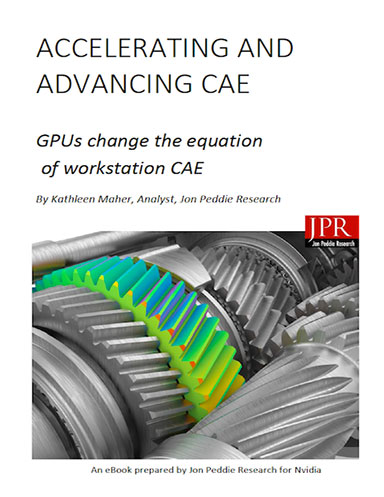
Accelerating and Advancing CAE
GPUs are changing the nature of engineering simulation, according to a new ebook from Jon Peddie Research (JPR). It explains how GPU acceleration is improving CAE workflows.

DE's editors contribute news and new product announcements to Digital Engineering. Press releases may be sent to them via [email protected].
Follow DE
Join over 90,000 engineering professionals who get fresh engineering news as soon as it is published.






About Us · Contact Us · Editorial Team · Advertising · Privacy Policy · Subscriber Services · © 2026 Digital Engineering 24/7 · Peerless Media