Helping design and engineering professionals discover, evaluate and specify technologies and processes that shorten the design cycle and enable success.



Cut Retrieval-Augmented Generation (RAG) Hallucinations by 50%
Most teams hit the same wall with enterprise AI: LLMs that hallucinate, pipelines that don’t scale, and infrastructure that’s harder to design than the models themselves.

What Is Intelligent BOM Management? A Guide to Smarter Product Development
Learn how intelligent Bill of Materials (BOM) management helps teams collaborate, reduce errors, and bring innovative products to market faster with cloud-based PLM tools.
AMD has released the AMD Radeon PRO V620 GPU, built with the latest AMD RDNA 2 architecture that delivers high-performance GPU acceleration for cloud workloads, including immersive AAA game experiences, intensive 3D workloads and modern office productivity applications at scale in the cloud, the company reports.
With its GPU-partitioning capabilities, multi-stream hardware accelerated encoders and 32GB GDDR6 memory, the AMD Radeon PRO V620 offers dedicated GPU resources that scale to multiple graphics users, helping ensure cost-effective graphics acceleration for a range of workloads. Built using the same GPU architecture that powers the latest generation game consoles and PC game experiences, the AMD Radeon PRO V620 GPU is also designed to develop and deliver immersive AAA game experiences.
“AMD is bringing high-performance AAA gaming experience to the cloud with the introduction of the AMD Radeon PRO V620,” says Jeff Connell, corporate vice president, Visual and Cloud Gaming, AMD. “We’re seeing adoption of gaming in the cloud from customers around the world, taking advantage of the latest virtualization features delivering efficient and low latency content streaming to multiple simultaneous users.”
The AMD Radeon PRO V620 GPU introduces architectural advancements in compute units, a visual pipeline, and new AMD Infinity Cache, enabling high-resolution gaming performance with the latest in visual technologies including Vulkan, DirectX 12 Ultimate and AMD FidelityFX. With the latest virtualization features, as well as AMD Infinity Cache and 32GB of GDDR6 memory, the AMD Radeon PRO V620 helps to deliver low latency content streaming to multiple simultaneous users.
Key features of AMD Radeon PRO V620 include:
Sources: Press materials received from the company and additional information gleaned from the company’s website.


AMD, or Advanced Micro Devices, has driven innovation in high-performance computing, graphics and visualization technologies. They develop high-performance computing and visualization products to solve some of the world’s toughest and most…
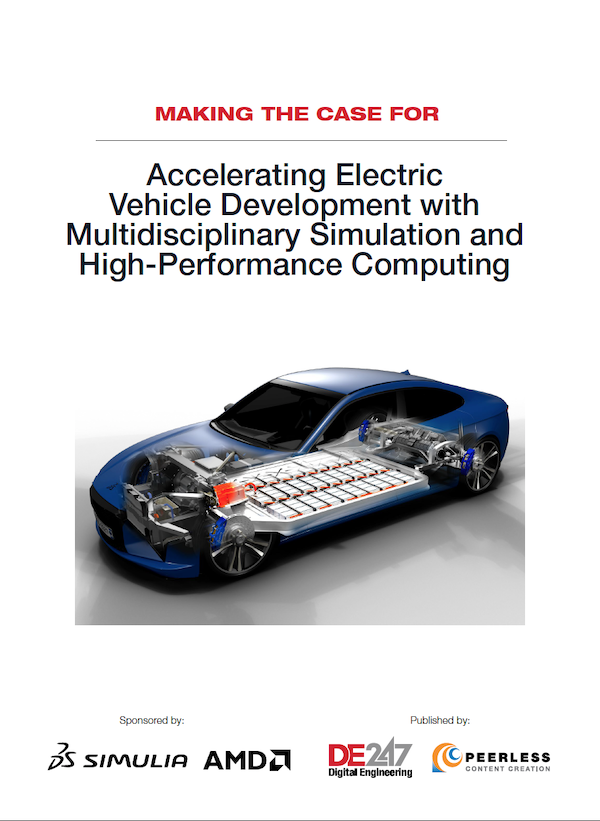
Accelerating Electric Vehicle Development with Multidisciplinary Simulation and High-Performance Computing
In this new Making the Case guide, learn how a unified approach to design and multidisciplinary simulation from Dassault Systèmes, combined with high-performance computing powered by AMD EPYC™ processors, can accelerate EV design.

DE's editors contribute news and new product announcements to Digital Engineering. Press releases may be sent to them via [email protected].
Follow DE
Join over 90,000 engineering professionals who get fresh engineering news as soon as it is published.






About Us · Contact Us · Editorial Team · Advertising · Privacy Policy · Subscriber Services · © 2026 Digital Engineering 24/7 · Peerless Media